Years of failing teens preceded closure of Maryland's Freestate Academy
Published in News & Features
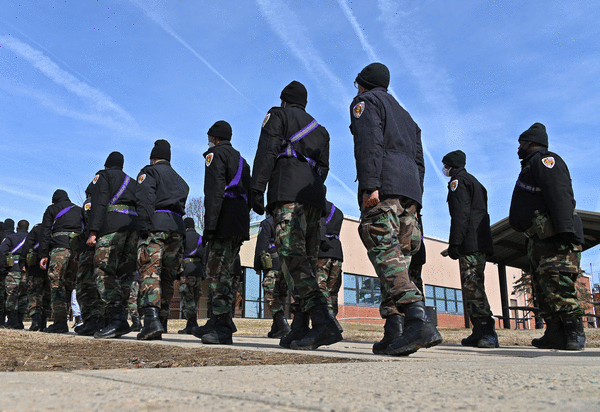
BALTIMORE — On her first night at the Freestate Challenge Academy, a state-run program for at-risk teens, retired National Guard Staff Sergeant Tory Griffin said a staff member ordered teens off a bus and into a mile-long walk through pitch-black woods.
The teens — cadets, as the program called its 16- to 18-year-old participants — had just arrived at Aberdeen Proving Ground. “It’s straight darkness, no light,” Griffin said.
When they reached the barracks, some having run through the dark, Griffin said the teens were upset — and the staffer “started taking his stuff off to fight.”
Griffin said she intervened and reported the episode, but the staffer remained on the job.
Records and interviews show such incidents were part of a pattern of failures at the Freestate Challenge Academy. Federal officials shut down the program this month, citing budget and academic concerns. But The Sun’s investigation reveals years of documented safety concerns, chronic understaffing and declining results.
‘Kids were hungry’
Created in 1993, Freestate, one of the oldest Challenge academies, promised high school dropouts a strict structure, along with free housing and food for 22 weeks. It was once a strong program. But over the last 15 years, it deteriorated. A 2025 federal report The Sun received via records request said facilities were old, unsafe and inadequate. Cadet achievement was below nationwide student averages, program reviews going back a decade showed. The program was understaffed, and employees were often unqualified, according to National Guard Bureau reports cataloged.
The Sun interviewed four people who worked for or with Freestate, and reviewed more than 1,500 pages of documents, including state contracts, and a decade’s worth of program reviews. Two spoke on the record and are named in this article; two verified claims of the others.
Former staffers told The Sun that the program underfed cadets — to the point that teens snuck out at night to steal food from nearby office buildings.
“Those kids were hungry,” said Griffin, who staffed Freestate Challenge Academy on and off between 2009 and 2014. “Me as a cadre, I would bring stuff in on the weekends for the kids: cookies, chips, … pizza and soda.”
But, she said, “I got in trouble for it.”
‘Deeply concerning’
The Sun asked the Maryland National Guard to respond to staff allegations of inadequate meals provided to the cadets, as well as address the federal reports calling facilities unsafe and staffing levels too low and unqualified.
“The Maryland National Guard is aware of allegations of misconduct from 2009-2015 involving former state employees who previously served as cadre at the Freestate ChalleNGe Academy. These allegations are deeply concerning,” Maj. Ben Hughes said in a statement on behalf of the state’s Guard.
“Since being appointed by the Governor in 2023, Maryland National Guard leadership took deliberate steps to assess, address, and resolve longstanding issues within the program. The safety, well-being, and trust of the cadets and their families was always our top priority,” he said.
Hughes said the Guard is committed to transparency and accountability.
The Sun asked multiple times to speak with Maj. Gen. Janeen Birckhead, the adjutant general for Maryland and former camp director Kisha L. Webster. Interview requests were declined.
Stealing to eat
Freestate cadets typically woke before dawn each day to log an hour of PT, military parlance for exercise. They might run or do pushups, situps and jumping jacks. After eating, they’d spend the day studying or volunteering, cleaning the barracks and doing homework. They rarely had much downtime, staff said.
Active teens need to eat. Adolescent girls need at least 2,000 calories a day, per dietary guidelines; an active adolescent girl needs hundreds more. And adolescent boys, either sedentary or active, need still more.
Griffin said she recalled the food Freestate served as meager, undercooked or unpalatable.
“They would get one piece of chicken — a small thigh — a scoop of green beans or corn and a scoop of mashed potatoes,” Griffin said. “And I remember vividly there were several times where the meat was raw.”
At night, former staff said, the trouble would start. The teens, hungry, would regularly sneak out of the barracks at night, break into nearby buildings where they logged volunteer hours with the 70th regiment during the day, and steal any food they could find.
When soldiers came to work the next morning, Griffin said, they’d find their food missing. A search of the tiled drop ceilings in the Freestate barracks would reveal empty wrappers: chips, Oreos, cookies and more, Griffin said.
As punishment, Griffin said, teens were given extra workouts, but that just made them hungrier.
The Sun requested complaints or reports by Aberdeen Proving Ground police citing cadets for theft since 2010. It has yet to receive any.
‘Kids were malnourished’
Retired Chief Warrant Officer 3 Tom Garcia taught English at Freestate from 2014 to 2016. He characterized the food as “unpalatable” and “nasty,” and estimated it cost the Guard anywhere between $3 and $5 a head to feed the teens.
“It was below the Army standard,” he said. “These kids were malnourished, in my opinion,” Garcia said, noting that hunger and insecurity drove a lot of misbehavior.
“I know what it’s like to be homeless, I know what it’s like to be hungry,” Garcia said. “I saw a lot of hostility and insubordination. But when I fed them, they worked with me.”
He said sergeants kept “chewy food” and “poky bait” on them for the teens (candy and beef jerky) to incentivize good behavior.
The Sun requested Freestate’s food service contracts going back to 2009 from the Maryland Military Department. The department’s procurement office, which took over administration of the food contracts from the federal government in Maryland’s fiscal year 2020, could only provide contracts to that date.
They showed it cost Freestate roughly $30 per day to feed the teens; $10 per meal. A sample lunch menu showed teens were allotted two pieces of fried chicken (8 ounces total), 4 ounces of macaroni and cheese, 4 ounces of green beans, two dinner rolls and one piece of fresh fruit.
Sewage leak forces move
The Freestate Challenge Academy had housed the teens enrolled in its program in facilities that were neither safe nor healthy, a memo dated Aug. 14, 2025, by the chief of National Guard Bureau Youth Programs, Jeffrey M. White showed.
The program had received an unsatisfactory rating in October 2024, and the Bureau required it to submit a corrective action plan or face suspension by Aug. 15, 2025.
However, after a July sewage leak, Freestate relocated operations to Camp Fretterd Military Reservation in Reisterstown. There, too, though, facilities and program offerings were inadequate, failing on 14 out of 20 points of inquiry, including minor safety, quality of education, and number, training and credentialing of staff.
Barracks and the dining facility were unmonitored; adults and minors slept in the same rooms. Showers were communal — and lacked curtains. Nurses could not lock the records office, store medication, contact parents or update digital medical records.
The education program had issues, too. The lead educator position was vacant and Webster, the program director, was forced to step in, but could not tackle curriculum problems. Webster blamed the lack of staffing on the relocation, White wrote in his report, however, he noted that Freestate was subject to a statewide hiring freeze that predated the move.
And at Fretterd, food once again became an issue for cadets, records show. The dining facility had no surveillance cameras, air conditioning, appliances or refrigerators, the memo said — and “since July 2025, cooks have been preparing all meals at APG South and then transporting them” to Fretterd, a roughly one-hour drive.
“Program staff alleged that cadets have been provided with inadequate portions and nutrition since the relocation,” the memo read.
Following White’s inspection, the program was suspended. It was shuttered permanently by order of the Department of Defense April 3, 2026, citing graduation rates, maintenance and repair costs.
‘We need programs’
The news of Freestate’s closure was met with dismay by some.
“This is such a sad bit of news,” Jason Williams wrote on Facebook. “As a young man, lost, searching for purpose, searching for the man I was to become, this place saved my life from what it most likely would have been.”
One current cadet who transferred to the New Jersey Youth Challenge Academy in August 2025 wrote to The Sun last week, lauding Freestate.
“Before the program shut down, I was genuinely at the best point of my life I had ever been … because of the academy,” Lucas Genovez said in an email. While he admitted cadets were sometimes overworked and passed out during PT, “all of the staff had the best intentions for all of us,” he said.
“I couldn’t be more grateful for that family.”
But others were thrilled by the closure, like Shayna Royal, whose son told The Sun he was beaten and concussed at the camp.
“It’s great news,” said Royal when the news first broke. “It’s a relief that none of the other children have to go through what mine or others went through. It seems (the program)’s been spiraling the last several years.”
Johns Hopkins University education professor Stefanie DeLuca focuses on how social settings shape and impact outcomes for young people.
“We need programs that support this transition to adulthood desperately,” DeLuca said. “This is a thing we don’t do well in the United States, especially for youth from disadvantaged backgrounds, folks who are at risk of incarceration or drop out. We know these things are catastrophic for their long-term well-being.
“What we don’t want are services and programs that are going to otherwise further disadvantage them or make them more vulnerable than they would be otherwise,” she said. “And I think we shouldn’t undervalue the resources for impoverished people.
“We would never expect affluent parents to put up with low-quality services for their kids.”
©2026 Baltimore Sun. Visit baltimoresun.com. Distributed by Tribune Content Agency, LLC.






Comments