Massachusetts the only state where Gov., Judiciary and Legislature are exempt from public records law
Published in News & Features
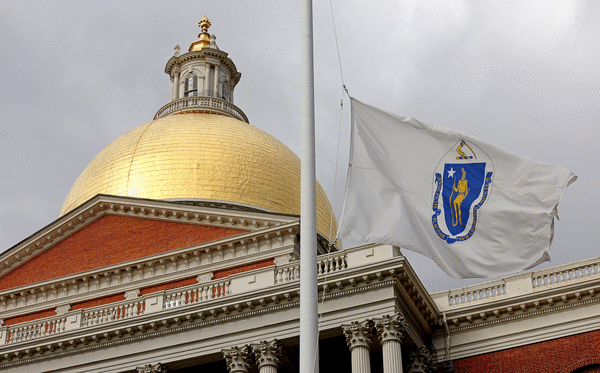
BOSTON — Massachusetts is the only state in the entire country where the Governor’s Office, the Judiciary and state Legislature are all exempt from the public records law, as Gov. Maura Healey recently hid behind this exemption to withhold hundreds of entries to the newly-created ICE Misconduct Portal and legislative leaders refuse to comply with a voter-approved audit.
The exemption contributes to Massachusetts’ reputation of hosting the least transparent state government in the United States, an issue that hit the spotlight recently when the Society of Professional Journalists (SPJ) named the Bay State the 2026 recipient of its “Black Hole” award – meaning it is the state where the most transparency and information is lost.
“The SPJ Freedom of Information (FOI) Committee selected Massachusetts for deficiencies in the state’s public records law, including broad exemptions, weak enforcement mechanisms and persistent delays that limit access to government information,” the SPJ said in a March 20 press release on this year’s award.
“Despite a legal framework that purports to guarantee access to public records, Massachusetts remains one of the few states in which the governor’s office, legislature and judiciary are largely exempt from public records requirements – leaving significant portions of the state government shielded from public scrutiny,” it said.
While Massachusetts exempts all three branches of government from the public records law, just eight other states have some sort of public records exemption for their respective state legislatures, according to the Reporters Committee for Freedom of the Press. These include California, Delaware, Georgia, Michigan, Minnesota, Oklahoma, Oregon, and Wyoming.
Only one other state – Michigan – joins Massachusetts in exempting its governor and state legislature from the public records law.
“The public should not have to fight, wait or pay exorbitant costs to understand how their government operates,” SPJ National President Chris Vaccaro said. “Transparency delayed or denied is accountability denied – and that undermines the very foundation of public trust.”
The SPJ lists five main criticisms related to the transparency on Beacon Hill, saying that requests for public records are frequently delayed or ignored, despite statutory deadlines; that excessive fees are sometimes used to discourage or block access to records; limited enforcement mechanisms; that requesters are often left with no option but costly and time-consuming litigation; and inconsistent compliance across state agencies, with little centralized oversight or accountability.
The consequences of this exemption are playing out in real time, with Healey utilizing her exemption as Governor to withhold hundreds of entries sent into the ICE Misconduct Portal – something she co-created with Attorney General Andrea Campbell.
Both have publicly expressed support for using information collected through the portal to prosecute ICE agents.
The Herald had requested the first two weeks worth of entries sent to the portal through a public records request, with Healey sending just six entries to AG Campbell’s office for review, four of which were ultimately disclosed for public consumption.
Entry ID’s featured on each report indicate that hundreds of reports were sent into the portal, and Healey’s office tells the Herald that the rest of the reports will not be disclosed, citing her exemption from the public records law and stating that releasing the remaining entries would “interfere” with and “hinder” her ability to perform her duties.
“After review, we refer you to the Attorney General’s letter to you of April 10, 2026, responding to the same public records request and producing four responsive records. We are unable to provide any other records responsive to your request as doing so would interfere with the Governor’s necessary, regular activities and responsibilities and, as a consequence, unreasonably hinder the Governor in effectively performing her duties,” Healey’s office told the Herald in a Monday response.
The governor is denying the release of hundreds of entries sent to the portal, despite a disclaimer with a box that users are required to click, indicating they are aware the reports are subject to public disclosure, before they can even submit the report.
“The Governor’s Office and/or Attorney General’s Office may use any information, photographs, or videos I provided in a public document, including in a legal proceeding or public report or statement. I also understand that the Governor’s Office and/or Attorney General’s Office may share this information with third parties for other lawful reasons, including in response to a public records request, and may be required to release this information pursuant to a court order or other lawful process,” the portal’s disclaimer reads.
The “Black Hole” distinction also comes as Senate President Karen Spilka and House Speaker Ron Mariano engage in a legal battle against the state auditor over complying with an audit of the state Legislature – approved by 72% of Massachusetts voters in 2024. AG Campbell has also worked to block the audit, refusing to represent Auditor Diana DiZoglio’s office in court and denying her request to seek outside counsel as she sues the legislature.
----------
©2026 MediaNews Group, Inc. Visit at bostonherald.com. Distributed by Tribune Content Agency, LLC.






Comments