Amid quarrel with pope, Trump strips Miami charity of funding to house migrant kids
Published in News & Features
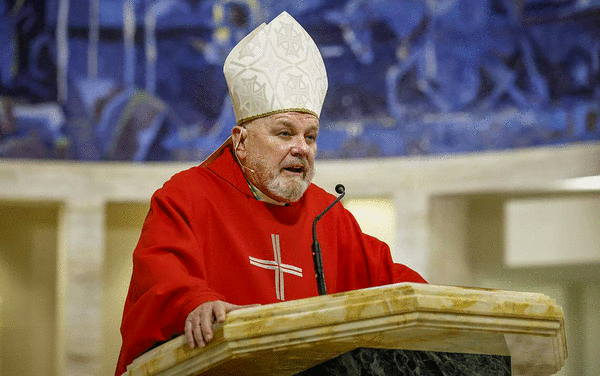
MIAMI — The Trump administration has abruptly canceled an $11 million contract with Catholic Charities of the Archdiocese of Miami to shelter and care for migrant children who enter the U.S. alone, ending a relationship between the Catholic Church and the U.S. government dating back to the first arrivals of Cuban exiles in South Florida.
The development comes amid rising tensions between the administration and American Catholics over President Donald Trump’s heated criticism of the Vatican’s first American pope, Leo XIV. The pontiff has made opposition to the U.S. war with Iran, as well as concern for the welfare of migrants, a cornerstone of his ministry.
The Office of Refugee Resettlement, part of the federal Department of Health and Human Services, has paid Catholic Charities in Miami for several years to house immigrant children who enter the U.S. without parents or adult supervision. The non-profit operates the equivalent of a federally funded foster care system, separate and apart from state agencies that have custody of abused and neglected children. The federal government reached out to the charity in late March about the cancellation of the funding.
The Archdiocese of Miami said late Tuesday that Archbishop Thomas Wenski was not immediately available to discuss the contract’s cancelation or the Trump Administration’s rift with the church. But it shared a statement that Wenski, a longtime immigrant-rights advocate, wrote for the Miami Herald’s editorial board.
“The U.S. government has abruptly decided to end more than 60 years of relationship with Catholic Charities in the Archdiocese of Miami,” Wekski wrote. “The Archdiocese of Miami’s services for unaccompanied minors have been recognized for their excellence and have served as a model for other agencies throughout the country.”
Wenski added: “Our track record in serving this vulnerable population is unmatched. Yet, the Archdiocese of Miami’s Catholic Charities’ services for unaccompanied minors has been stripped of funding and will be forced to shut down within three months.”
In response to a Miami Herald inquiry, the Department of Health and Human Services said the daily population of unaccompanied migrant children in the agency’s care was “significantly lower,” at 1,900, under the Trump administration compared to a peak of 22,000 under the Biden administration.
“ORR is closing and consolidating unused facilities as the Trump Administration continues efforts to stop illegal entry and the smuggling and trafficking of unaccompanied alien children,” said Emily G. Hillard, the Health and Human Services’ press secretary, though she did not single out Catholic Charities as an affected organization.
Acknowledging the reality of declining migration, Wenski wrote that while “it is true that the number of unaccompanied minors” had declined and “some programs may be scaled back” or shuttered, “it is baffling that the U.S. government would shut down a program that it would be hard-pressed to replicate at the level of competence” shown by the church.
There are still children in the care of Catholic Charities in Miami and elsewhere. It’s unclear how many there are, and where they are besides South Florida, or where they will go. Robert Latham, associate director of the University of Miami Law School’s Children and Youth Law Clinic, said any relocation to a new foster home or shelter likely would be traumatic for children who already have suffered uncertainty and loss.
“It’s incredibly psychologically harmful to be moved,” sometimes as stressful as serious illness or a death in the family, Latham said. “For little kids, moving repeatedly creates bonding issues and destroys the sense of both self and community. They don’t know who they are and where they will be” from day to day.
“This should only be done with a lot of emotional support that you normally would find within a family. Unfortunately, that is not there in a group home setting,” Latham added. The children who are uprooted “will lose the friends and connections and the community they have formed here.”
Under the contract, Catholic Charities operated a full-service child welfare program in Miami-Dade. One shelter – named Msgr. Bryan O. Walsh Children’s Village after an early advocate for refugee children – has 81 beds for unaccompanied minors. The program provides foster homes and family reunification and offers supportive services, “given the trauma that many of these children have endured before arriving in the U.S.,” Wenski wrote.
Shelters at the crosshairs
If the children still in the care of Catholic Charities do need to be relocated, it could be a significant undertaking. Unless there are existing licensed foster homes and shelters available, finding guardians could take months.
Citrus Family Care Network, a mental-health and social-services provider in Miami-Dade, has 200 employees devoted to caring for 1,200 kids in its foster care and child welfare program, said Esther Jacobo, a former Florida Department of Children and Families secretary who is the program’s director. Jacobo said it likely would take three to six months, at least, for any agency to get a new child welfare program up and running.
“You have to recruit people – and not everyone is suited to be a foster parent,” Jacobo said. “They have to be appropriately trained. That takes time. There’s a licensing process that happens. Everybody has to make sure that children are safe and in appropriate placements.
“That takes a very long time,” she added. “We struggle in our area. It is not easy to be a foster parent. You are volunteering for a board rate that does not cover the entire cost of raising children. You are doing this out of the goodness of your heart.”
The cancellation of Catholic Charities’ contract is not the first time unaccompanied children find themselves caught in the middle of conflict between Washington and Florida.
In December 2021, Gov. Ron DeSantis ordered Florida child care administrators to cease issuing or renewing the licenses of providers that operated shelters or foster homes for migrant children who were waiting either to be reunified with their parents or moved into homes with approved sponsors.
At the time, DeSantis was angry at the administration of President Joe Biden over what he called its failure to police the U.S.-Mexico border. Florida had become the home to more than 11,000 unaccompanied children who had been released to sponsors between October 2020 and September 2021.
Pedro Pan Kids
The Catholic Church has a long history of providing services to unaccompanied immigrant children in South Florida, dating back as far as the 1960s. In 1959, as Fidel Castro rose to power in Cuba, Catholic Charities and the U.S. State Department initiated a covert program called “Operation Pedro Pan,” that began with the airlift to Miami of the children of Cuban dissidents, but came to include families seeking a better life for their kids. Msgr. Bryan Walsh directed the efforts.
While some of the Pedro Pan children had extended family members who could take them in, others moved into orphanages run by the Catholic Church. As the program expanded, children were welcomed into foster homes in Miami and elsewhere – some as far away as New York and the Midwest.
It is estimated that the airlift rescued as many as 14,000 unaccompanied children. Many went on to become business and community leaders in South Florida.
“The positive impact of this cooperation between the federal government and Catholic Charities can be readily seen in the lives of former Pedro Pan children who, through this intervention, grew up to be successful members of our communities,” Wenski wrote.
Pedro Pan “alumni” include academics, doctors, lawyers, priests and politicians, he wrote. A Florida Republican, former U.S. Sen. Mel Martinez, came to the U.S. as a Pedro Pan kid; he served in the Senate from 2005-09. Healthcare executive and Miami philanthropist Miguel “Mike” Fernandez also came to the U.S. through the program.
In recent weeks, Trump has been sparring with the pope, with tensions particularly acute over the pontiff’s stated opposition to the U.S. bombing campaign in Iran.
“God does not bless any conflict. Anyone who is a disciple of Christ, the Prince of Peace, is never on the side of those who once wielded the sword and today drop bombs,” the pope wrote on his social media accounts. The comments drew the ire of Trump, who criticized the pope and said he would not apologize for his remarks.
“There’s nothing to apologize for. He’s wrong,” Trump said.
Trump also recently posted an AI-generated illustration of himself in the image resembling Jesus Christ, wearing robes and healing a sick man, sparking backlash. With soaring eagles and an American flag waving in the background, the image shows the president touching the head of a gray-haired man as if to heal him. Trump, who later suggested his intention was to compare himself to a Red Cross physician, had the image taken down.
©2026 Miami Herald. Visit at miamiherald.com. Distributed by Tribune Content Agency, LLC.






Comments