United CEO has pitched possible tie-up with rival American
Published in Business News
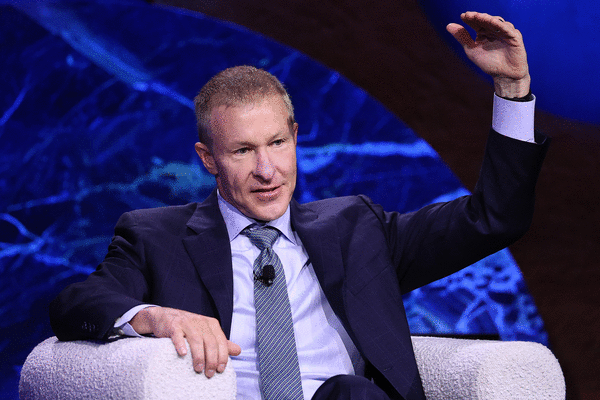
United Airlines Holdings Inc. Chief Executive Officer Scott Kirby has floated a possible combination with American Airlines Group Inc., according to people familiar with the conversations, an audacious proposition that would face intense scrutiny even under the business-friendly Trump administration.
Kirby has pitched the idea to senior government officials, though it’s unclear if any overtures have since been made or if an actual process is underway to explore a deal, according to the people, who asked not to be identified because the conversations are private.
A spokesman for United Airlines declined to comment, as did representatives for American Airlines.
United and American are among the top four U.S. carriers, together controlling more than a third of the market. A combination would create the largest airline on the planet. As a result, any merger between the two aviation giants would pose serious antitrust concerns and likely face significant backlash from consumers, politicians and rival U.S. airlines.
At the same time, the deliberations show how recent market upheaval has brought the possibility of consolidation to the fore. Kirby told employees in a memo last month that the carrier would benefit from any shakeout in the industry as part of rising oil and fuel prices, potentially providing purchase opportunities.
“We’ll be there to pick up some of those assets, might be a win-win for them,” Kirby said in a Bloomberg Television March 24 interview in Los Angeles. Asked if that would mean buying entire companies, he said “we’ll see, there’s lots of rumors about that.”
For Kirby, a deal involving American Airlines would also be personal. Kirby was previously president of American, but left after it was made clear he didn’t have a path to becoming the carrier’s CEO. Kirby joined United as president in 2016 before rising to the top job.
The two companies have engaged in a continuous exchange of strategic one-upmanship, particularly at Chicago’s O’Hare International Airport, where they’ve battled over gate access and market share.
Kirby has also faulted American Airlines for being too late and too slow to add more premium products, which have proven popular and lucrative at United and Delta Air Lines Inc.
The United CEO’s considerations come as airlines are grappling with higher jet fuel prices due to the U.S.-Iran war and the effective closure of the Strait of Hormuz, a key passageway for oil transports. Kirby has already responded by taking some capacity out of the market, saying he wants to be prepared for potential cost increases.
U.S. airline mergers have to be reviewed and approved by the Transportation Department, as well as the Department of Justice. Transportation Secretary Sean Duffy said the government would look at a number of factors when considering potential tie-ups, including the impact on competition — both domestically and globally — and ticket prices.
“President Trump, he loves to see big deals happen,” Duffy told CNBC on April 7. “Is there room for some mergers in the aviation industry? Yeah, I think there is,” he said.
However, Duffy added that he wouldn’t “pre-commit to anything.”
He also said if there is a merger between two larger airlines, they’ll have to “peel off” some of their assets because the U.S. doesn’t want to see one carrier with too much market share, which could drive up consumer prices.
United has a market value of about $31 billion, compared with just $7.4 billion for American. United’s stock has lost 15% in value this year, though American has fared worse, losing 27% since the start of 2026.
Shares of American jumped as high as 11% in postmarket trading after the Bloomberg News report. United’s stock gained as much as 1.3%.
With Fort Worth, Texas-based American, United would gain access to the largest U.S. domestic network — and scuttle the simmering turf war between the carriers in Chicago.
But it would also come as American is navigating a slate of operational and strategic challenges, from cutting about $35 billion in debt to trying to win back corporate flyers alienated by an unpopular — and since reversed — marketing strategy. American Chief Executive Officer Robert Isom is meanwhile under pressure from pilots blaming him for failing to close the gap with more profitable peers, including Delta and United.
The U.S. airline industry as it exists today was built largely through consolidation, including Delta and Northwest Airlines, United and Continental, and American and U.S. Airways.
Still, the industry’s history is lined with stalled deals.
In January 2025, United denied it was in deal talks with JetBlue Airways Corp. A previous alliance between JetBlue and American was ordered dismantled by a federal judge for violating U.S. antitrust laws. A separate deal by JetBlue to acquire Spirit Airlines Inc. was also blocked on antitrust grounds.
©2026 Bloomberg L.P. Visit bloomberg.com. Distributed by Tribune Content Agency, LLC.






Comments