Alaska Airlines launches Starlink Wi-Fi systems on Embraer planes
Published in Business News
More than a decade after introducing in-flight Wi-Fi, airlines are turning to the next wave of sky-high connectivity.
Airlines are tapping into satellite technology to make in-flight internet faster, harnessing the power of low Earth orbit satellites from Elon Musk’s Starlink and Amazon’s Project Kuiper, now officially called Leo.
Several of the nation’s largest carriers have announced plans or expressed interest in connecting with one of the low Earth orbit satellite providers, with three carriers intending to roll out the service across their fleet in 2026 or 2027.
United and Alaska have chosen Starlink. Budget airline JetBlue has inked a deal with Amazon. American is reportedly in talks with the Amazon team, while Delta tested Starlink's satellite technology three years ago without any commitments. Southwest is launching faster Wi-Fi through a partnership with T-Mobile, but hasn’t commented on the latest satellite technology.
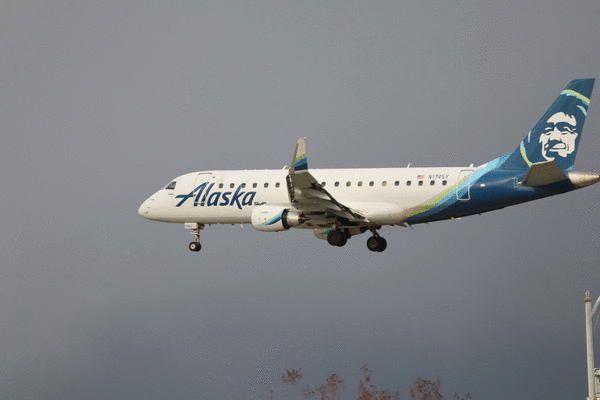
On Monday, Alaska Airlines said it had launched its first passenger flights with Starlink-enabled Wi-Fi, after completing installation of the new system on four Embraer E175 regional jets. The new technology should speed up internet service for passengers in the air, with less lag time while watching movies, scrolling social media or sending emails. With the new service, passengers could even make video calls, but that’s still frowned upon.
Put simply, “using Starlink on an airplane is basically the same as using internet on the ground,” said Todd Traynor-Corey, Alaska’s vice president of guest products and experiences.
Alaska Air Group, which includes the namesake carrier, Hawaiian Airlines, regional carrier Horizon Air and subsidiary McGee Air Services, announced in August it was joining with T-Mobile to update its Wi-Fi system to use Starlink across its fleet, with plans to complete installation by 2027.
Hawaiian Airlines, which Alaska acquired last year, was at the forefront of the new satellite wave. It was the first major carrier to use Starlink’s system on its Airbus fleet last year.
United came next when it introduced Starlink on a regional jet in May and its mainline fleet in October. United said it plans to install Starlink systems on up to 15 Boeing 737-800 jets each month.
Alaska had expected to complete its first Starlink installation in 2026 but sped up the rollout after receiving certification from the Federal Aviation Administration faster than expected, Traynor-Corey said. It will begin installing Starlink systems on its 737 fleet next year.
Airlines need separate FAA approval for the Wi-Fi systems on each plane model and variant, Traynor-Corey said. For example, an Embraer 175 operated by SkyWest may be slightly different from the same plane operated by Horizon, he said.
The installation process is mostly about hardware, Traynor-Corey said. Alaska will remove or modify existing hardware, including gear that looks like flat boxes sitting on top of the fuselage, and install new Starlink antennas, equipment and wiring. The equipment doesn’t affect the plane’s flight controls or other systems.
He declined to share how much the installations would cost but said Alaska is investing significantly in the project.
Right now, aircraft connect to the internet either through ground equipment or geostationary satellites, which are much deeper in space than low Earth orbit satellites. Tapping into low Earth orbit satellites speeds up internet connection because data doesn’t have to travel as far.
Geostationary satellites orbit more than 22,300 miles above Earth, while Amazon’s Leo satellites orbit between 367 and 391 miles above the planet, Amazon said in a blog post on its website. That shorter distance translates to lower latency and more reliable service.
The low Earth orbit satellite constellations also mean aircraft antennas won’t have to spend as much time searching for a satellite to beam data to and from, Traynor-Corey said.
Amazon and Starlink are competing to win the low Earth orbit satellite market to improve broadband access not just in the air, but on the ground. Both companies say their satellite constellations will help expand internet connectivity to rural areas that struggle to receive reliable service.
Starlink has about 9,000 satellites in orbit, while Amazon’s Leo has about 150. Leo plans to launch another 27 satellites this month.
Both companies are building their space ventures in Seattle’s backyard. Starlink produces its satellites in Redmond and Woodinville. Amazon Leo has a research and development facility in Redmond, a logistics hub in Everett and a manufacturing facility in Kirkland.
JetBlue was the first airline to sign a deal with Amazon’s Leo in September, with plans to integrate its internet service into the entire fleet in 2027. Last week, American Airline’s CEO Robert Isom told Bloomberg the airline was in talks with Amazon’s satellite division.
As airlines speed up internet service, they’re also dropping the fee, which ranges from $8 a flight to more than $30. Most airlines that offer free internet require travelers to join the airline’s loyalty program.
©2025 The Seattle Times. Visit seattletimes.com. Distributed by Tribune Content Agency, LLC.










Comments