Peru extends voting for president, congress amid delays at polling sites
Published in Political News
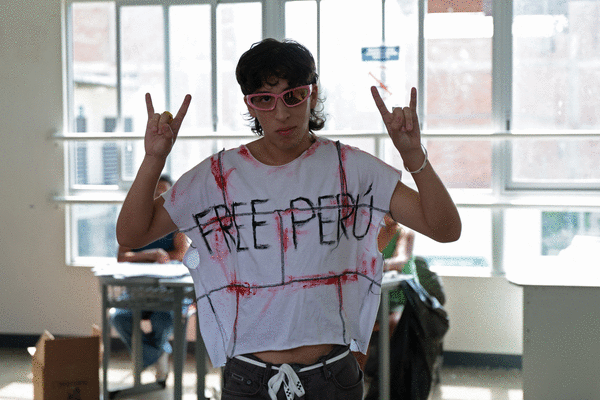
Peru’s nationwide elections suffered severe delays at some polling stations, especially in the capital Lima, muddying what was already a complex race among a record 36 presidential candidates.
The election, which was supposed to help Peruvians reset their political course after years of turbulence, quickly descended into confusion as many voters lined up Sunday morning only to find that ballots had not arrived.
The ONPE, a national body overseeing the elections, initially reported that just 1% of polling stations had experienced delayed openings because a private company contracted to deliver ballots failed to show up on time. By early afternoon, however, another national electoral authority said that as many as 30% of polling sites had failed to open by 1 p.m.
An independent observer group put the number lower, at 14%, before later saying that 94% of nationwide voting sites had opened by 2 p.m.
Whatever the final percentage, the delays threatened to disenfranchise a significant number of Peruvians and kicked off a round of finger-pointing, with the ONPE vowing to sue the ballot distributor while voters and monitors demanded answers.
“Our observers report very serious delays in some voting tables due to a lack of electoral materials in Lima,” Alvaro Henzler, the head of election monitoring nonprofit Transparencia, said in a press conference. “We call on authorities to explain this situation, which is unprecedented.”
Roberto Burneo, the head of the national electoral body JNE, said Peru would allow polling locations nationwide to remain open until 6 p.m., one hour later than originally planned, in a bid to ensure voters cast ballots in a country where participation is compulsory. Stations would have until 2 p.m. to open, two hours later than the initial deadline, or they’d be permanently closed.
The problems exacerbated tensions in a nation that has cycled through multiple leaders over the last decade, especially amid expectations that the outcome would come down to razor-thin margins.
Although most polling sites, especially outside Lima, ran smoothly, frustrations flared among voters forced to wait in hours-long lines at affected stations. Some began protesting against perceived irregularities in the electoral process, local TV stations showed.
“They said the ballots were delayed. How could they not have more suppliers? How could they not manage things better to prevent something like this?” asked Katia Burneo, who was voting at a school in Lima’s Miraflores district.
Polling stations there only opened at noon, five hours later than the scheduled 7 a.m. start time. The line wrapped around half the building, with several voters shielding themselves from the scorching sun under umbrellas.
“This has never happened before,” said Ximena Temoche, who arrived at 10 a.m. and waited more than two hours to get inside the school. “This time it’s strange.”
Prominent candidate Rafael López Aliaga — a former Lima mayor popularly known as Porky for his cherub-like cheeks — renewed fraud allegations that he’d already made during the campaign. Four-time candidate Keiko Fujimori, daughter of late President Alberto Fujimori, called for polls to stay open for an extra two hours until 7 p.m.
Impossible to predict
Some 27 million eligible voters are choosing a new president and legislature, which for the first time in over three decades will return to a bicameral system.
The ballot sheet is the largest and most expensive in Peru’s tumultuous history. With such a crowded field and many voters deciding at the last minute, the outcome was already impossible to handicap, with ample room for surprises even before the polling site issues.
Even frontrunners have little support, and many of the dizzying ballots are likely to be spoiled or invalid. The only sure bet is that no presidential candidate is expected to secure more than half the vote, making a June runoff between the top two contenders all but inevitable.
The winner may struggle to govern effectively, as an expanded legislature will be the deciding factor on many policy decisions, sowing tensions that could prolong Peru’s chronic political instability.
Edla Gamarra had to wait more than an hour at her polling station in Lima’s financial district, San Isidro, where voting began only after 9 a.m.
“The ballot is terrible, it looks like a will,” she said as she left. “I had to fold it about eight times.”
Gamarra and her husband, business entrepreneurs in the tourism sector, hope these elections can bring an end to the cycle of political instability that has gripped Peru, home to about 35 million people, over the last decade. “We need stability, a strong state,” Fernando Delpino, her husband, said.
The winner of the presidential race will succeed José María Balcázar, a caretaker who replaced Dina Boluarte in February after she was impeached for “permanent moral incapacity.”
Whoever prevails will be the nation’s 10th head of state since 2016. That year was the last time a Peruvian president completed a five-year term. Of the last eight leaders, only two were elected through a popular vote.
Far-left Pedro Castillo was the last to be elected in the 2021 cycle. The rural schoolteacher surged in polls only weeks before the vote to massively outperform his poll numbers in the first round and then win the final ballot against three-time runner-up Keiko Fujimori. Castillo was ousted by Congress and jailed in December 2022 after attempting to rule by decree. Three presidents have followed him since.
Despite its dysfunctional politics, copper-exporting Peru is among the region’s top economic performers. Gross domestic product grew over 3% for the second consecutive year in 2025, outpacing Colombia, Chile, Brazil and Mexico, while inflation is among the lowest in emerging markets.
Rising crime
As in many Latin American countries, a top concern of Peruvian voters in this electoral cycle is rising crime. Homicides have soared by 40% over the last five years, according to official data.
“We need an iron fist,” said voter Emma Julián Turbe, 39, calling for a president who “takes action against disorder and crime.”
Many of the presidential candidates have pledged to crack down with proposals ranging from building El Salvador-style megaprisons to reinstating the death penalty.
Right-wing, pro-Washington and pro-market, Fujimori is trying for a fourth time to follow in the footsteps of her father, the polarizing late president Alberto Fujimori. Other conservative candidates include TV comedian Carlos Álvarez and another former Lima mayor, Ricardo Belmont.
Centrist and left-wing contenders include sociologist Jorge Nieto, former central bank director Alfonso López-Chau and congressman Roberto Sánchez.
Peruvians will also vote to fill 130 seats in the lower house, and for the first time since the 1990s, 60 senators as the Andean nation returns to a two-chamber system.
The restoration of the Senate is intended to raise the bar for impeachment that has felled one president after another for years.
©2026 Bloomberg L.P. Visit bloomberg.com. Distributed by Tribune Content Agency, LLC.








































Comments