OpenAI gives Pentagon AI model access after Anthropic dustup
Published in Political News
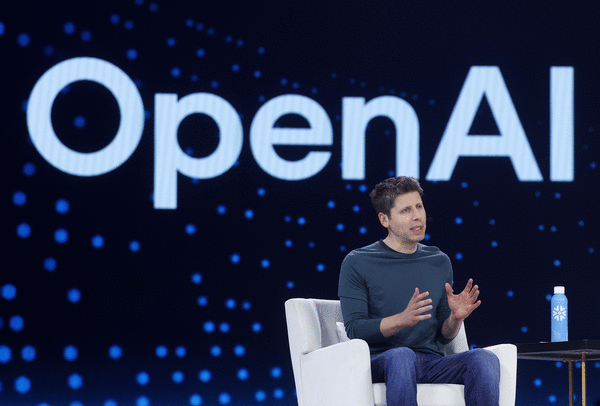
OpenAI has agreed to deploy its own artificial intelligence models within the Defense Department’s classified network after rival Anthropic PBC saw its relationship with the Pentagon implode over surveillance and autonomous weapons concerns.
OpenAI Chief Executive Officer Sam Altman said late Friday that he’d reached an agreement with the department that reflects the company's principles on prohibiting “domestic mass surveillance and human responsibility for the use of force, including for autonomous weapon systems.” The startup also built safeguards to ensure its models behave as they should as part of the deployment, Altman said in a post on the social media platform X.
OpenAI declined to comment on whether the company’s services for the department would replace the work previously done by Anthropic. The Defense Department did not immediately respond to a request for comment late Friday night.
Just hours earlier, the Pentagon declared Anthropic a supply-chain risk, a move that could have profound consequences for the company’s business and escalated a feud between the artificial intelligence startup and defense officials over safeguards on its technology.
In a post on X, Defense Secretary Pete Hegseth outlined a six-month period for Anthropic to hand over AI services to another provider. “America’s warfighters will never be held hostage by the ideological whims of Big Tech,” Hegseth wrote. “This decision is final.” His post appeared shortly after President Donald Trump wrote on social media that he was ordering federal agencies to drop Anthropic.
Anthropic, which has stipulated that its products not be used for surveillance of Americans or to carry out strikes without human involvement, said on Friday that “no amount of intimidation or punishment from the Department of War will change our position on mass domestic surveillance or fully autonomous weapons.”
The Pentagon offered terms to Anthropic earlier this week that incorporated some language that the company had proposed on surveillance and autonomy, a person familiar with the situation said, asking not to be identified because the talks weren’t public. But in Anthropic’s opinion, they didn’t go far enough in ensuring the department wouldn’t be able to set aside any restrictions when it deems it necessary to do so, the person said.
OpenAI’s deal with the Pentagon threatens to widen the rift between the Trump administration and Anthropic, which has drawn strong support for its stance in Silicon Valley where tech workers rallied to the company’s side and urged other major tech companies including Amazon.com Inc. and Microsoft Corp. to follow suit.
Altman addressed some of issues of surveillance and autonomous weapons in his post, saying the Defense Department agreed with its principles and reflected them in its agreement with OpenAI — asking the department “to offer these same terms to all AI companies, which in our opinion we think everyone should be willing to accept.”
Dario Amodei, CEO of Anthropic, used to work at OpenAI and left in 2020 in part because of his concerns that the startup was prioritizing commercialization and speed over safety. OpenAI began as a nonprofit and converted to a more traditional for-profit enterprise last year. Although the company initially prohibited the use of its technology for military applications, OpenAI updated its policy to allow such uses in 2024. The company has also dropped the word “safely” from its mission statement, which currently states that the company’s goal is to “ensure that artificial general intelligence — AI systems that are generally smarter than humans — benefits all of humanity.”
Anthropic and OpenAI are now increasingly turning their attention to profits as they push for initial public offerings as soon as this year, tapping frenzied investor interest in AI.
Earlier on Friday, OpenAI announced it had raised $110 billion in a deal that values the startup at $730 billion, representing the ChatGPT maker’s largest funding round to date and bolstering its costly push to secure more computing power and talent for AI development. Anthropic raised $30 billion in a funding round earlier this month from some of OpenAI’s same investors.
Amodei and Altman have publicly clashed over the years. Most recently, during an AI summit in New Delhi this month, the two men ended up standing next to each other with Prime Minister Narendra Modi, and noticeably didn’t hold hands while everyone else lined up on stage did.
©2026 Bloomberg L.P. Visit bloomberg.com. Distributed by Tribune Content Agency, LLC.




































Comments