Congress might end a ban on mining near the Boundary Waters. Here's what to know
Published in Political News
This week, the U.S. Senate is expected to vote on whether to overturn a 20-year ban on mining next to the Boundary Waters Canoe Area Wilderness.
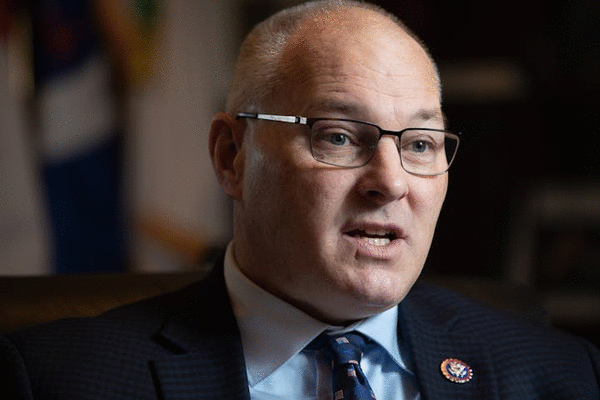
If the measure passes, it would again allow mining companies to apply for mineral leases on federal land in Superior National Forest. It would also mark a major victory for Republican U.S. Rep. Pete Stauber, who represents Minnesota’s Iron Range and has worked for years to ease the path for new mines.
A constellation of local and national conservation groups has been trying to push back, following the House’s January passage of the bill. They have a champion in Democratic U.S. Sen. Tina Smith, who said in a statement that Republicans are “using an unprecedented, sneaky maneuver that would open the door to reversing protections across all our public lands.”
And on Feb. 6, a new group of opponents emerged: the descendants of U.S. President Teddy Roosevelt, who protected 230 million acres of land during his terms in the early 1900s.
Here’s what to know about the upcoming vote:
The U.S. Forest Service started a study at the end of the Obama administration to determine whether the area could be safely mined, probing what the effects would be on the environment, on tribal communities and the local economy. That study was scuttled during President Donald Trump’s first term but was revived by former President Joe Biden.
When it was finally released in 2022, the study concluded that mining could not be done safely in the Rainy River watershed, which covers the national forest and flows to the Boundary Waters. The Forest Service reached this conclusion even as they considered mitigation measures a mine might use to minimize pollution and runoff.
As a result, the Biden administration enacted a “mineral withdrawal” in 2023 — barring any new mining leases on federal minerals across 225,000 acres in the Superior National Forest.
The mineral withdrawal had effectively blocked the Twin Metals proposal, a mine envisioned by a subsidiary of the Chilean mining company Antofagasta.
The proposed mine would be dug underground in Lake County, between Babbitt and Ely, and employ an estimated 700 people. It would produce an estimated 20,000 tons of ore a day, including copper, nickel, cobalt and platinum group metals. This mine would be in the watershed of the Boundary Waters Canoe Area Wilderness, meaning that any pollution that escaped would flow in the direction of the BWCAW.
Proponents argue the project is necessary to support the economy of northeast Minnesota, where taconite mines continue to lay off workers, and to ensure a domestic supply of critical minerals. The project would depart from Minnesota’s iron mining history, however, by extracting sulfide ore — something environmentalists say poses too much risk of toxic runoff.
In a recent statement, Twin Metals spokeswoman Kathy Graul wrote that the company “is very appreciative of Congress for their efforts to overturn an unnecessary and detrimental action that locked out a significant domestic source of critical minerals.”
Stauber is using a power unique to federal legislators under the Congressional Review Act, a 1996 law that allows lawmakers to roll back rules issued by the executive branch. The CRA has never before been applied to a similar mining ban, however.
The resolution passed the House on Jan. 21, after which it has 60 working days to pass the Senate. The legislation is not subject to the filibuster, meaning it will only need a simple majority to pass the Republican-controlled chamber.
If the resolution passes both chambers of Congress and is signed by President Donald Trump, that would bar a future president from enacting similar federal action. Only an act of Congress could reinstate similar mining prohibitions in the Superior National Forest.
Ingrid Lyons, the executive director of Save the Boundary Waters, previously called this attempt to overturn the mining ban “the realest legislative threat we’ve seen to the Boundary Waters in this administration.”
But MiningMinnesota, a group that represents companies proposing copper and nickel mines, said in a statement, “The CRA vote is a practical affirmation that science and process, not shifting politics, should guide mine permitting. Minnesotans can safeguard our environment and supply the minerals essential to grid reliability, electric vehicles, and defense systems for national security.”
President Donald Trump has been a consistent supporter of expanded mining in Minnesota and is expected to sign the resolution if it passes.
That wouldn’t automatically revive Twin Metals’ rights to mine.
Prior to the mining ban, the Biden administration had canceled two federal mineral leases for the project, leaving the company without rights to mine key areas. Twin Metals was suing to restore these leases, but the lawsuit is currently paused.
The government would need to reissue the company’s mineral leases for the project to move forward.
If that happens, Twin Metals would then have to restart an environmental review process with both state and federal regulators. New mines in the United States regularly take a decade or more to permit, though in some cases, the Trump administration has pledged to speed up that process.
“Mine construction is years away,” wrote Dean DeBeltz, vice president of external affairs and project operations at Twin Metals. “Any project we propose will be subject to a rigorous, multiyear state and federal environmental review and permitting process before operations could begin.”
_____
©2026 The Minnesota Star Tribune. Visit startribune.com. Distributed by Tribune Content Agency, LLC



















































Comments