Top-down approach has Congress AWOL on FDA, experts say
Published in Political News
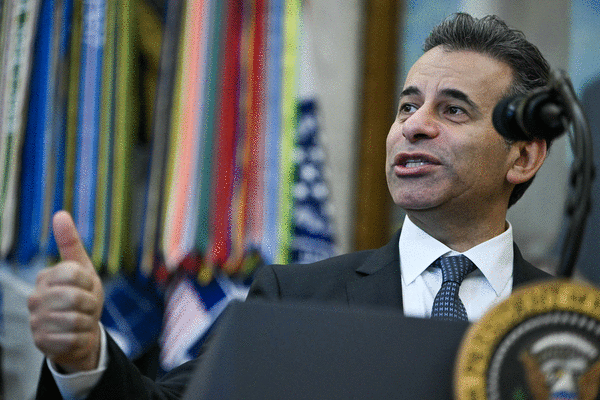
WASHINGTON — An overarching theme of the second Trump administration’s relationship with Congress has been forging ahead without pausing to let lawmakers weigh in. That dynamic has proven out at an agency that is responsible for regulating 20% of the economy: the Food and Drug Administration.
Despite its typically low profile, the FDA has had a turbulent year.
Since President Donald Trump took office, the agency has lost about 20% of its staff through reduction-in-force efforts, faced a mass exodus of senior leaders that usually remain after an administration change, and has had a hand in major changes to U.S. vaccine policy.
The sea change has raised a key question among FDA watchers — where is Congress?
Oversight can take a back seat when the same party holds both chambers and the presidency, and the FDA in particular has a fair bit of supervision baked in, including through its user fee agreements that outline how the agency regulates various medical products.
But some FDA experts say that given the level of shake-ups at the agency and the pace with which they’ve occurred, more oversight is warranted.
Since FDA Commissioner Marty Makary was confirmed in March, he’s appeared before Congress just once for a routine hearing on the agency’s budget. Health and Human Services Secretary Robert F. Kennedy Jr. has appeared before the Senate Health, Education, Labor and Pensions Committee twice since he was confirmed.
“This is a broad pattern; FDA just fits into it,” said Steven Grossman, a regulatory consultant who is president of HPS Group and author of the FDA Matters newsletter. “They’re treating Congress as if it was, at best, a secondary factor.”
‘On its back foot’
Reshma Ramachandran, an assistant professor of medicine at Yale University, said in an interview that the FDA over the past year has engaged with the public much less than it typically does before making policy decisions.
For example, Makary has convened fewer advisory committee meetings, which help inform approval decisions and agency policy. The physician and health services researcher said that departure and others at federal health agencies have left Congress “on its back foot in some ways.”
That’s all while the agency is significantly altering policy. The FDA last year stopped approving routine COVID-19 vaccines for the healthy, non-elderly population and consulted in the decision to revamp the Centers for Disease Control and Prevention’s childhood vaccine schedule, announced earlier this week.
And lawmakers’ partisan issues also make it harder for them to agree on overseeing the agency, she said. Republicans, for example, are challenging the agency over its regulations of the abortion drug mifepristone, while Democrats want investigations into the agency’s new drug approval system.
“There is some partisanship that is happening, unfortunately, around these issues … instead of a concerted effort to actually have a lot of the political appointees — not just the commissioner and not just the HHS secretary — really discuss how they came to these sorts of policy conclusions,” she said.
Joshua Sharfstein, a Johns Hopkins University public health professor and former FDA principal deputy commissioner during the Obama administration, said in an interview that when he was at the agency, the Office of Congressional Affairs was among the busiest divisions. If staffing changes and cuts were enacted at the same level then, “we would have been in a hearing very quickly,” he said.
One reason that the FDA might get less scrutiny is its regular cycle through Congress.
Since the 1990s, lawmakers have passed user fee legislation for prescription, generic, certain over-the-counter, biosimilar and animal drugs; medical devices; and tobacco products. Those packages are generally passed on a five-year timeline, which gives Congress the ability to revisit the programs each time it reauthorizes them, make changes to reporting requirements and specify other transparency measures.
“Unlike most other legislative areas, everybody knows that at least once every five years, there will be a reckoning of what represents good policy and congressional will,” he said.
Lasting impact
But experts also worry that while some policy changes could be easily reversed under a new administration, other actions could be hard to undo.
“When you talk about capacity, it’s not just that the agency has 20% fewer people,” Grossman said. “It’s the loss of expertise, the loss of insights into how to do this well. It takes time to rebuild.”
“I am deeply worried that this is setting this sort of precedent, that the agency cannot rely on scientific integrity in making decisions and, instead, can go forth and do whatever it wants,” Ramachandran said.
In her practice, she sees patients who are largely low-income, underinsured or uninsured. She said she’s worried that long-term changes at the agency could make the job for clinicians like her more difficult. Taken in context with the cuts to Medicaid included in the GOP reconciliation package and the loss of the enhanced premium tax credits for many people who get insurance through the Affordable Care Act, the FDA’s brain drain will have a deep impact on the health system on the whole.
Other countries have historically looked to the FDA to guide their own regulatory actions, she said. They may start to turn away from the United States as the international standard.
“It’s like death by 1,000 cuts in some ways,” she said.
-------------
©2026 CQ-Roll Call, Inc. Visit at rollcall.com. Distributed by Tribune Content Agency, LLC.


















































Comments