Nvidia gains, Hospitals hurt: Congress winners and losers
Published in Political News
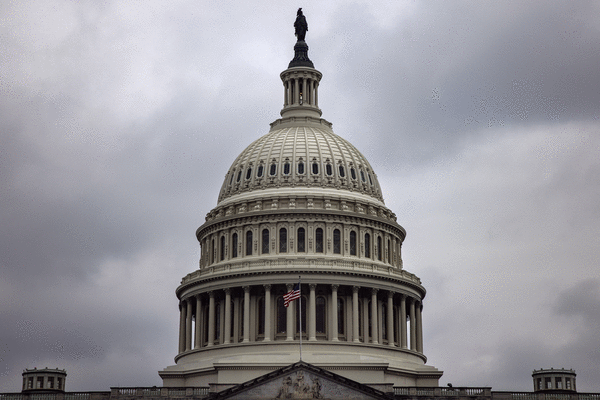
The Republican-controlled Congress has been very good to most of corporate America this year. Foremost among the boons is a $4 trillion tax cut package that extended and added generous breaks for businesses large and small.
But it hasn’t been all good news for U.S. companies and some industries have benefited more than others. The legislative branch’s acquiescence to President Donald Trump’s sharp tariff increases raised input costs across the economy and provoked retaliatory moves against U.S. farm exports.
The health-care sector, renewable energy companies and Las Vegas’s casinos have taken legislative hits while chipmakers, drug companies and private equity fended off potentially costly congressional interventions.
Here are this year’s winners and losers:
Winners
Nvidia
America’s most valuable company beat back influential Republican China hawks’ efforts to insert provisions in legislation aimed at ensuring U.S. companies get first dibs on Nvidia’s products. Chief Executive Officer Jensen Huang’s visits to Congress and the White House also helped pave the way for Trump administration actions easing export restrictions so the company could sell advanced chips to Chinese customers.
Private equity
The struggle to preserve a tax break cherished by private equity proved to be one of the rare instances this year when congressional Republicans stood up to Trump, rebuffing the president’s early demands to raise taxes on carried interest.
The provision would have eliminated a lower income tax rate for a key portion of private equity executives’ compensation. PE firms worked to squelch the change in tandem with venture capital and real estate partnerships, whose executives and dealmakers also benefit. Better yet, private equity also won an expanded interest expensing tax break.
Oil & gas
Energy companies secured a tax break worth more than $1 billion for oil and gas producers in the Trump tax package. The provision allows businesses subject to a 15% corporate alternative minimum tax to deduct certain drilling costs when calculating their taxable income. Companies including ConocoPhillips Co., Ovintiv Inc. and Civitas Resources Inc. lobbied in favor of it.
Crypto
Digital assets companies achieved a breakthrough with the passage of a light-touch regulatory law for dollar-pegged stablecoins, clearing the way for broader use of the technology in everyday finance. An industry drive for a broader rewrite of securities and commodities laws to set up favorable regulation of cryptoassets is moving closer to the finish line. A $263 million campaign war chest the crypto industry has amassed in super-PACs is sure to help.
Pharma
Drug companies mostly succeeded in blocking legislative efforts to control their soaring prices. While Trump talked up requiring massive price cuts from pharmaceutical companies, Republican leaders on Capitol Hill made no moves to codify such a policy. Still, the Senate’s confirmation of Health and Human Services Secretary Robert Kennedy Jr. empowered a foe of vaccine makers.
Tech giants
Technology giants have stymied public pressure for federal legislation to regulate social media and other tech products amid rising concern over harm to children. Even so, the industry so far hasn’t been able to secure a federal law blocking state regulation of artificial intelligence. The Trump administration stepped in with an executive order to override state AI regulations, though that faces legal challenges.
Financial planners
The wealth management industry came out ahead when Senate Republican leader John Thune’s campaign to add a repeal of the estate tax to Trump’s tax law foundered. The tax overhaul kept in place the complex loopholes that the rich employ financial planners to navigate on their behalf.
Defense & aerospace
The defense industry thwarted efforts by Elon Musk’s DOGE team to cut military spending and scored big increases in the Pentagon budget. Trump’s massive tax and spending package included $150 billion in new defense spending.
A defense policy bill Congress just passed came in $8 billion above the White House request. Notable beneficiaries include Anduril Industries Inc., Palantir Technologies Inc. and Boeing Co. with the new F-47 fighter. A provision to allow the Pentagon to repair weapons systems without paying contractors to do so was defeated.
Domestic car dealers
Car dealers won a tax break for loan interest on purchases of new U.S.-built automobiles.
Large corporations
The $4 trillion Trump tax cut bill extended a bevy of 2017 tax breaks that had expired. Manufacturers won bonus depreciation for the cost of production upgrades and a research and development tax break. Attempts to pay for these by scaling back the corporate state and local tax deduction and to increase the stock buyback tax were beaten back by a heavy lobbying effort.
Small businesses
The 2017 law that allowed pass-through businesses to deduct up to 20% of their qualified business income from their taxable income was permanently extended.
Losers
Hospitals
A $50 billion bailout for rural hospitals included in Trump’s tax cut plan won’t offset the loss of funding from Medicaid cuts in the law. Millions of Americans will lose health insurance in the coming years, according to forecasts, leading to a surge in uncompensated care in emergency rooms.
Health insurers
Big insurers are in line to lose millions of customers with the expiration of enhanced Obamacare premium tax credits at the end of this month. Fewer healthy people signing up for policies also could further harm insurers’ bottom lines. While a bipartisan group of moderates in both parties are trying to renew the credits in January they face an uphill battle against Republican congressional leaders, who oppose the effort.
Green energy
The Trump tax bill ended former President Joe Biden’s signature tax credits for solar, wind and other renewable energy sources and curtailed the $7,500 consumer electric vehicle tax credit for cars made by Tesla Inc., Rivian Automotive Inc. and General Motors Co. Renewable energy companies Sunnova Energy International Inc., Solar Mosaic Inc. and Pine Gate Renewables LLC all filed for bankruptcy protection this year in part due to the ending of tax incentives.
Banks
Crypto bros’ gain is bankers’ loss as the stablecoin legislation Congress passed this year threatens the banking sector’s long and profitable dominance of the payments system. Still, bankers’ congressional allies blocked votes on credit card competition legislation, which would cut into the nearly $190 billion in swipe fees retailers pay annually to banks, Visa Inc. and Mastercard Inc. Congress also repealed a Biden-era regulation limiting bank overdraft fees.
Casinos
Under the tax bill, professional gamblers would only be able to deduct 90% of their losses against their winnings, leading to a situation where they could still owe income tax if they break even over a year or lose money overall. Major casino companies are pushing to repeal the provision, fearing a drop-off in business from their best customers.
Airlines
Airlines lost hundreds of millions of dollars in ticket revenue during the longest government shutdown in history as the Trump administration moved to curtail flights during the congressional impasse. Delta Air Lines Inc. alone estimated it took a $200 million hit from the shutdown.
Importers
Retailers and other importers stung by Trump’s tariffs got little help from lawmakers this year, as Republicans largely sat back while the president claimed broad authority to rewrite the world’s trading order. House Speaker Mike Johnson, a close Trump ally, has so far managed to delay a looming floor fight over the legality of the tariffs until at least the end of January.
_____
With assistance from Roxana Tiron, Ari Natter, Katanga Johnson and Emily Birnbaum.
_____
©2025 Bloomberg News. Visit at bloomberg.com. Distributed by Tribune Content Agency, LLC.



















































Comments