Government shutdown, reconciliation law highlight turbulent year in Congress
Published in Political News
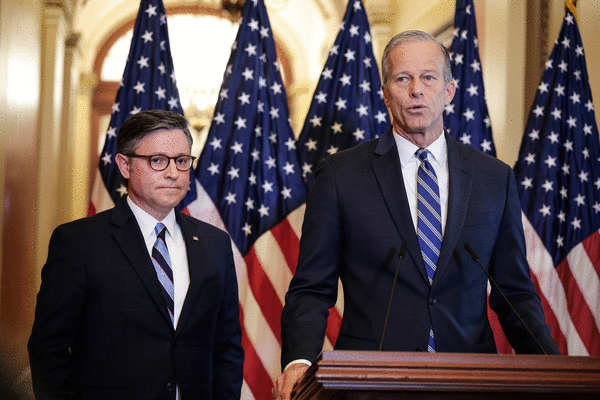
WASHINGTON — Five months ago, the story of the first session of the 119th Congress was expected to be the passage of President Donald Trump’s signature policy legislation known as the One Big Beautiful Bill. But that was before the longest partial government shutdown in American history and the intertwined extended absence of the House.
After the House passed a continuing resolution in September, Speaker Mike Johnson opted to halt legislative business, leading to a funding standoff as the chamber waited for the Senate to sort out how to act on reopening the government.
Senate Democrats, for the most part, refused to support a stopgap spending bill without addressing the pending expiration of enhanced health care tax credits under the Affordable Care Act — and they did not relent on blocking measures put forth by the GOP until after the open enrollment window for insurance plans had started and November elections in New Jersey and Virginia had taken place.
It was a different tack from the one taken by Democratic senators — particularly Minority Leader Charles E. Schumer — back in March, when the New York Democrat was among those to back a continuing resolution to avert a shutdown. The Democratic base was not happy with that decision, viewing it as acquiescence to Trump.
Later in the year, when the lapse in appropriations finally ended on Nov. 12 — after 43 days — Schumer was not among the Democrats who voted for the pact. The funding package that was approved included three of the 12 regular fiscal 2026 spending bills, while Congress punted the deadlines for the remaining bills to the end of January.
Trump and congressional Republicans scored the biggest victory of their first year back with unified government control just before the Fourth of July – even if that now feels like a distant memory.
The massive reconciliation law made permanent tax cuts first enacted during Trump’s first term and other sweeping domestic policy changes. Republicans are hopeful that voters will see positive effects from that law in the first part of next year, ahead of the midterms.
“It’s probably in the top five in terms of marquee landmark achievements,” Johnson told reporters at the beginning of December. “The component pieces of that is some of the most nation-shaping, productive, pro-growth policies that have ever occurred to help all Americans.”
There were also a series of successful efforts by the GOP majority to overturn rules promulgated during the Biden administration, with Trump eager to put his signature on efforts to undo his predecessor’s actions.
“Here in Congress, we’ve used the Congressional Review Act to repeal rules, regulations and mandates that were creeping into seemingly every facet of Americans’ lives,” Senate Majority Leader John Thune said in a Dec. 2, floor speech. “That includes four separate rules on appliances.”
But as with the budget reconciliation law, the expedited procedures available under the CRA only required simple majorities to advance in the Senate.
That was also true of judicial and executive nominations. Senate Republicans this year made it even easier to confirm presidential nominees over the opposition of the minority party. The new process, which is being employed again during the last scheduled session week of the year, allows the majority to advance executive resolutions to bundle together large batches of nominees.
Republicans say they were forced to act because Democrats were taking their obstruction of nominees to new levels and not consenting to advance even the least controversial of the president’s civilian nominees.
Thune and Senate Republicans, however, have not acquiesced to all of the president’s demands related to chamber procedure, such as eliminating the Judiciary Committee’s blue-slip process or torpedoing the legislative filibuster.
Other legislative achievements
Not everything Congress accomplished in 2025 was done along party lines. Bipartisan achievements included an effort to combat the sharing of nonconsensual intimate deepfake images.
That law, known as the Take it Down Act, was among the measures the president highlighted at last week’s White House Congressional Ball, singling out the advocacy of first lady Melania Trump.
“She came home and said, ‘I heard you got a unanimous vote.’ Yeah, she looks at me like, ‘What was the big deal?” the president told assembled Republican lawmakers. “But that was a great thing that she did and a great thing that all of you did.”
At the same event, Trump also predicted: “Very soon, I’ll hopefully be signing a National Defense Authorization Act that makes a historic investment in the United States military, which I think most people want to see.”
The fiscal 2026 defense policy bill should be heading to his desk as early as this week following the Senate’s expected passage. The NDAA includes an assortment of other significant measures, including Coast Guard, State Department and intelligence reauthorizations.
Another legislative highlight of the year was the first bill Trump signed into law this term. The Laken Riley Act was named for a 22 year-old nursing student from Georgia, who was killed by an assailant who was not legally in the country. The law directs the Homeland Security secretary to issue detainers for undocumented immigrants arrested for or convicted of a variety of crimes.
“Republicans ended catch and release. We stopped the illegal invasion of our country. For the past six months, zero illegal immigrants have been released into our country,” Senate Majority Whip John Barrasso said earlier this month in a floor speech about Republicans’ immigration agenda.
Other key laws enacted during 2025 include a measure regulating stablecoins, though broader cryptocurrency legislation has yet to make it to the president’s desk.
Bypassing leadership
While Republicans hold narrow majorities in both chambers, it’s Johnson who’s had the tougher time holding his conference together on big-ticket items.
But there’s also been a considerable level of discord both within the House Republican Conference and within the chamber at large. Once Arizona Democrat Adelita Grijalva was sworn in following the end of the shutdown, a bipartisan coalition had the signatures needed to bypass leadership and force consideration of a resolution directing the Justice Department to release files related to the case of the late convicted sex offender Jeffrey Epstein. The bill went on to move quickly through Congress last month after Trump dropped his opposition.
And that hasn’t been all. Just last week, the House passed a bill called up pursuant to a discharge measure designed to reinstate collective bargaining protections for federal employees.
There are also multiple petitions circulating to force votes on a yet-to-be resolved matter: extending the Affordable Care Act tax credits that were at the center of the partial government shutdown fight.
As part of the agreement that ended the November shutdown, the Senate Democratic Caucus secured a commitment for a vote on an extension of the expanded credits, which expire Dec. 31. But their three-year measure did not get the GOP support needed to advance last week.
“Democrats’ focus does not change,” Schumer said after the vote. “We fought like hell to stop these hikes, and we’re going to continue to fight like hell to bring costs down for the American people..
“Jan. 1 is coming. Republicans are responsible for what happens next.”
©2025 CQ-Roll Call, Inc., All Rights Reserved. Visit cqrollcall.com. Distributed by Tribune Content Agency, LLC.


















































Comments