Coming of age: Mega Cat Studios releases new 'God of War' video game
Published in Science & Technology News



PITTSBURGH — Pittsburgh’s own rising video game design studio recently spearheaded “God of War: Sons of Sparta” — the latest entry in the widely beloved triple-A franchise — and emerged a different outfit.
With more than 66 million units sold since the God of War series debuted on Playstation 2 in 2005, the opportunity to transform the modern gaming classic into a retro, 2D, side-scrolling “Metroidvania”-style prequel marked a new triumph and challenge for Mega Cat Studios in Polish Hill.
The new game, which follows the harrowing journey of a young Kratos and his brother into Spartan manhood in ancient Greece, all started with one swing hefty enough to rival the arc of the future god-killer’s signature Blades of Chaos.
“The coming-of-age story isn't just in the game, it's a coming of age for Mega Cat,” said cofounder and CEO James Deighan, a Friendship resident.
“Crossing these thresholds has been definitely surreal — so fulfilling on so many levels. And it really does feel like we're just getting started.”
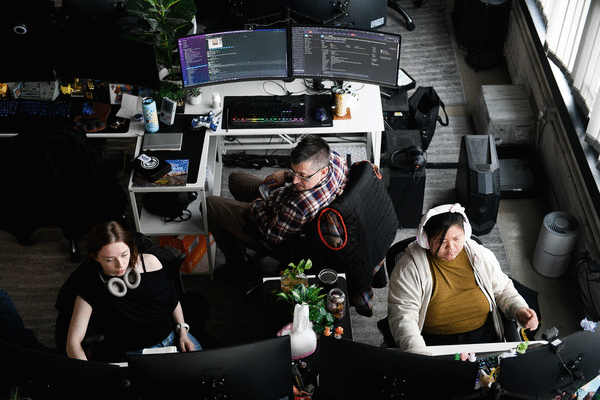
The sun never set on the predominantly retro-style gaming studio’s years of work on “God of War: Sons of Sparta,” which released digitally on PS5 on Feb. 12 as part of the series’ 20th anniversary. A 400-person development team — from Mega Cat’s Pittsburgh headquarters to recently purchased spaces in Laguna, Philippines, and Florianopolis, Brazil — contributed to the game in a day-and-night cycle that’s become a common industry workflow over years of development.
“The Philippines is like a second home to me at this point,” said Deighan, noting he made industry connections through four of the company’s original Pittsburgh hires. “I have lifelong friends there, and the team members in the Philippines are just the same as the team members in Pittsburgh. They’re part of the family.”
Mega Cat was co-founded in 2015 by Deighan, game director Zack Manko and COO Nick Mann as a passion project making old-school cartridge games out of Deighan’s home. The studio has gained ground in the industry by developing original, nostalgia-laden 2D titles like “Coffee Crisis” and “WrestleQuest” and working with established brands like “Backyard Baseball” and “Five Nights at Freddy’s.”
But the dreams have always been outsized for the quirky, eclectic studio featuring a giant sunglasses-wearing cat atop its roof, a wall of retro boomboxes and TVs inside its office and a tight-knit group of pleasant, wise-cracking “cats” at the helm.
With a recent string of company successes under their belt and the sting of an unreleased project still fresh, Mega Cat’s leaders decided to take aim at something that has been atop the company’s wish list since the beginning.
They cold-pitched “God of War” developer Santa Monica Studios on the idea for a prequel via email.
“If you have a really sophisticated, fan-driven franchise plan, we think there's a retro play,” said Deighan.
In this case, the odds were against them.
“I remember listing it as a 1% chance. So it was: What's the harm in us taking this chance anyway?” Deighan said. “Half of my job is swinging.”
The first move was made by executive producer Danny Pesante.
“Danny, who has many titles here — EVP of partnerships, head of ‘Pika,’ which is a department he invented one day,” said Deighan, drawing a laugh from the assembled team. “He's a massive, massive, massive ‘God of War’ fan, and he sent the first, original email.”
“I remember he called me after the email and he was like, ‘They opened it. What do we do?’ I'm like, ‘Email them back again and say ‘I see you.’”
Months later, Mega Cat got the green light.
“‘God of War’ is like the ‘Sonic’ and ‘Mario’ of Sony,” said Deighan of the magnitude of the get.
’A whole new lens’
For the project, Mega Cat utilized a method employed by only a handful of game studios to Deighan’s knowledge.
“We took it from a different genre — this open spectacle fighter being interpreted into Metrovania — which means a lot of thoughtful reinterpretation,” he said.
Designers were given the keys to use original cold-storage 3D assets used in the first “God of War” titles. They then created a multi-angled camera-capture tool to begin the process of making detailed 2D images and animations that mimicked the feel and variability of the originals.
“Using this camera-capture tool, we captured the equivalent of a hand-drawn spreadsheet,” said Deighan. “And then our pixel artists actually traced over them and added their own ‘tweens,’ which are the frames between each animation to bring them to life. And in many cases, they added their own big key frames, which are these big, punctuated character moments.”
“That not only brings this layer of authenticity, but it's also this nostalgia bomb, because we're using the exact minotaur and some of these exact characters that launched the franchise before it was world-beloved.”
It was a labor-intensive approach.
“Every single sprite had to be hand-drawn, hand-colored and modified with additional tweens,” said Deighan.
With players like four-time Grammy-nominated series composer Bear McCreary and original Kratos voice actor Terrence Carson on board, the pressure was high as the team aimed to preserve pillars of the series — story, combat and exploration. Santa Monica jokingly dubbed their project “the little game.”
“It's huge to be able to tell really the player’s story as part of this greater, just grand franchise and this grand multi-decade story that they've put together,” said cinematic director Andrew Marsh of the South Side. “Getting to be a part of that has been an incredible experience.”
“It became really important to me and my team to not just look at what they did in the original games, but even what they're doing in the modern ones, and really make it the player's story, make them feel like they're there in that world. You're not just watching this story about Kratos and his brother, you're there with them.”
The Mega Cat team also wanted to create something that appealed to longtime fans of the series and its new genre.
“If you’ve never played a ‘God of War’ game, it’s a great entry point,” said Manko, a Verona resident. “If you are a ‘God of War’ fan, it shows this new side to Kratos’ character that adds a whole new lens to see him throughout the rest of his journey. I think seeing his relationship with his brother as a kid paints a new picture of him as a father in the Norse games.”
‘Go crazy’
By Mega Cat’s own internal benchmarks, the game is already a success.
“Seeing these ‘God of War’ fans and Metroidvania fans converge and celebrate and play and enjoy the games, it's so fulfilling,” said Deighan. “The reason you make these games is you want fans to pick them up and go crazy. So being able to watch some of these streams and some of these content creators just go crazy has been so much fun.”
But to survive as an indie gaming firm, you must juggle multiple projects at once, so there’s little time for celebration.
“We have another big project that's not the same first-party prestige, but has a lot of gaming prestige, that will come out later this year that we've also been working on for three years,” said Deighan. “It’s definitely surreal having the growth we've had the last several years coming from making games at my house and for fun and making cartridges and stuff, which we still do.”
The studio released its first 3D game seven years ago and both the aforementioned project and another “internal franchise” release in development for four years will be more in line with modern three-dimensional console releases.
“We're most known for our pixels, but as we've grown the last couple years, we've invested pretty heavily in diversifying into more modern approaches while still retaining this Mega Cat ethos of accessible gameplay and all these things that make a Mega Cat game fun,” Deighan said.
Though “Sons of Sparta” has received criticism from “God of War” creator David Jaffe, Deighan and company have put their focus on player enjoyment as they journey onward.
“I’d like to thank David Jaffe. You know he did some great great work, known for his legacy of being such a contributor to community and a positive impact on the future of the games industry — like young game developers that want to make an impact and follow their dreams,” said Deighan sarcastically. “He really props them up.”
He termed the game’s release a career moment for himself and Manko.
“Seeing the fans show up, that's really the dream for us. It's not just contributing to these franchises. It's not just having a chance to work on these games you grew up with,” Deighan said. “It's being able to do that and then deliver something that meets fan expectations. That's literally the end game, you know?
“All these nights and days and weekends and all these Spartan morning workouts have been coming up to this moment. It really feels like that to the team.”
© 2026 the Pittsburgh Post-Gazette. Visit www.post-gazette.com. Distributed by Tribune Content Agency, LLC.





Comments