Supreme Court’s Michigan pipeline case is about Native rights and fossil fuels, not just technical legal procedure
Published in Science & Technology News
What began as a straightforward question from one water-quality advocate has morphed into a high-stakes battle over an oil pipeline at the highest levels of the U.S. government – with implications that go far beyond the fate of a technical legal conflict.
The question arose after a 2010 Enbridge Energy oil spill in Michigan. The advocate asked what other Michigan waterways were at risk from crude oil spills. But in the wake of, among other issues, two ships doing damage to an underwater section of another Enbridge oil pipeline, the conflict has now come all the way to the U.S. Supreme Court.
On Feb. 24, 2026, the justices will hear oral arguments and thereafter deliberate about the future of Enbridge Energy’s Line 5 oil pipeline, which runs through Michigan and Wisconsin.
As a water policy scholar with a focus on the Great Lakes, I have participated directly in the Line 5 debate as a gubernatorial appointee to an advisory board, as well as analyzed its implications. I see this moment in the Supreme Court as one layer of a complex debate that Line 5 has stirred up about states’ rights, Indigenous rights and the future of the fossil fuel economy.
The actual issue in front of the Supreme Court is procedural: In 2019, Michigan Attorney General Dana Nessel sued Enbridge in a Michigan state court, seeking to shut down the pipeline, alleging “violations of the public-trust doctrine, common-law public nuisance, and the Michigan Environmental Protection Act.” Federal law allowed Enbridge to seek to move the case to federal court within 30 days of the initial filing.
Enbridge did not do so, but the Canada-based multinational company has since argued that it still should be allowed to deal with the case in federal court, as it is doing in a similar case brought by Michigan Gov. Gretchen Whitmer in 2020.
The specific question before the Supreme Court is a very technical legal one: Even though Enbridge failed to request the move to federal court in a timely way, should that prevent Enbridge from moving it later?
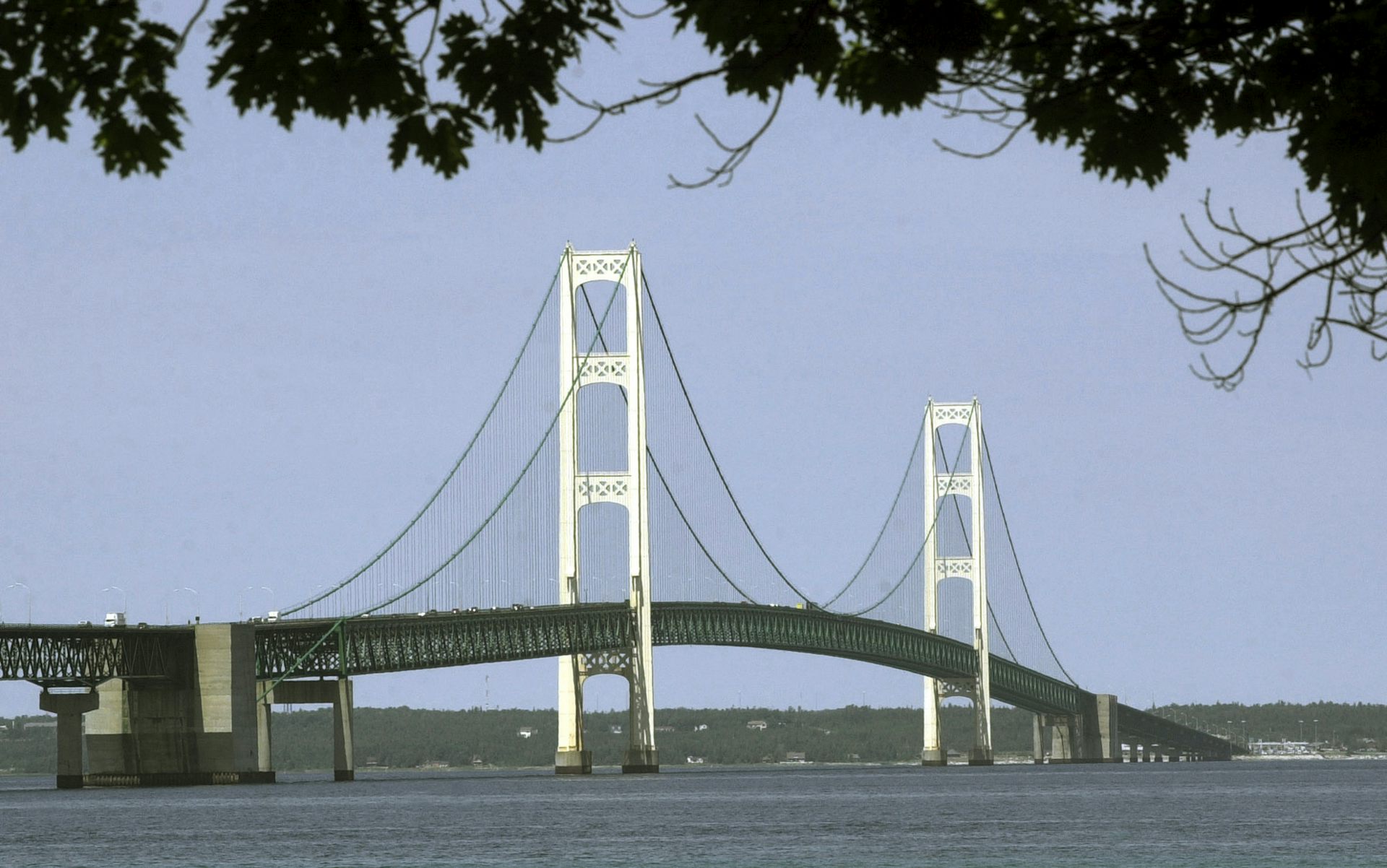
There is no debate that Line 5’s crossing of the Straits of Mackinac – which separate Michigan’s Upper and Lower Peninsulas right where Lakes Michigan and Huron meet – lies within Michigan’s territorial boundaries.
The lawsuits from Nessel and Whitmer are attempting to stop Enbridge from operating the pipeline in this sensitive area of the Great Lakes.
The risks became clearer to the public when a ship’s anchor struck the underwater pipeline in 2018 and another ship damaged one of the pipe’s supports in 2020. In the 2018 incident, some fluid – not crude oil – leaked into the lake water.
But Enbridge is refusing to shut the pipeline down. The company says the dispute belongs in federal court because state laws and regulations generally do not apply to this pipeline, which carries mostly Canadian oil to mostly Canadian refineries, using Michigan and the Great Lakes as a shortcut. Enbridge maintains that a treaty with Canada supersedes state authority.
The ruling from the Supreme Court will likely be narrow and procedural. However, all parties seem to agree that the decision will also have much wider consequences, including being a key determinant and signal of states’ rights to protect their waterways and other natural resources in the face of industry opposition.
Meanwhile, in Wisconsin, the Line 5 oil pipeline passes through the reservation of the Bad River Band of Lake Superior Chippewa, and the pending legal outcome in a separate federal court case is well beyond procedural.
The band revoked Enbridge’s easement in 2013, but Enbridge has refused to remove the pipeline, so – after years of failed negotiations – the Bad River Band sued in 2019.
U.S. District Judge William Conley ruled in 2023 that Enbridge had been trespassing for 10 years and awarded US$3 million in damage payments. Conley gave Enbridge until June 2026 to find an alternative route around the Bad River Band’s land, or shut the pipeline down.
As this date approaches with no clear resolution in sight, the Trump administration joined Enbridge in seeking to reverse that decision and keep Line 5 open. While Conley’s decision is being contested by both Enbridge and the Bad River Band in an appeals court one level below the U.S. Supreme Court, the status of the pipeline during this legal process is very much in question.
Line 5 cannot operate without the Bad River Band reservation section, but the deeper issue is about Indigenous peoples’ rights to control their own lands and future on reservations. If Enbridge wins, many analysts believe that Indigenous rights to self-determination on reservations will be significantly eroded.
Enbridge has a two-pronged strategy to save Line 5 from decommissioning: fight in the courts against the state of Michigan and the Bad River Band, while simultaneously working to reroute the pipeline around these problematic areas.
In the Straits of Mackinac, that means attempting to put Line 5 in a tunnel underneath Lake Michigan. This requires federal permits – which will likely be issued soon – as well as state permits. The permission issued by the Michigan Public Service Commission to build the tunnel is being challenged in the Michigan Supreme Court, while advocates are pressuring Whitmer not to issue another state permit that is also required.
The situation is similar in Wisconsin, where federal permits for rerouting the pipeline outside the reservation – but not beyond the watershed serving the Bad River Band’s land – were issued in October 2025 by the Trump administration. The state permit is caught up in legal and political challenges.
In each case, the immediate issue is about the direct environmental impacts of the projects. But also in each case, the underlying battle is about the long-term effects of projects involving fossil fuels. Environmental advocates want the state and federal agencies to consider the permits in light of the potential for more climatic, health and environmental damage from burning the oil the pipeline carries. Enbridge and its allies want to focus narrowly on local ecological impacts and not on the larger debate about the future of fossil fuels.
As the highest court in the land considers what some might see as a very mundane and localized issue, I believe it’s useful to peel back the layers and see deeper meaning. Jeffrey Insko, an American studies professor at Oakland University and tireless chronicler and analyst of the Line 5 saga, summarizes this depth well:
“If shutting down Line 5 were about nothing more than getting an aging pipeline out of the water, if it weren’t about addressing the climate crisis, about reducing fossil fuel consumption, about a habitable future, about cultivating better relations with the more-than-human world, about respecting Indigenous rights and lifeways, it wouldn’t be a movement worth having. It would just be a technical problem with a technical solution, one that basically accepts the way things are. But shutting down Line 5 is ultimately a step toward changing the way things are.”
The Supreme Court’s ruling may be on technical grounds, but its repercussions could be very wide indeed.
This article is republished from The Conversation, a nonprofit, independent news organization bringing you facts and trustworthy analysis to help you make sense of our complex world. It was written by: Mike Shriberg, University of Michigan
Read more:
A Great Lakes oil pipeline faces 3 controversies with no speedy resolutions
Michigan pipeline standoff could affect water protection and Indigenous rights across the US
Green or not, US energy future depends on Native nations
Mike Shriberg previously worked at the National Wildlife Federation which received external funding from foundations and private donors to work on issues related to the Line 5 oil pipeline. He currently does not receive any funding relating to the Line 5 oil pipeline.







Comments