From a pit in Pawnee to one in Greece: Amy Poehler and Mike Schur reunite for 'Dig'
Published in Entertainment News
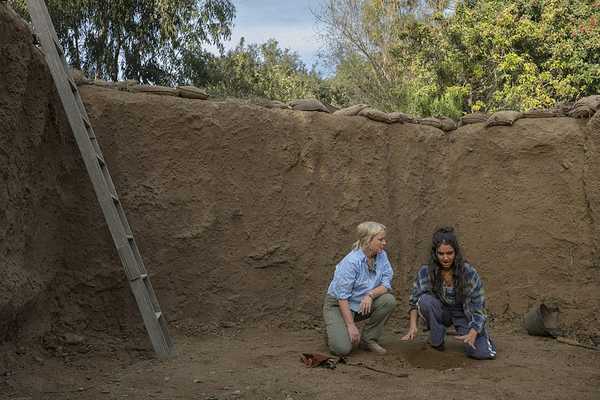
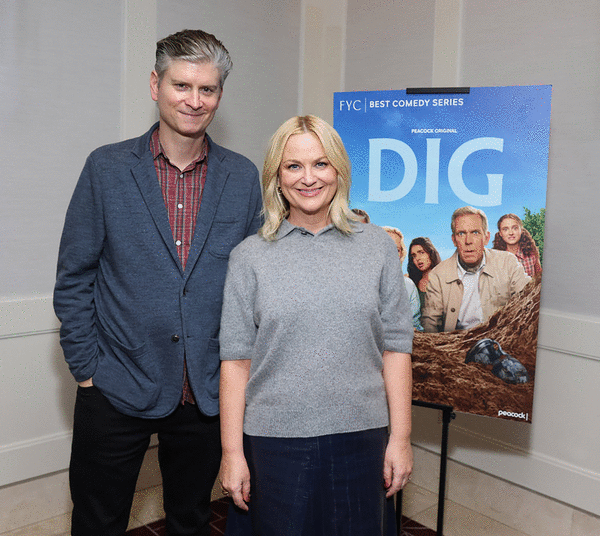
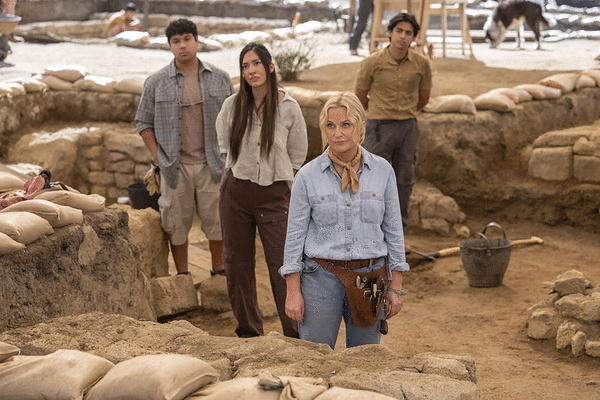

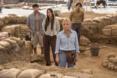
LOS ANGELES — Another massive hole in the ground has brought Amy Poehler and Mike Schur together again.
Seventeen years after Poehler's relentlessly optimistic Leslie Knope first fought to turn a construction pit into a park in the premiere of "Parks and Recreation" — the NBC sitcom helmed by Schur — the duo has teamed up again to create a new comedy, "Dig," where a trench in Greece is the propitious epicenter.
Based on Kate Myers' novel "Excavations," the comedy follows four women archaeologists at an excavation site in southern Greece, each dealing with personal turning points in their lives. There's Dylan (Geraldine Viswanathan), who returns to field work after a five-year absence; Clare (Antonia Thomas), a head preservationist running the site's lab and museum who comes from a background of privilege; and Patty (Fina Strazza), an eager but inexperienced undergraduate assistant in over her head. Then there is Poehler as Elise, a highly competent and driven excavator who is poised to take over the leadership position from her mentor — professor and field veteran Neville (Hugh Laurie) — who performatively dangles his retirement each year, but never follows through. When the researchers unearth a rare, history-changing artifact in a giant hole in the ground, they think it could be their ticket out of their personal ruts; instead, they find themselves in the midst of a mysterious, long-buried secret.
"It's good luck, I think," Poehler says of her and Schur's affinity for pockets of dirt.
"Amy said that when we were pitching the show," Schur adds. "She started the pitch by running through — in great, eloquent detail — all of the themes that she wanted to explore, and all of the character relationships that she thought were really interesting. And then she ended up by saying, 'Also, there's a big hole in the ground. Traditionally, when Mike and I make shows, and there's a big hole in the ground, people tend to like them. So we're just going to go back to that.' "
It's also a fitting metaphor, Schur contends, that Leslie and Elise, while they don't have much overlap beyond their portrayer, find themselves literally at the bottom of a hole.
"They start off in a little bit of a deficit of something," he says. "Leslie was swimming upstream and trying against all odds to make her town better. And Elise has been at this dig for a long time. She's kind of stalled out because the guy above her just has no intention of leaving. She has some personal relationships in her past, that need a little attention. She is starting out in a hole, and so it just works as an image to put her down in the in the dirt and have her feel like I got to climb my way out."
Premiering Monday, Nov. 23, on Peacock with all 10 episodes, "Dig" brings Poehler back to headlining a TV series for the first time since "Parks and Recreation" wrapped — though she's hardly been off the clock. She's kept us plenty entertained in that hiatus as a director, producer and — since 2025 — as the powerhouse podcast host of "Good Hang With Amy Poehler," churning out viral, meme-ready interviews with her famous pals.
When Megan Macmillan, who oversees comedy development at Universal Television, suggested to Poehler that she read "Excavations" as a potential property to develop through her production company Paper Kite, Poehler found herself drawn to the intergenerational relationships of its protagonists. The book shifts between the perspectives of its four women characters, primarily offering millennial and Gen Z-zillennial perspectives. But Poehler locked in on Elise, a woman fiercely devoted to her work who is exasperated by feeling stalled in her career due to institutional gatekeeping while watching the effortless progression of those around her, and because "she's my age and she has this way about her that I recognize; it just felt familiar." It wasn't until late in the development process, Poehler says, that she thought about starring in the show.
"Playing Leslie Knope was one of the proudest things I've ever done," Poehler says. "Being in a show is different than producing. You can be in your own clothes [as a producer] and take a phone call — you can come in and out of the day. When you're inside a scene, you really can't go anywhere. I am not complaining that acting is my job, but it is a long, long day. But this also felt like a different way of making TV that I hadn't acted in."
Schur was just as eager to be a part of Poehler's TV homecoming: "I would have said yes to literally anything she wanted to do," he says. "This is a testament to her — she spent the last decade since 'Parks' ended being a producer and director and she has started thinking about projects from a different angle. If you're gonna do this again, this is the right one."
On a recent late afternoon, Poehler and Schur are seated alongside each other on a sofa, about to finish a full day of press interviews inside a West Hollywood hotel. Unburdened by the worry of being on camera, Poehler kicks her shoes off and it isn't long before the rapport the pair developed since their time working together on "Saturday Night Live" in the early aughts — Poehler as a cast member, and Schur as a writer — reveals itself after a question about how their creative collaboration has evolved since.
"I would say 'Parks and Rec' was me and [co-creator] Greg Daniels doing a show together and asking Amy to be our third partner, essentially," Schur says. "One of my favorite dates of the year was when I would get together with the writers in June and we would work for six or eight weeks and then Amy would be in Nantucket usually, and we'd schedule a call and I would pitch her the entire season — or as much of it as we had — big movies, big ideas, characters, all that sort of stuff..."
"And I would say, 'Mike, I can't hear you, I'm on a yacht and my motor is too loud and I only hear the ocean. You have to speak up,' " Poehler teases as Schur bursts into laughter.
"You'd have to stop and say, 'No, I said poached salmon!" Schur adds, making Poehler launch into a joyful giggle. "It was a collaboration, but I was writing and she was acting. She would join in when she could, or direct sometimes. I would be on set when I could, but really, I was in the writers' room or the edit bay. In the intervening decade, she has become a producer and director — and a force. We basically reversed the flow. She locked into what she thought was great about the project and came to me and asked me to be a part of it."
One thing they knew for sure was they wanted to quickly make it clear to viewers that Leslie Knope didn't suddenly become an archaeologist. Despite the commonality of staring down a hole in the ground, the first words uttered by Poehler as Elise in "Dig" are: "We are so f—. That's a greasy pole jammed right up our butt." It's a far cry from Leslie's cheerfulness and tame approach to expletives (e.g., "pee-pee heads").
"We wanted something that felt very propulsive and kind of weird and confusing in all the right ways," Poehler says.
It sets the mystery at the center of the comedy in motion. That too brings a tonal shift from the mockumentary-style workplace comedy of their past — Schur has recent experience blending comedy with mystery on "The Good Place" and "A Man on the Inside." But it's the women's experiences that drive the story. And Elise's thwarted ambition actually sets her on a course to lead in a much different fashion than if things had gone the way she wanted them to in the beginning.
"You get to a point where you realize, I can either pivot to more, more, more; grab, grab, grab, or I can use my currency to elevate someone else or I can even — more mind-blowing and the hardest thing to do in this capitalist world — 'Could I even start giving s— away?'" Poehler says. "Our instinct is to protect the stuff we have. Elise is not the most generous person. She is a victim of patriarchy like a lot of Gen X women are, which is this idea that I worked my ass off for this and I worked with this guy who wasn't always fun and I'm still here and territorial. I deserve this [promotion]."
As she's come to see it, frustration with younger talent for their inexperience or journey is just projection of one's own past shortcomings. Embracing that truth has made mentorship from women at a variety of stages in life especially vital to her now — a dynamic that looks different from Poehler's early career.
"As a Gen X person, a lot of our mentors were men, and a lot of them were men who made us feel like we were the chosen favorite child, like the oldest daughter. It's cool stuff to think about politically and in the big picture when you're making a comedy," she says.
And while "Dig" is set in Greece, it was primarily shot on NBCUniversal's backlot in Universal City: "We shot in places on the Universal lot that look 100% like they're in Greece. There are scenes where if you didn't see David Niednagel [the show's VFX supervisor] work, you would in the background see a giant Minion on the top of a building; instead what you're seeing is the Aegean Sea in the background." (They spent three weeks in Italy subbing in as Greece, and roughly five days shooting in Athens.)
The series, right away, pokes fun at the trope of young people, often after taking an introductory anthropology or archaeology course, being inspired to become explorers of human history, culture and field discoveries. Poehler notes Laurie majored in archaeology in college, but neither she nor Schur ever got a taste of it as an elective. The closest Poehler got to it, she says, was an art history class at Boston College.
"I loved the detective quality of art history," she says, also highlighting that her alma mater's Jesuit roots brought an inherent archaeological feel to it. "I loved figuring out the mystery. And I love art and artists and their stories behind a work. I didn't know a lot about anthropology. I felt like it was boys talking about apes and how agro apes are and I was like, 'OK, cool. We know that. We get it.' "
But the two got some education eventually. The show enlisted Joseph Rife, a professor at Vanderbilt University, as an archaeology consultant, who was helpful in explaining how digs work, what they're like and how fundraising can be. Women who had been undergraduate-level archaeology students or UGS on a dig also provided perspective of what it's like being out on the field.
"It was fascinating, and also made me very jealous," Schur says.
"I know!" Poehler interjects. "Why didn't we do a dig?"
"We're so stupid," Schur adds. "I stayed in Boston and got a stupid job."
"I worked at an ice cream place and was like, 'I'm going to be near my boyfriend!' " Poehler says with a playful annoyance that sends them into laughter. "I was like, I can't go anywhere, I have a boyfriend!' I needed to watch my boyfriend get in fights at the Burger King parking lot. God forbid I go away to a fantastic dig."
"Yeah, who wants to make friends for life and have an incredible experience," Schur quips.
Better a late fake than a permanent never.
©2026 Los Angeles Times. Visit latimes.com. Distributed by Tribune Content Agency, LLC.









Comments