Review: 'Dragon Mama,' part 2 of Sara Porkalob's epic Filipina American family saga, reels us in for more
Published in Entertainment News

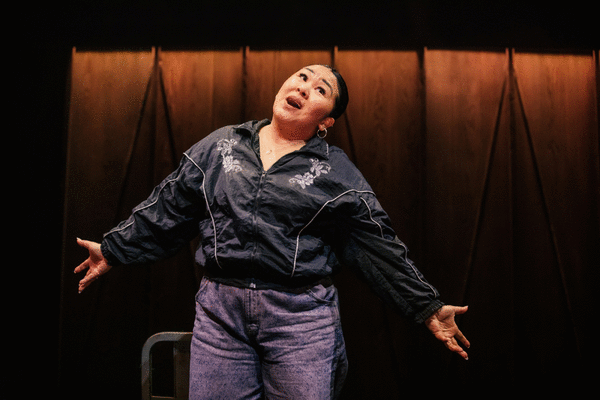




LOS ANGELES — In "Dragon Mama," the second part of her Dragon Cycle, writer-performer Sara Porkalob fleshes out the story of her Filipina American family. The focus here is squarely on her mother, another survivor who inflicts her own share of damage along the way.
"How do you solve a problem like Maria?" Maria herself sings these words from "The Sound of Music" at the start of the play. It's a question that will take a long time for the character to figure out — and with good reason. It's a miracle she made it out of her childhood.
Maria is 8 years old when the play begins, living in Honolulu with her mother, also named Maria, whose harrowing early story was told in "Dragon Lady," the first installment of the trilogy presented at the Geffen Playhouse's Gil Cates Theatre in 2024. That piece, more of a solo musical, was able to command the bigger stage.
"Dragon Mama," which opened earlier this month at the Geffen Playhouse's Audrey Skirball Kenis Theater, affords Porkalob brief opportunities to showcase her captivating singing talent (including one memorable bit of Whitney Houston karaoke). But the piece is a more traditional coming-of-age drama, and it flourishes in the intimacy of the smaller venue.
But one thing is for certain: All of Porkalob's characters lead epic lives. "Dragon Mama" offers snapshots of Maria's daredevil youth in Hawaii, her reckless adolescence in Bremerton, Washington, and the self-destructive spiral that leads her to venture out on her own. A young mother at this points, she leaves her daughter, SaraLee, in the care of her family while she finds work and a stabilizing lesbian relationship in Anchorage.
There's some plot overlap in the first two plays. Teenage Maria, forced to be a second mother to her younger siblings, is shown keeping the household together while her mother goes inexplicably AWOL for weeks. And like anyone who has had to grow up too quickly, she struggles to attain real maturity.
Porkalob doesn't moralize. She re-creates the family story through the perception of a youngster who doesn't have the language for neglect and abuse. Practical emergencies crowd out big picture analysis. How will her siblings eat when all the food has run out? How can they keep a low enough profile so that the authorities won't be summoned when her brother Junior is getting into scrapes at school?
Porkalob has the storyteller's gift of total absorption. If the array of characters can sometimes be challenging to sort out — she is perhaps too faithful to the memoir aspect of the work — the vivid textures of the generational memories bring the work sensually to life.
Maria's brothers, with their perpetual runny noses, are summoned with a sniffly wipe. Her baby sister gurgling helplessly in the background isn't the only one utterly dependent on her maternal care.
Even when mother returns from her unexplained excursion to SeaWorld, Maria still must pick up the slack for a woman unable to keep up with the rent despite working multiple jobs.
Maria doesn't have the luxury of making smart choices. When troublemaker Arlene moves in across the street to live with her father, Maria falls helplessly under her corrupting influence.
She also falls in love, lured into a flirty intimacy that is just a game for Arlene but serious business for Maria. Through this one-sided romance, she discovers the truth of her attraction, even as she ends up sleeping with men to stay on Arlene's good side.
Maria's mother warned her about Arlene, but she refuses to wallow in regret. She desperately wants the baby she's just had at 19, the same age her mother had her. And with the introduction of precious SaraLee, the curtain comes down on the first act.
The second act focuses on Maria's attempt to bring some order to her life. To do that, she has to leave home, separating herself from her upbringing and entrusting SaraLee to her family's care.
In Anchorage, she finds work on a fishing boat. It's hard labor, but nothing in her life has been easy. Her stamina impresses her manager, Greg, a gruff gay man who tells her about the gay club in town, where she meets Tina, the woman who teaches her acceptance through unconditional love.
The turnaround isn't easy, but Porkalob makes you care about the outcome. The journey is long — a touch too long for a solo work — but the emotional trajectory is satisfying and well earned.
Porkalob wholly immerses herself in the world she's conjuring. When she eventually breaks the fourth wall to momentarily make contact with the audience, the timing is unexpected but not at all jarring. The spell has been expertly cast.
Director Andrew Russell trusts Porkalob's ability to transfix an audience. Which she does in a performance that has the tight focus of a good short story and the theatrical immediacy of what might be called a narrative cabaret.
To be frank, I wasn't sure I was up for a trilogy on Porkalob's family history. But after "Dragon Mama," I can hardly wait for "Dragon Baby," the third and final segment, in which presumably SaraLee will take her place in the spotlight in this series of music-inflected dramas about matriarchs discovering their own power in the face of obstacles that would crush most men.
———
'DRAGON MAMA’
Where: Audrey Skirball Kenis Theater at Geffen Playhouse, 10886 Le Conte Ave., L.A.
When: 7:30 p.m. Wednesdays-Thursdays, 8 p.m. Fridays, 3 and 8 p.m. Saturdays, 2 p.m. Sundays. Ends April 12
Tickets:$45-$139 (subject to change)
Contact: (310) 208-2028 or geffenplayhouse.org
Running time: 2 hours, including one intermission
———
©2026 Los Angeles Times. Visit latimes.com. Distributed by Tribune Content Agency, LLC.











Comments