Gustavo Arellano: What 'One Battle After Another' doesn't get about resistance in Trump's America
Published in Entertainment News
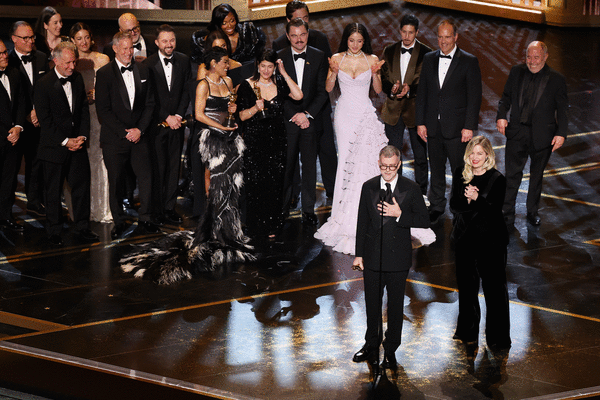
LOS ANGELES — The cheers were loud and long at the 98th Academy Awards after "One Battle After Another" won best picture.
It was a great night for the Paul Thomas Anderson-directed film, which nabbed six Oscars for its depiction of California revolutionaries taking on a white supremacist federal government hell-bent on deporting undocumented immigrants and crushing dissent.
Wait, isn't that what CNN airs every night?
The 2.5-hour-plus film didn't do well at the U.S. box office, not even earning back its estimated $130 million budget. But it sparked dozens of thought pieces that kept it in the national conversation long after it left the theaters. Conservatives decried the action-comedy for supposedly glamorizing armed resistance; progressives hailed its ripped-from-the-headlines élan.
It's supposed to be a movie that Means Something. But Anderson, who won his first best director Oscar for "One Battle," has maintained in interviews that people should regard it less as a reflection of our times and more as a commentary on the eternal struggle of American democracy.
"There are articles in the L.A. Times from 100 years ago showing this kind of stuff," he told my colleague Glenn Whipp in September. "The selfish part is for us to think, 'Boy, look at what's happening. I've never seen this before.'"
That's what makes "One Battle" far less weighty than critics and supporters alike have characterized it as being. In his attempt to make a comedy of errors about an era of terror, Anderson missed the forest for the trees about resistance in Trump's America. His critiques and conclusions are as edgy as a soap bubble.
There's a lot to like about "One Battle" — the tense score, the taut cinematography, the superb casting highlighted by best supporting actor winner Sean Penn, whose portrayal of the film's villain bears such an uncanny resemblance to former Border Patrol commander at large Gregory Bovino that the disgraced migra man should ask for a consulting producer credit.
In an industry that still often sees Latinos as the help, spicy señoritas, cartel members or extraterrestrials, I especially appreciated the Latino nuances in "One Battle," from lingo like carnalito (little buddy) and chota (police) to Leonardo DiCaprio whistling at a group of Mexicans in a pivotal scene, just like I do when I'm trying to get a cousin's attention at a family picnic.
I wish there was more of that real-life feel. Ultimately, Latinos are reduced to side characters, save for Benicio del Toro's sardonic karate sensei. Anderson's big mistake is arguing, based on the political struggle at the heart of "One Battle," that uprisings from the left never truly succeed.
As the title implies, "One Battle" imagines an America where little improves, no matter how much people fight tyranny. It focuses on a group called the French 75, who kick things off by liberating an immigration detention camp at the U.S.-Mexico border. Then, they commit a string of bombings and robberies in their Los Angeles home base. Fast forward 16 years, and members are in hiding in a sanctuary city in the forests of Northern California while life goes on for everyone else in the form of proms and getting stoned.
"One Battle" is based on the 1990 Thomas Pynchon novel "Vineland," with Anderson swapping President Ronald Reagan's war on drugs for President Donald Trump's deportation deluge while keeping the author's send-up of burnt-out wokosos.
The director scores easy laughs off of modern-day progressive shibboleths such as gender-fluid pronouns, trigger warnings and Native American land acknowledgments. He depicts conservatives, on the other hand, as one-note evil and whiter than a blizzard — a typical Hollywood take that doesn't allow for people of color ever siding with MAGA, even as Latinos voted for Trump in record numbers in 2024, the secretary of State is Cuban American Marco Rubio and the FBI director is Indian American Kash Patel.
On the left, Anderson trots out stock characters — the oversexed Black woman revolutionary, Leo's cuckolded white stoner, doctrinaire newcomers — from a Bob Hope skit about hippies. He argues that the right succeeds because it's disciplined, while the left devolves into chaos by relying on imperfect leaders. "Every revolution begins fighting demons, but motherf— end up fighting themselves," says the French 75's firebrand leader, Perfidia Beverly Hills, whose every curve Anderson's camera creepily obsesses over.
Her comment is too often true. But if Trump's second term has shown us anything, it's that everyone is a revolutionary now — and no one looks to figureheads to lead the way.
Trump supporters are calling out his excesses, while suburban moms join ICE Watch groups. Activism isn't just about wielding guns and throwing rocks but organizing online, in the classrooms and among households. Latinos aren't just running underground railroads for undocumented immigrants, as shown in the movie — they're voting out Republicans and calling out Trump in the halls of Congress.
What's going on right now in this country disproves what "One Battle" posits: that the only way to push back against an authoritarian regime is to mimic far-left militants of the 1970s like the Weather Underground and the Symbionese Liberation Army.
"Revolutionary violence is the only way. Don't tell me to vote. Don't tell me we shall overcome," Perfidia also says. The daughter she had with DiCaprio's character signs up for that ideology at the end of the movie, as Tom Petty's "American Girl" and Gil Scott-Heron's "The Revolution Will Not Be Televised" play over the credits. Trump wants Americans to believe that his opponents are of this ilk, with his lackeys casting activists as domestic terrorists for merely showing up to protests.
But at the dozens of protests, meetings and get-togethers I've attended since the start of Trump's reign, organizers have forcefully decried actual violence, because it ultimately doesn't work. The other side will always have bigger weapons and more resources.
Instead, a persistent but peaceful — and loud — approach has been so effective at opposing Trump's evils that he has told Republican Party leaders to downplay the xenophobic rhetoric until at least after the midterms.
To reduce people who confront fascism to bloodthirsty cartoons begs the question: Is Anderson truly clueless about today, or is he just trying to satirize it? Either he needs to talk to folks who are out there every day protecting immigrants, or he's far more conservative than I thought — and then again, most Hollywood types tend to be.
The San Fernando Valley native is a brilliant director who has made sprawling, messy epics about imperfect people synonymous with his name, like John Ford with Westerns or A24 with art house flicks. He's especially great at documenting his native land, from the porn epic "Boogie Nights" to "Licorice Pizza," a cinematic love letter to the Valley.
"One Battle" doesn't belong in the same conversation as those masterpieces. The film it beat out for best picture, the Ryan Coogler-directed "Sinners," is far more damning of our racist society, more critical of the human flaws that get in the way of progress — and far more enjoyable and original. Compared to it, "One Battle" comes off as a modern-day "Crash," the 2006 film widely considered one of the worst ever best picture winners for its tone-deaf take on race relations in Los Angeles.
Anderson's film is nowhere near as bad, but it's as deluded about reality and self-important about its perspective as "Crash" was. The revolution isn't just televised — it's here.
———
(Gustavo Arellano is a columnist for the Los Angeles Times.)
———
©2026 Los Angeles Times. Visit latimes.com. Distributed by Tribune Content Agency, LLC.







Comments