Glenn Whipp: The case for 'Sinners' to win best picture
Published in Entertainment News
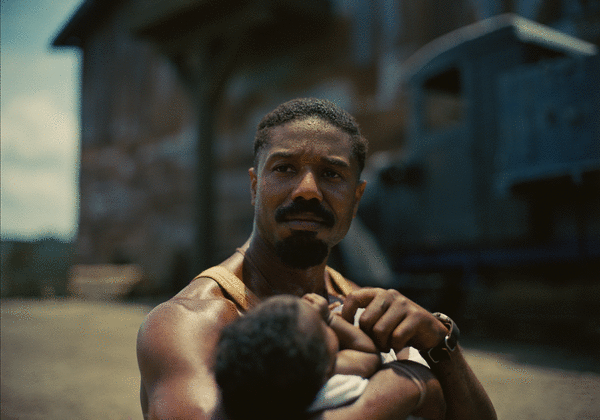
LOS ANGELES — To get to the “Sinners” exhibit on the Warner Bros. Studio Tour, you have to navigate past the backlot’s iconic water tower, cross through the New York Street and then skirt city hall and the fountain from the opening credits of “Friends.” Eventually, you wind up at Stage 48, home of the Central Perk Cafe, a gift shop selling all manner of “Friends” bric-a-brac and offering a smattering of knockoff furniture from Monica’s palatial apartment to enjoy.
Comparatively, the newly installed “Sinners” showcase, featuring costumes and a couple of props, is, to use a real estate agent’s euphemism, “cozy,” certainly smaller than Rachel’s closet. On the night of its opening, “Sinners” production designer Hannah Beachler and cinematographer Autumn Durald Arkapaw are inside sitting on a sofa — not the sofa, but close enough. A few hours ago, they were celebrating with their fellow Oscar nominees at the academy’s annual luncheon.
“She’s a regular,” Arkapaw says, her arm around Beachler, who won an Oscar in 2019 for her work on “Black Panther.”
The two women and the rest of the “Sinners” team have been hobnobbing with Oscar and guild voters for months now and talking about their work on the film, which was released in April, for even longer. At the time of this “Sinners” event on the Warner Bros. lot, which included yet another screening of the movie for guild members, the Oscars were still more than a month away.
“I can believe it,” Beachler says. Adds Arkapaw: “Me too. I’m stressing about the stuff they’re having us doing. But I think Teyana Taylor said it best: ‘Don’t be complaining about answered prayers.’”
“Sinners” had a lot of prayers answered when Oscar nominations were announced last month — 16, to be precise.
Now the question is whether that record-breaking haul might be enough to catapult Ryan Coogler’s genre-defying American horror story to a best picture Oscar victory.
When it opened in September, Paul Thomas Anderson’s “One Battle After Another” immediately took the pole position in the best picture race, and it remains the front-runner. But all those “Sinners” Oscar nominations do complicate things. Put it this way: When you submit your movie in 16 different categories and hit in each and every one of them, you have a film boasting broad support across a dozen voting branches. That’s significant.
And if you’re a voter and you weren’t necessarily a fan of the film — or had put off watching it because the horror genre gives you pause — the nominations total does something else. It prompts you to take stock. What is everyone else seeing? Maybe you watch “Sinners” again. Maybe you finally clear the deck and press play for the first time. Perhaps you see that it’s just as much a movie of the moment as “One Battle,” what with the unapologetic, overt racism coming from the White House.
So if you’re on the fence and you do reconsider “Sinners,” maybe it’s not a complete reversal. But it might be enough for you to put the movie higher on your ranked ballot when you vote for best picture.
As you may know, the Academy of Motion Picture Arts and Sciences uses a preferential ballot for the best picture category and only the best picture category. When the academy’s 10,136 voting members mark their ballots this year, they cast a single vote in 23 of the 24 Oscar categories. The nominee with the most votes wins.
For best picture, though, members are instructed to rank the 10 nominated movies. The system, in place since the academy expanded the best picture field from five to 10 nominees in 2009, is designed to reflect the wishes of the greatest number of voters. This means that the winner is sometimes not the movie that is most passionately loved but the picture that is most generally liked — or, if you’re a glass-half-empty kind of person, the picture that is least disliked.
The process works like this: Once voting ends, PricewaterhouseCoopers accountants sort the best picture ballots and place them in stacks based on members’ No. 1 votes. They then eliminate the movie with the fewest first-place votes, giving those votes to each ballot’s second-ranked film. The process continues — smallest stacks eliminated, votes redistributed to the next choice down — until one movie has more than 50% of the vote.
The math to “Sinners” winning best picture necessitates it being the No. 1, 2 or 3 choice on more ballots than “One Battle After Another.” And that plays into what a couple of awards consultants told me about the psychological effect the movie’s record-breaking 16 nominations might have on voters when they rank the nominated movies.
“Maybe it’s not your favorite, but you still rank it high because of that overwhelming level of respect,” says one rival campaigner. “Who knows if the math adds up. But at this point in the season, you’re looking for any advantage you can find.”
A test of that math will come Saturday at the Producers Guild Awards, a ceremony that uses the same preferential ballot system to determine its best picture. The PGA winner more often than not repeats at the Oscars, though in the last decade there have been two notable exceptions — “Moonlight” besting PGA winner “La La Land” in 2017 and, three years later, “Parasite” taking the Oscar over “1917.”
Should “Sinners” prevail at the PGA and then the next night go on to win the cast prize at the Actor Awards (formerly known as the Screen Actors Guild Awards), then the race will be dramatically recast. Both ceremonies take place in the middle of the window of final voting for the Oscars, which runs Feb. 26 through March 5.
“It’s a miracle that we were all nominated,” Beachler says. “That’s rare for everyone to get that recognition.”
For a film with a hero named Preacher Boy, one last miracle certainly isn’t out of the question. And if the last few months have taught us anything, it’s that you underestimate “Sinners” at your peril.
---------
©2026 Los Angeles Times. Visit at latimes.com. Distributed by Tribune Content Agency, LLC.










Comments