Movie review: 'EPiC: Elvis Presley in Concert' reanimates King of Rock and Roll
Published in Entertainment News
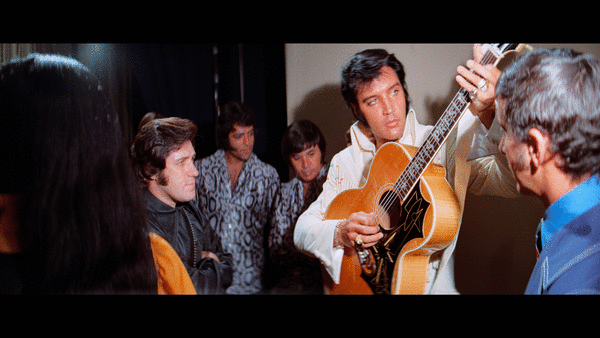
For a long time, the image of “Elvis in Vegas” has been a joke: the white jumpsuits, the sunglasses, the sideburns. It’s meant more “Halloween costume” than “rock god” recently, but Baz Luhrmann is here to set the record straight.
While working on his sprawling 2022 biopic “Elvis,” the filmmaker went searching for lost footage of the Elvis Presley concert films “Elvis: That’s the Way It Is” and “Elvis on Tour,” and discovered a treasure trove in the Warner Bros. vault — 59 hours of unseen film negative that he has now lovingly restored and edited into one of the best concert films of all time, “EPiC” (for “Elvis Presley in Concert”). If you’ve ever wished you could have seen Elvis in Vegas, now’s your chance, and don’t miss it on IMAX.
If you know Luhrmann, you know this is going to be a visual spectacle, almost a hallucinatory physical experience. The sheer vibrancy of the restored footage is stunning. Towards the end of the film, there’s a close-up of Elvis, deeply tanned, white jumpsuit crisp, jet black hair falling over his brow, piercing blue eyes and lashes wet with sweat, set against a blazing fuchsia backdrop. It’s simply one of the most powerfully erotic images ever put to screen. Luhrmann knows what he’s doing.
“EPiC” isn’t so much a concert film as is it as reanimation of the icon via filmmaking. He is the Dr. Frankenstein, bringing Elvis back to life on screen, making palpable the charisma and energy that drove audiences at the Las Vegas International Hotel into a sexual frenzy, as seen in montage of Elvis kissing all the overwhelmed women in the crowd.
But “EPiC” isn’t just about reminding us how sexy Elvis was — though that’s certainly a part of it. His hips managed to disrupt the entire social order of the 1950s for good reason, and they remain in fine, fluid form here. But the film is foremost a celebration of his talent, musical obsession, and skill as a live performer. The Vegas residency may have been a chance for his manager Colonel Tom Parker to milk as much money as he could from his client, but it’s also clear that Elvis finds so much joy in performing, and that the concerts were a return to his roots after getting lost in so many Hollywood movies of questionable quality.
Luhrmann and editor/executive producer Jonathan Redmond skim through the necessary context (teen idol, military service, Hollywood) in rapid-fire montages before settling into the musical process, intercutting rehearsal and performance footage with snippets of songs from his band’s 150 song-deep repertoire. If you’ve ever wanted to see Elvis sing Del Shannon’s “Runaway,” the Beatles’ “Yesterday,” or Simon & Garfunkel’s “Bridge Over Troubled Water,” now’s your chance. He also performs high-octane gospel songs like “How Great Thou Art,” interpolates the Beatles’ “Get Back” into his own “Little Sister” and connects the dots from his country, gospel, and rhythm and blues roots to the rock and roll of the 1960s and ‘70s throughout his set.
In rehearsals, Elvis is relaxed, goofy, but focused and diligent. On stage he is a man possessed, channeling something larger than himself, conducting his band and the audience with the smallest of gestures and looks. Luhrmann and Redmond craft sequences of rehearsal, performance, backstage footage and press conference interviews with Elvis that never lose the fidelity of the songs themselves.
Luhrmann acknowledges aspects of the star’s personal life without abandoning the framework of the concert film. A sequence about the Colonel is set to “Devil in Disguise” and juxtaposes images of merchandise with audio of Elvis speaking about the Colonel, clearly oblivious to his manager’s machinations. Another sequence features sweet home videos of Priscilla and Lisa Marie set to Elvis singing “You Were Always On My Mind.”
Luhrmann doesn’t need to tell Elvis’ life story — he’s already done that. But it’s clear that he’s not done examining what Elvis meant, and still means, for culture, as a symbol, an earthquake, an influence. At the end of “EPiC,” Bono reads his 1995 poem “American David,” describing the way Elvis shifted the center of gravity, made it “slippery.” Double entendre aside, that’s exactly what Elvis did, combining musical traditions across race, class and geographical lines, using his own telegenic charisma to bring that new creation to worldwide audiences, and shifting the planet off its axis in the process. Through his concerts, Luhrmann brings us all back to that truth as well, and in “EPiC,” puts us right on stage with the King of Rock and Roll. It’s an exhilarating cinematic experience, whether you’re an Elvis fan or not — but Luhrmann makes sure you are by the end.
———
'EPIC: ELVIS PRESLEY IN CONCERT'
3.5 stars (out of 4)
MPA rating: PG-13 (for smoking and some language)
Running time: 1:30
How to watch: On IMAX screens Feb. 20, in theaters nationwide Feb. 27
———
©2026 Tribune Content Agency, LLC











Comments