Plotters in Haiti president's assassination were cast as 'avenging angels,' witness says
Published in News & Features
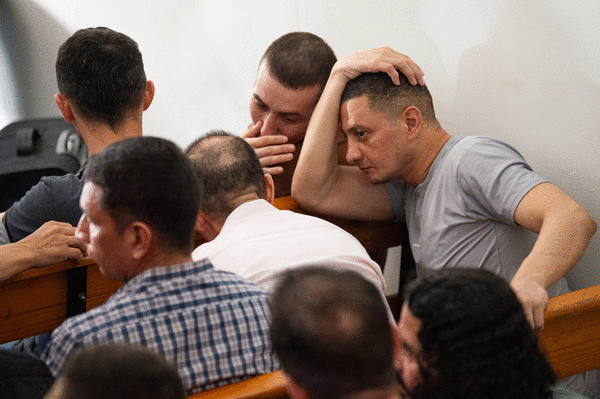
MIAMI — The FBI informant at the center of the assassination of Haitian President Jovenel Moïse nearly five years ago saw himself as an angel — and assigned the plot’s participants angelic names.
But Arcángel Pretel Ortiz, who helped managed Counter Terrorist Unit Security, a firm based in Doral, Florida, that hired a squad of Colombians accused of carrying out the presidential assassination on July 7, 2021, did not see his team as ordinary angels, a retired Colombian Army captain testified Thursday in federal court in Miami.
They were avengers, he said. “Not just angels with arms and wings, but rather avenging angels,” Colombian former soldier Germán Alejandro Rivera García told the jury about Pretel, whose nickname was “Gabriel,” after the messenger archangel, while Rivera went by “Mike” or “Mikael.”
Rivera’s testimony came as defense attorney Andrew Briggs displayed a group chat message from May 10, 2021, in which an image of an angel with outstretched wings and a sword and armor was shared in a discussion about Haiti. It was accompanied by the phrase: “Not All Angels Play the Harp and Sing. Some Are Called to Battle.”
In Christian theology, archangels are the highest-ranking angels, and they are considered messengers and warriors of God. Gabriel is a messenger, Michael a protector.
Text messages presented by prosecutors during the ongoing trial, now in its sixth week, show repeated references to Pretel, a Colombian national and permanent U.S. resident, as “Gabriel,” and to co-defendant and CTU owner, Antonio “Tony” Intriago, as “Ariel.” James Solages, another co-defendant, was called “Yakov” or Jacob. He also assumed the moniker “Boukman,” an ode to the enslaved Vodou priest who launched the Haitian Revolution and became a symbol of resistance and liberation.
Other angel code names assigned by Pretel, who sometimes invoked God in discussions, included Uriel and Rafael. U.S. officials have said that Pretel, despite being an FBI informant, was not working for the U.S. government when he got involved in the plot to oust Moïse.
Rivera testifed Friday that the plan to assassinate Moïse emerged about two weeks before the killing. Joseph Felix Badio, a fired Haitian government official, had appeared on the scene after a failed June 19, 2021, operation to grab Moïse after he returned from a trip to Turkey. After a meeting at the house of a former senator, Rivera said he was informed by Pretel to heed the instructions of Badio, code named “the cousin,” the new CTU representative in Haiti.
At that point the team switched its support for the person who was going to replace Moïse as president. Originally that was a Haiti-born doctor and pastor who lived in South Florida, Christian Emmanuel Sanon, but now the team supported a justice of Haiti’s high court, Windelle Coq Thélot, nicknamed “the Diamond.”
Rivera, 47, accused Pretel of “brainwashing” him and other Colombians recruited for the mission, presenting the job as a security gig that required “professional quality people” like him.
He said he was promised a monthly salary of $4,000 to $4,500 to guard infrastructure projects in Haiti — work he was told would “last several years.”
The Colombians, Rivera said, were made to believe “we were warriors, avengers, and we were going to help change the government of Haiti and improve the living conditions of its population.”
Instead, he is now serving a life sentence after pleading guilty to conspiring to kidnap and kill Moïse.
‘The party has not begun’
Rivera is the government’s fourth cooperating witness, and the second Colombian commando to take the stand in the federal trial of Pretel and his three other co-defendants, who are accused of conspiring to kidnap and kill Moïse.
Along with Duberney Capador Giraldo, a retired Colombian army officer, Rivera was in charge of the squad after recruiting some of its members and landing in Haiti on May 10, 2021. He testified that once he arrived in Haiti he kept Pretel abreast of everything that was happening including tensions in the squad, concerns about some of their collaborators and the failed attempts “day after day” to attack the presidential palace and oust Moïse.
“I’m reporting that the party has not begun,” he said about one of his text messages to Pretel who was in Miami and never traveled to Haiti. “The word party is a word used by special forces when you’re ready to engage in combat.”
Five men have pleaded guilty in the Miami federal case and received life sentences, while a sixth pleaded guilty to a lesser charge of shipping ballistic vests to Haiti and received nine years. Like those who have testified before him, Rivera hopes to get a reduction in his sentence by testifying against his former comrades. It is also the right thing to do, he said moments after taking the witness stand in U.S. District Judge Jacqueline Bacerra’s courtroom.
“I have a guilty conscience and this is a way to ease my guilty conscience and I want to show my daughter no matter the mistake, you must do the right thing,” he said.
Unlike earlier witnesses — a former Haitian senator, Joseph Joel John, and a businessman, Rodolphe “Dodof” Jaar — Rivera said he communicated directly with Pretel and Intriago. He also was in close contact with Solages. All three are on trial, along with a Broward County mortgage broker, Walter Veintemilla, who prosecutors say financed the plot.
Rivera also had an amicable relationship with Sanon, who promoted himself as Moïse’s successor with CTU’s backing. Sanon, who has also been indicted on the conspiracy charge, will be tried separately due to health issues.
The nicknames the group took on were part of the coded language it used throughout their discussions, according to testimony and text messages the government has presented. Moïse was “the rat” or “the thief” while the presidential palace was “the volcano.”
Pretel, described as sometimes being dressed in military camouflage, wanted military-type discipline within the group, Rivera testified. Therefore, Pretel assigned them ranks even though none were active military personnel.
Pretel “informed me that I was too old to be a captain, and he gave me the rank of colonel,” said Rivera, often referred to as Capt. or Col. Mike.
In fact, he actualy was assigned the rank of lieutenant colonel, because Pretel was a colonel and therefore his superior. Intriago was also a colonel, Rivera said. Other witnesses have referred to Solages as “major” even though he has never served in the U.S. military despite telling the team he had.
In the chain of command, Rivera said he and Capador were at the top. However once the group arrived in Haiti, they found themselves outranked by Solages, Rivera testified, detailing how he was shut out of meetings after mid-June when several plans to overthrow the president went nowhere.
The group, he said, struggled to acquire weapons and ammunition and went unpaid.
Silence and shock
Rivera said Pretel first approached him in late December 2020 or early January 2021, offering a job claiming he had the approval of the U.S. Justice Department. Later, when Rivera was introduced to Sanon, he was told Sanon had the support of the United States. He was also told that Sanon had “millions and millions of supporters in Haiti who were just simply awaiting him to arrive to the country to make him the president.”
Rivera said he was also told by Pretel over a period of five months that “Mr. Jovenel Moïse was a thief, a corrupt person, a money launderer, a drug trafficker” who was not the legitimate president of Haiti and who wanted to hold onto power forever even though “he had shut down the Supreme Court Justice of Haiti and the Senate, and was becoming a dictator.”
Rivera testified that there were “multiple plans” to oust Moïse, including staging a mass demonstration of churchgoers to break “into the National Palace” and overthrow the president and install Sanon as president.
Rivera testified that he and Capador often engaged in informal amicable discussions with Sanon. “In one of those meetings, Mr. Sanon said that Mr. Jovenel Moïse would be assassinated,” Rivera testified.
Asked if he was surprised, Rivera said he was — particularly when Sanon cited a biblical passage suggesting that it was better for one man to die than for a whole population to suffer.
Asked by Briggs how he and Capador took it, Rivera said: “In silence,and (he was) as surprised as I was.”
The statement about the plot becoming an assassination came during a coded exchange on May 29, in which Rivera said he told Pretel that Sanon had decided to “give the rat the tickets” — “the rat” referring to Moïse and “tickets” to his death.
The same discussions included a reference to the late Venezuelan leader Hugo Chavez in which Pretel pointed out that before becoming president, Chavez was arrested, and that after that he had received amnesty, won the presidential election and went on to become a dictator.
The defense argues that Moïse was already dead by the time the Colombians arrived at his residence in the middle of the night on July 7, 2021. Rivera said he took the job because he was having a hard time trying to support his wife and child.
_____
©2026 Miami Herald. Visit miamiherald.com. Distributed by Tribune Content Agency, LLC.




Comments