Aldermen bristle over Chicago Mayor Brandon Johnson move on pension costs for aides
Published in News & Features
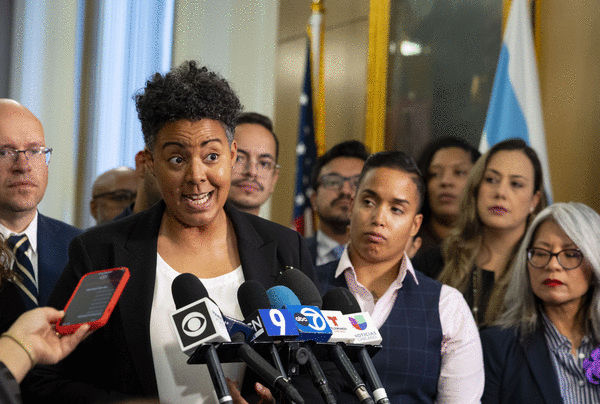
CHICAGO — City Council progressives are among those expressing fresh gripes over Mayor Brandon Johnson’s move to make them cover pension costs for their part-time aides, the latest City Hall rift as fiscal woes and political divisions from the fight over this year’s budget continue to fester.
North Side Ald. Maria Hadden on Wednesday wrote an email to her colleagues contending the mayor’s office wants contributions to certain aldermanic staffers’ pensions to come out of their ward expense accounts, according to a copy of the correspondence obtained by the Tribune. She added that she’s met with the mayor and his budget director Annette Guzman “to express my concerns.”
“I believe that this is a cost shifting decision that they do not have the authority to make without Council approval,” Hadden, 49th, wrote. “I am also prepared to take legislative action to prevent an action that would have a negative impact on constituent services for the majority of Council. … I hope to have your support in objecting to this action.”
Hadden’s alarm stemmed from an aldermanic briefing from the Office of Budget Management and other city departments at the end of March that noted that for part-time City Council aides’ who work at least 700 hours in a calendar year, “employer contribution costs will be encumbered in Ward Expense Accounts,” according to the slide deck. About 28 ward offices and one City Council committee contain at least one employee who is impacted, per her analysis of budget data.
Johnson’s spokesperson retorted Wednesday that aldermen were crying foul over a practice that’s been required for over two years.
“This is not a new policy and has been in place since the 2024 budget took effect,” Griffin Krueger wrote in a statement. “This has been brought to their attention during every budget cycle since 2024. The administration implemented these changes in an effort to increase fiscal transparency and responsibility in accordance with state pension law.”
Krueger said starting in 2024, aldermanic offices saw their staff budget go up from three to four full time employees, and all payroll costs were moved from ward expense accounts to their aldermanic personnel allowances.
Aldermen were each given a $122,000 allowance for those accounts in this year’s budget. Often, that money is spent at ward offices on rent, utilities, office supplies, printing and other bills. Sometimes, they use it to pay contractors.
In addition to their own pay and that $122,000, each alderman separately has a roughly $327,000 wage allowance for up to four full-time salaried staff to work in ward offices or with them at City Hall.
Krueger said council members were told starting in 2024 that part-time staff should work under 700 hours in order to stay below the threshold of being entitled to pension contributions, per state law.
“If they elect to have a part-time staffer work more than the prescribed hours per the pension code, they are required to make allowance for that within their appropriated expense budget,” Krueger said.
Reached for comment on Wednesday, Hadden, co-chair of the Progressive Caucus, said “I’m not convinced with some of the explanations they’ve given us.” Her ward office employs two part-time staffers who will be impacted, incurring a $30,000 withdrawal from her aldermanic expense account, her notice to her colleagues said.
“This is about people’s jobs. These are employees of the city, and to make decisions like this without including the people impacted, it’s just a recipe for bad policy,” Hadden told the Tribune. “This feels like maybe even the administration acting outside of its authority on a budgetary matter that, honestly, is the purview of Council.”
North Side Ald. Andre Vasquez, the other co-chair of the Progressive Caucus, said he was skeptical that the majority of the legislative body missed the cue to pay this pension cost before.
“Any ward office would be firmly aware of any expenses that were north of $15,000, because we don’t have that much expense to start off with,” Vasquez, 40th, said. “We’re not confused. We understand what it is, and we know that we have people and jobs on the line.”
Ward expense accounts have been a touchy area for mayoral administrations to encroach on in times of austerity. The budget line gives council members wide discretion to cover official duties, but in the past has also raised questions about political patronage and nepotism on the public dime.
As it pertains to these dozens of part-time aldermanic aides, however, it was not immediately clear which fund has in fact covered their statutorily required pension costs since 2024. Hadden and other aldermen believed the cost came from the city’s Finance General fund, a claim that Krueger denied.
The “finance general” category is a catch-all fund that includes the cost of technology, future labor contracts and health care benefits. Freeing up those funds traditionally allows the budget team more flexibility during fiscal crunches.
A 2024 email exchange obtained by the Tribune does show Johnson budget officials flagging to his former intergovernmental affairs chief the 700-hour cutoff for employees to be entitled to the pension contribution. An attached slide deck says, “The City would need to switch from contributing to Social Security to the pension” but does not clarify which entity within the city is responsible.
The presentation last month says aldermanic expense accounts specifically will incur the “encumbrances.” The slide goes on to calculate that 1,000 hours worth of payments for an aide working more than 700 hours a year totals about $15,690 each.
According to budget data, most part-time aides work about 20 hours a week and earn anywhere from $16.60 to $50 an hour. Most aldermen have one to three hourly aides that work at least 700 hours.
Another council member expressed frustrations over what he described as mayoral overreach.
“The executive branch is stepping into the legislative branch’s territory and trying to dictate to us, and that’s not acceptable,” Ald. David Moore, 17th, said on Wednesday. “They can’t blame us for their failure to govern properly.”
Moore voted for the counterproposal to Johnson’s 2026 budget in December, but he has backed the mayor in tough votes before and said he tries to be more “even-keeled” than some of his more antagonistic colleagues. No more if he will have to incur a sudden, sizable ward account expense for two of his part-time aides, he said.
“If this is a move that an administration is pulling without our input … it’s gonna be hard for me to be very supportive of this administration going forward,” Moore said.
The internal notice came after City Council members already saw a 3% cut to their spending across ward offices and committees this year and last year, both following challenging budget cycles that frayed relationships between aldermen and the mayor’s office. But the latest spat over these pension costs could open new political issues for Johnson, especially since it affects scores of aldermen who sided with him against the final counterproposal to his 2026 budget plan — Hadden and Vasquez included.
The mayor last December went on to lose a historic budget vote, in what one ally declared was a return of the 1980s Council Wars — a reference to the struggles of former Mayor Harold Washington. Johnson, for his part, blamed the opposition for stymieing his failed head tax proposal and warned the alternate budget passed over his objections could lead to midyear layoffs. But he did not veto it.
Since then, the mayor has continued to publicly doubt his council foes’ revenue projections.
Looming ahead for both Johnson and his legislative counterparts, however, is the fourth and final budget cycle of this term. That is a fight not expected to be any easier fiscally, or politically, than the last. Under the “baseline” outlook from the city’s 2026 budget forecast released late last summer, the City was projected to face budget shortfalls of $1.16 billion in 2027 and $1.23 billion in 2028.
Those forecasts, however, are released before each year’s budget, meaning they don’t include new revenues or cuts, nor does it reflect the city’s recent downgrade.
Johnson and all 50 aldermen are up for reelection less than a year from now, likely making the prospect of hiking property taxes and other politically unpopular moves to balance the 2027 budget nonstarters.
---------
—Tribune reporter A.D. Quig contributed.
____
©2026 Chicago Tribune. Visit at chicagotribune.com. Distributed by Tribune Content Agency, LLC.






Comments