Iran is the first war of the social-media age. It's a black box
Published in News & Features
It’s been half a century since the Vietnam War, when journalists had almost unrestricted access to the battlefield.
In the years since the fall of Saigon ended that first conflict of the television age, restrictions on press freedom have grown.
Now, with the U.S.-Israeli war on Iran — the first major military engagement with American involvement of the social-media era — the world is facing an information black box.
Internet blackouts have been imposed in Iran. In Gulf states dealing with Tehran’s response, filming damage from attacks is banned, and people who defy the orders are being arrested in large numbers.
Earlier this month, The Telegraph reported that Sky was terminating a joint venture with the United Arab Emirates over concerns that the Sky News Arabia channel was spreading propaganda in the region, with Sudan being a particular area of concern. IMI, a UAE media business, said in a statement to The National that the report was incorrect. THe two sides “are engaged in standard commercial discussions under an existing agreement that runs until May 2027,” it said.
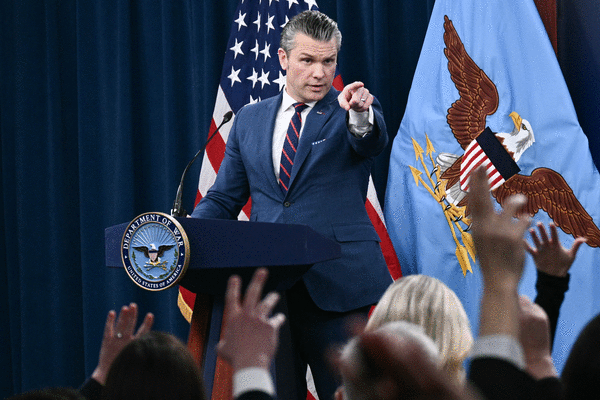
After the clampdown on reporting in Gaza, Israeli restrictions — enforced by a military censor — have been expanded as it fights a war on two fronts, in Iran and in Lebanon. In the U.S., President Donald Trump makes contradictory statements on Truth Social while Defense Secretary Pete Hegseth has attacked “a dishonest and anti-Trump press” for questioning the war’s progress.
The result is a difficulty in reporting what is happening in the conflict zones in real time as the warring parties and their respective militaries hold a near-monopoly on information. Absent demonstrable facts, the public on all sides is left trying to make sense of a war that is killing thousands, damaging the world economy, and ratcheting up global instability.
“Blanket limitations on reporting can be used as a tool by governments to control the narrative and obstruct the flow of reliable information, at a time when the public most needs independent journalism,” Anthony Bellanger, general secretary of the International Federation of Journalists, said in a statement.
The paradox is that the hostilities are taking place in an era of unprecedented information overload. Yet arguably it’s the most difficult conflict with American participation to ascertain the truth of what is going on.
The emergence of artificial intelligence is further muddying reality, as social media timelines are flooded with AI montages that are not always labeled as such and which are becoming ever harder to spot.
In the United Arab Emirates, the Attorney-General ordered the arrest of 35 of people from various countries last weekend for sharing “misleading content” online, some real and some AI-generated.
Gulf Arab states have never exactly been a haven for free press. But media organizations including Reporters Without Borders say the region’s governments have taken advantage of the current situation to impose more restrictions.
While there is some legitimacy in exercising control, particularly to avoid giving away the position of defenses as well as to suppress AI-generated misinformation, the current measures come against a backdrop of tightening restrictions more broadly.
In 2007, the UAE ranked 65th of 180 countries in the annual Press Freedom Index published by Reporters Without Borders - or RSF. It placed at 87 in 2010, 128 in 2018, and 164 in 2025, when the RSF cited the government’s habit of “tracking down and persecuting dissenting voices.”
Kuwait’s fall down the rankings has been almost as precipitous. It was in 128th place in 2025, down from 63rd in 2007. Bahrain ranked 157th last year.
“This war just came to kill the last hope of freedom of expression” in the region, said Sara Qudah, Paris-based regional director for the Middle East and North Africa with the Committee to Protect Journalists, which is running a daily tally of violations to press freedom.
“This is the first time in our modern history where we see a war with this number of countries involved and directly attacked. I don’t think that any government or authority in the Middle East was prepared for such an event,” she said. “And the first response to what’s happening was to control the media until they know where this is going.”
Image conscious
Projecting an image of normalcy is about economic survival given the need to remain attractive for expatriates. In Dubai, restaurants, malls and hotels have all remained open and, outside the main tourist areas, are surprisingly busy.
Yet more than 500 people have been arrested in Qatar alone, for filming and “circulating unauthorized video clips,” according to the Interior Ministry. Another 26 have been arrested in Bahrain, including for expressing support for the attacks, and a handful in Kuwait.
“Sharing rumors, false information, or any content that contradicts official announcements or that may cause public panic or threaten public safety, order, or health is prohibited,” the Dubai Police posted on X, in English. Anyone violating the order could face criminal penalties, including imprisonment and fines.
The authorities can do little to stop the reality of plumes of smoke rising from attacks on fuel tanks at Dubai and Kuwait airports, or obvious damage to buildings in areas of Bahrain. The U.S. embassy in Kuwait took hits, as did the pension fund building in the center of Kuwait City next to the Four Seasons Hotel, a popular choice for many visiting U.S. executives and bankers.
That’s not comparable to what people witnessed in Kuwait during the 1990-91 Iraqi occupation and first Gulf War. Yet even during the U.S.-led invasion of Iraq during the second Gulf War of 2003, when Kuwait was a target of Iraqi missiles, journalists and civilians were free to visit impacted sites. Not so today.
The damage is also nothing like the destruction currently in Tehran and other Iranian cities, or in Beirut and other areas of Lebanon.
Repressive regime
Iran is described by RSF as “one of the world’s most oppressive countries in terms of press freedom.”
Prior to this war, visiting foreign journalists who were given selective visas were required to work with Iranian government-approved “media agencies” that provide an official translator, fixers and film crews and which would chaperone reporters.
Journalists are often targeted by the state for their reporting or, in the case of foreign and dual nationals, to be used as leverage in disputes with other countries. Iranian journalists working for local media can be arrested when they report on stories that become politically sensitive or draw significant domestic or international condemnation.
At least a dozen journalists remain behind bars in Iran, according to data from the CPJ, which notes that the near-total Internet blackout has effectively cut them off from the outside world.
War guidelines
In Israel, war-specific guidelines issued by the military censor this month forbid all reporting on missile impacts in or around security sites, but do permit filming at civilian impact sites.
Broad restrictions apply on the broadcasting of missile interceptions which Israel relies on for defense. The Israeli military also limits information on the numbers of missiles and drones fired from Iran.
Overall, Israeli authorities have taken more of a press-defiant approach since the October 2023 attacks by Hamas. The Israeli military banned journalists entering Gaza at the beginning of that war and hasn’t lifted the restriction to date. Limited access is occasionally granted to small groups of journalists in the form of “embeds” with Israeli forces operating in the territory. An appeal to the Supreme Court demanding free access awaits a ruling.
The Israel Defense Forces operate an expansive spokesperson unit that’s led the information front since then. Top decision makers, including Prime Minister Benjamin Netanyahu and Defense Minister Israel Katz, rarely engage with Israeli media, leaving little room for questions on the country’s longest and most expensive military conflict in history.
Netanyahu’s Cabinet has been attempting to curb media freedom since it came to power in late 2022. Like Trump, Netanyahu has a complicated relationship with the media, which he says is hunting him and spreading misinformation.
His government recently tried to shut down Army Radio — a popular public news station — and was temporarily stopped by the Supreme Court. A broadcast bill is being debated in parliament that seeks to politicize media regulators, slash the budget of the country’s largest public broadcaster, Kan, and grant authorities generous powers to sanction outlets.
Television age
It’s all a far cry from the U.S. of the 1960s, when military transportation was made readily available for the press. The upshot was a degree of proximity to the battlefield that, combined with the arrival of the television age, brought uncensored reports into the living rooms of the world.
Media access was pared back in subsequent conflicts. In the first Gulf war, CNN made its name broadcasting from a Baghdad hotel rather than with the army. During the second, the U.S. and other nations “embedded” reporters with military units on the ground, giving a degree of controlled access.
Today’s war on Iran is primarily being waged from the air by U.S. and Israeli forces, leaving little room for independent reporting outside military confines. The Trump administration is in any case in the process of shaking up the media, favoring right-wing influencers and podcasters who share the president’s worldview over legacy news outlets.
A federal judge on Friday blocked the Trump administration’s decision to curtail the activities of reporters at the Pentagon.
Hegseth — a former Fox News host — has meanwhile limited access to his briefings on the Iran war. Stars and Stripes, the U.S. military newspaper, was not approved to attend a briefing last week, its Pentagon reporter said.
The U.S. is at the same time slipping down the rankings of press freedom, placing 57th of 180 last year, according to RSF. In 2002, the first year of the index, it was 17th of the 139 countries then ranked, five slots ahead of the U.K. Last year, it was 37 places behind.
After a century of expanding rights, the U.S. “is experiencing its first significant and prolonged decline in press freedom in modern history,” RSF said. Trump’s presidency is “greatly exacerbating the situation.”
Last week, U.S. Federal Communications Commission Chairman Brendan Carr warned broadcasters to “course correct” on news coverage of the Iran war or risk losing their licenses.
On Truth Social, Trump said he was “thrilled” at Carr’s move.
-------
—With assistance from Justin Sink, Golnar Motevalli, Zoe Schneeweiss and Chris Miller.
©2026 Bloomberg L.P. Visit bloomberg.com. Distributed by Tribune Content Agency, LLC.


Comments