Bay Area city of Richmond extends Flock contract, agrees to turn cameras back on
Published in News & Features
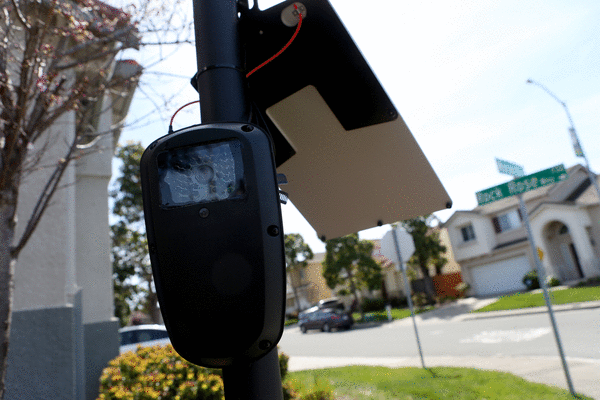
RICHMOND, Calif. — Driven by public safety concerns, automatic license plate readers will be turned back on in Richmond, months after they were shut down over privacy risks.
In addition to turning the cameras back on, a 4-3 vote by the City Council on Tuesday extended the city’s contract with Flock Safety, one of the largest surveillance technology companies in the nation, through the end of the year.
Police Chief Tim Simmons said he shut down the license plate reader system in mid-November after learning a national lookup feature allowed any agency using the Flock system to access a city’s data by searching a full license plate number.
The decision and related concerns about the system being used for federal deportation efforts are both personal and professional, Simmons said. The department has an interest in preserving trust with the whole community, he said, while noting he has family locally and in Mexico that are impacted by the issue.
“Our department’s mission is centered on public safety, community trust and constitutional policing,” Simmons said. “Our policies are built to ensure that everyone in our community, regardless of immigration status, feels safe reporting crimes, cooperating with investigations and seeking help from law enforcement without fear.”
Simmons said he’s held numerous meetings with Flock leadership, and negotiated new contract terms he believes will provide additional safeguards against improper access.
In addition to disabling its national lookup feature for all of California and prohibiting the formation of data sharing relationships between agencies inside and out of the state, Simmons said the company has also agreed to pay a $290,000 fee for any unauthorized data disclosures.
The community has been divided over whether or not to turn back on the cameras. Some, particularly in the business community, argue the system is needed to prevent crime, while others say Flock’s system could not be trusted and its systems are used to harm vulnerable communities.
Not all were convinced the new provisions were enough to justify reentering a relationship with the company.
Mayor Eduardo Martinez and councilmembers Claudia Jimenez and Sue Wilson said they could not trust the company which they said had not been transparent about the feature which had been enabled since 2023, when the city first went live with the system.
Simmons has asserted the city has no evidence their data was breached, but questioning by Wilson revealed that Flock conducted a system audit and was unable to say either way whether the city’s data was compromised.
“I don’t trust Flock as a company that’s going to respect our boundaries here,” Wilson said. “I’m open minded about whether we need and could use cameras here. I’m not open minded about Flock. I think fool me once shame on you. Fool me twice, shame on me. And we’ve been fooled once.”
The three councilmembers were also concerned about the ways Flock systems have been and could be used during federal immigration operations, or to track people in states where abortion and being transgender are legally challenged.
In support of extending the Flock contract were councilmembers Jamelia Brown, Cesar Zepeda, Soheila Bana and Vice Mayor Doria Robinson, each driven by a concern for fighting and preventing crime.
“Public safety is immigrant safety and protecting one community while leaving others vulnerable is not public safety. It’s negligence,” Brown said. “The system in our community needs to return to its normal state. Regardless if it’s not deterring crime, it’s helping our officers and investigators solve it more quickly.”
Robinson said she distrusts the company, arguing the issue was “not an oopsy.” She also shared concerns about the proliferation of mass surveillance, but noted that Richmond would be a singular blackout zone in a region where security cameras are widespread.
More than 150 Flock cameras have been installed across the city — 96 automatic license plate readers, which capture images of all vehicles that pass in front of them; and 65 closed-circuit televisions, a fixed surveillance camera system. Drones that provide aerial coverage during emergencies are also used by the Richmond Police Department.
Flock cameras are also in use by more than a dozen cities in Contra Costa County alone, though jurisdictions in other parts of the Bay Area have either canceled their contracts with Flock in part due to data security concerns or are in the process of reviewing the relationship, including Mountain View, Santa Clara County, San Jose, and Alameda County.
“It’s hard for me to understand how having a blackout space in Richmond, where people are traveling using all of these different systems, provides true security from this kind of surveillance,” Robinson said.
_____
©2026 MediaNews Group, Inc. Visit at mercurynews.com. Distributed by Tribune Content Agency, LLC.






Comments