Lt. Gov. Juliana Stratton wins Democratic nomination for US Senate
Published in News & Features
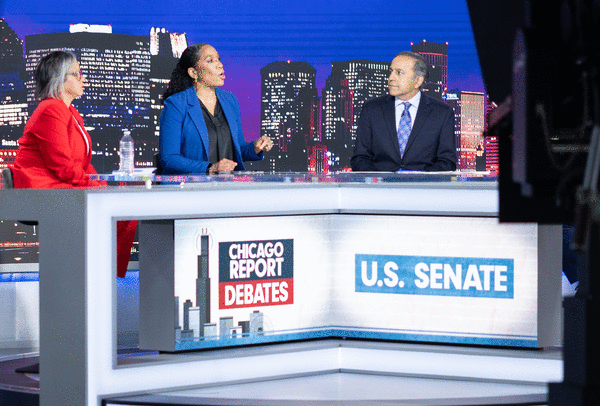
Two-term Lt. Gov. Juliana Stratton of Chicago defeated a pair of experienced members of Congress in Tuesday’s Democratic primary for the U.S. Senate seat long held by retiring Sen. Dick Durbin.
The Associated Press called the race for Stratton just before 9:40 p.m., a short time after five-term U.S. Rep. Raja Krishnamoorthi of Schaumburg and seven-term Rep. Robin Kelly of Lynwood conceded. Stratton will face former Illinois Republican Party Chair Don Tracy of Springfield in November.
With 90% of the estimated vote tallied in the race for Illinois’ first open Senate seat in 16 years, Stratton had 40% of the vote to 33.2% for Krishnamoorthi and 18.2% for Kelly, with the remaining votes divided among seven other candidates.
Stratton’s victory also marked a major win for Gov. JB Pritzker, who in 2018 chose the then-freshman state representative to be his running mate. The decisive win on Tuesday demonstrated the billionaire governor’s broader political influence as he seeks a third term in November and considers a potential 2028 presidential bid.
Pritzker, unopposed in the primary race for governor, contributed at least $5 million to an ostensibly independent super political action committee, Illinois Future, which reported spending roughly $12.2 million to boost Stratton’s campaign.
“Tonight we showed what’s possible when you listen to the people and give the people what they want,” Stratton said in a victory speech shortly after 10 p.m. at her election night party at CineCity Studios Chicago on the Near West Side.
Stratton thanked her family, her opponents in the primary race and Illinois voters, promising to be a “fighter” in Washington for all voters, “no matter who you cast your ballot for.”
Stratton underscored her campaign pledge to push to abolish U.S. Immigration and Customs Enforcement and alluded to community resistance to President Donald Trump’s Operation Midway Blitz immigration enforcement crackdown and other aspects of the president’s agenda.
“I’ve seen the very best of Illinoisans who have taken to the streets, stood up for their neighbors and refused to back down,” she said.
“Together we’ve confronted one of the most frightening moments of our lifetimes, but despite the fear, we never lost sight of what’s most important, and that is courage,” she said. “Courage inspired me to run. Courage powered this campaign. And courage will bring this fight straight to Donald Trump’s door.”
Stratton also had the backing of Sen. Tammy Duckworth, and if Stratton wins in November, the pair would be the first women of color to represent the same state in the Senate at the same time.
Speaking before Stratton at her campaign celebration, the governor said, “a lot of people have suggested this was personal to me. They were right. It was.”
Krishnamoorthi nodded to Pritzker’s influence in the race as the northwest suburban lawmaker conceded, thanking county Democratic Party chairs across the state who “had the courage to defy the party establishment and endorse the candidate with 29 letters in his name,” 14 labor unions that backed his campaign, and his family.
Although he raised about 10 times as much money for his campaign as either of the other top candidates, Krishnamoorthi said the “nearly 90,000” individuals who contributed to his candidate committee over the past decade “enabled me to compete against very wealthy interests.”
“Only in this country could my story happen,” Krishnamoorthi said. “Only in this country could a kid like me serve in the halls of Congress. Now we must come together as Democrats and as Americans to make sure that we return to the principles that made us a beacon of freedom and opportunity for the world.”
While the three candidates largely aligned on many issues, the race — fueled by tens of millions of dollars in campaign and outside spending — exposed fissures within the state’s dominant political party, including how far to go in overhauling the federal immigration system in the wake of Trump’s militarized enforcement crackdowns and how aggressively Democrats should embrace economic populism.
Krishnamoorthi amassed about$30.5 million in his campaign fund, money he had stockpiled for years while representing a safely Democratic suburban district for a decade and preparing for a Senate run. The total ranked second-largest among federal candidates nationally this year, allowing him to begin running TV commercials across the state in July, months before his rivals.
As Election Day neared and those funds dwindled, outside political committees funded at least in part by Krishnamoorthi supporters poured more than $11.6 million into the race. The vast majority was spent by a pro-cryptocurrency PAC, Fairshake, on ads attacking Stratton, but some was also spent on ads supporting Krishnamoorthi and, in an effort to drive Black voters away from Stratton, boosting Kelly.
The most experienced of the top candidates, Kelly struggled to break through the bickering, a dynamic her campaign referenced in a closing commercial in which she knocked over a television playing dueling ads featuring Stratton and Krishnamoorthi slamming each other. Pritzker’s full-throated support for Stratton, which some of Kelly’s backers in the Congressional Black Caucus decried as heavy-handed, revived past tensions over the governor’s maneuvers four years ago to oust the south suburban congresswoman as head of the state Democratic Party.
Kelly noted the role of big money in the campaign when she took the stage at the historic South Shore Cultural Center at about 9 p.m. and conceded the race. As she had throughout the campaign, Kelly bemoaned the big spending that dominates high-profile races, which she said discourages “good people” from running for or remaining in public office.
“It is hard to be, especially in Illinois, unbought and unbossed,” Kelly said.
Also seeking the Democratic nomination were Kevin Ryan, Steve Botsford Jr., Bryan Maxwell, Jonathan Dean, Sean Brown, Awisi Bustos and Christopher Swann. The accounted for 8.6% of the estimated votes counted.
In heavily Democratic Illinois, where the last Republican elected to the Senate was Mark Kirk in 2010 and the GOP’s last statewide victories came in 2014, Stratton will be the prohibitive favorite in the general election to replace Durbin following his 30-year tenure in the Senate. In a statement, Durbin said, “I look forward to passing the torch to Juliana Stratton at the end
of my term,” and he called for Democrats to unite behind their nominee.
In the GOP race, Tracy, whose tenure leading the state party came to an end in 2024 amid squabbling among various factions, led a field that also included attorney Jeannie Evans, a first-time candidate; Casey Chlebek, who unsuccessfully sought the GOP Senate nomination in 2020 and 2022; Pamela Denise Long; Jimmy Lee Tillman II; and R. Cary Capparelli.
With 89% of the estimated vote tallied, The Associated Press called the race for Tracy, who had 40% of the vote, according to unofficial results.
Unlike in the Democratic contest, the Republican Senate primary drew little outside spending.
“We’ll work hard every single day to win this open U.S. Senate seat for working families,” Tracy said to his supporters at his election night party at the President Abraham Lincoln Hotel in Springfield. “With your help, we’ll deliver that underdog victory in November that will shock the nation and make Illinois a better, more balanced state.”
While disputes over campaign contributions and spending from outside backers dominated debates and negative ads, the three leading Democratic candidates also staked out differing positions on several issues, most notably how to push back on the aggressive, sometimes deadly tactics of ICE and Border Patrol under Trump.
Stratton called to “abolish ICE,” without offering a thorough explanation of what would replace the agency. Krishnamoorthi said he wanted to “abolish Trump’s ICE,” a position he repeatedly noted he shares with Pritzker. Kelly, who introduced articles of impeachment against now-former Homeland Security Secretary Kristi Noem, called for a complete overhaul of the Cabinet-level agency.
Economic concerns also loomed over the campaign as Democrats nationally sought to turn affordability issues that helped propel Trump back to the White House against the president and his party in the midterm elections. All three top candidates supported raising the $7.25-per-hour federal minimum wage. Stratton called for an immediate increase to $25 an hour— a position her opponents, who supported a gradual increase to $17 per hour, said reflected naivety and a lack of Washington experience.
The candidates also all called for changes to make health care more affordable and accessible, with Stratton and Kelly backing the so-called Medicare for all proposal and Krishnamoorthi favoring more immediate steps to shore up coverage under the Affordable Care Act.
Trump’s decision to go to war with Iran in late February thrust a new issue into the final weeks of the campaign, but it was one that saw little divergence among the candidates. All argued that it was an illegal action because Congress did not give authorization.
_____
(Chicago Tribune’s Jack O’Connor and Rebecca Johnson contributed.)
_____
©2026 Chicago Tribune. Visit chicagotribune.com. Distributed by Tribune Content Agency, LLC.




Comments