NATO boosts defenses around key US radar in Turkey amid Iran war
Published in News & Features
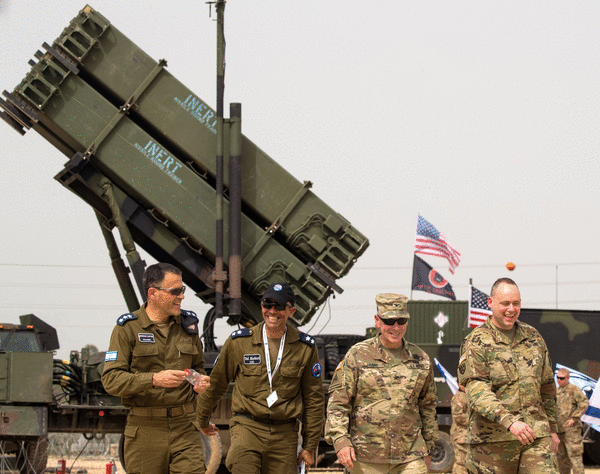
The North Atlantic Treaty Organization is increasing air defenses in southeast Turkey, where the U.S. operates a key radar supporting the alliance’s ballistic missile shield.
The decision to deploy the Patriot systems in Malatya province came in the wake of two Iranian missile attacks targeting Turkey.
Since the start of the U.S.-Israeli war on Iran, Tehran has targeted American radar systems elsewhere in the Middle East, including a strike in Jordan that destroyed an RTX Corp. AN/TPY-2 radar and support equipment. The $300 million radar system was seen as crucial to directing U.S. missile defense batteries in the Persian Gulf to counter attacks from Iran.
The same type of advanced radar is deployed at Kurecik, about 435 miles (700 kilometers) from Iran, according to a U.S. State Department document from 2011, the year when Turkey agreed to host the equipment.
Iranian officials warned more than a decade ago that Tehran could target NATO’s missile-defense installations in Turkey should it come under attack from the U.S. or Israel, arguing that Kurecik was designed to help protect Israel.
“In addition to the national measures we have implemented, NATO has enhanced air and missile defense measures,” Turkey’s Ministry of Defense said in a statement on Tuesday. “As part of this framework, a Patriot system is currently in Malatya and is being prepared for operational readiness to support the protection of our airspace.”
After intercepting a missile headed for Turkey last week, NATO said it was raising its “alliance-wide ballistic missile defense posture.” It shot down a second ballistic projectile in Turkish airspace on Monday.
Turkey has so far sought to avoid escalating tensions with Iran and cautioned its neighboring country against actions that could spread the conflict further across the region.
President Recep Tayyip Erdogan warned against “wrong and provocative actions,” saying they could damage his country’s relationship with Iran. “I once again stress that there should be no persistence or stubbornness in wrongdoing,” he said on Monday.
Turkey possesses advanced Russian-made S-400 air defense batteries — a purchase that strained ties with NATO allies.
Turkey and Iran maintain a complex relationship that blends economic cooperation with strategic rivalry. The two countries hold trade ties — including Iranian gas exports to Turkey — while backing opposing sides in conflicts such as the Syrian civil war.
Prior to Tuesday’s announcement, the only Patriot battery Turkey has known to host belongs to Spain, stationed at the Incirlik air base in the southern Adana province since 2015.
NATO last deployed Patriot batteries to Turkey in 2013 at Ankara’s request, in response to missile threats from the civil war in Syria.
Turkey’s drive toward greater defense self-sufficiency accelerated after 2015, when several NATO allies, including the U.S., withdrew their Patriot batteries from the country.
In 2017, Turkey struck a deal with Russia to purchase the S-400 system. Their delivery in 2019 prompted the U.S. to bar Turkey from buying Lockheed Martin Corp.’s F-35 fighter jets and participating in the joint program to manufacture it.
During U.S. President Donald Trump’s second term, relations between Washington and Ankara have improved markedly. U.S. Ambassador to Turkey Tom Barrack has said Turkey must relinquish the S-400s if it wants to rejoin the F-35 program.
©2026 Bloomberg L.P. Visit bloomberg.com. Distributed by Tribune Content Agency, LLC.






Comments