Florida Senate approves bill targeting 'terrorist' groups
Published in News & Features
Legislation that would allow Florida leaders to designate domestic “terrorist” groups passed the state Senate on Thursday, even as critics warned it could invite costly legal challenges because they believe it tramples on Floridians’ First Amendment rights.
The proposal would allow the Florida Department of Law Enforcement’s chief of domestic security to decide certain groups are terrorist organizations. The Florida Cabinet, which the governor chairs and is made up of three other statewide elected officials, would have to approve the designation.
Islamic groups are particularly concerned about the consequences of the legislation because it specifically mentions “Shariah” law, the duties required of Muslims.
But Sen. Erin Grall, R-Fort Pierce, assured her colleagues the state would use an already-existing statute to define what constitutes a terrorist organization, and it is consistent with the criteria used by the federal government to identify foreign terrorist groups.
“We have not touched the definition of terrorism,” said Grall, who sponsored the Senate’s version of the bill.
If the proposal becomes law, state universities and colleges that “advocate for” these groups might have their performance funding withheld, and students who promote these organizations could be expelled. Additionally, anyone who works for state-designated terrorist organizations could face felony charges.
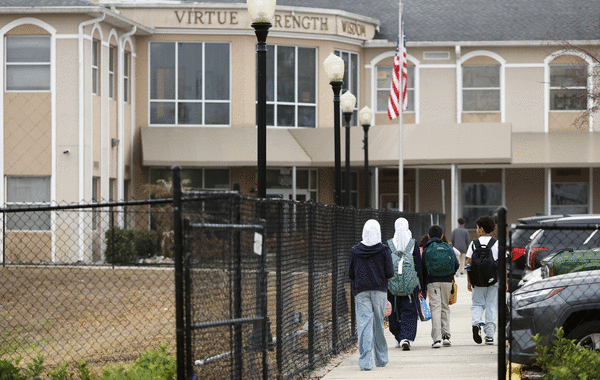
The legislation would also ban schools affiliated with “terrorist” organizations from receiving money through the state’s voucher program, which students use to pay tuition at nearly 2,500 private schools across the state. A small fraction of those campuses — about 1% — are Islamic.
Though the House approved the proposal on Tuesday, the Senate voted for an amended version of the lower chamber’s bill, so it will need to go back to the House before it comes before Gov. Ron DeSantis.
A spokeswoman for DeSantis declined to comment on whether the governor was likely to sign the legislation.
“The governor has not yet received this bill from the legislature,” Press Secretary Molly Best wrote in an email. “Once delivered to his office, he will review it in its final form.”
Senators mostly voted along party lines for the Republican-backed legislation.
Republicans Alexis Calatayud and Ileana Garcia, both of Miami, joined Democrats in voting against the bill. Sen. Jason Pizzo, a South Florida lawmaker who left the Democratic party last year and is now unaffiliated, voted with Republicans in favor of the measure.
The part of the bill that mentions “Shariah” law has been particularly controversial.
Sen. Tina Polsky, D-Boca Raton, said American courts do not enforce religious or foreign laws and she thought that part of the bill was unnecessary.
Polsky, an attorney, pointed out that the state government had attacked other groups in the past, including civil rights organizations like the NAACP.
“This bill lacks the precise definitions, due process protections and First Amendment safeguards needed to prevent this abuse,” Polsky said, describing it as a “dangerous, slippery slope.”
The language in the legislation is vague, she said, and could lead to the state targeting nonprofit organizations and advocacy groups engaged in lawful activities, as enforcement could become politically motivated. And it would likely draw expensive legal challenges, Polsky and others warned.
Supporters of two prominent Muslim groups have already scored a victory against DeSantis, as a federal judge temporarily blocked the enforcement on Wednesday of an executive order the governor issued last year that designated them as foreign terrorist organizations. The order targeted the Council on American-Islamic Relations and the Muslim Brotherhood.
U.S. District Judge Mark E. Walker wrote in his preliminary injunction that the First Amendment bars the governor from using his office to make a political statement that interferes with others’ constitutional rights, the Associated Press reported.
But Grall, who is also an attorney, did not seem fazed by Walker’s decision.
“I am aware of the opinion that came out yesterday about the executive order and I would note that there has been an injunction that has been in place for one of the organizations but not all, so there is an open question about what our governor will be able to do through executive order,” Grall said.
A related proposal that would exempt from public disclosure records concerning the decision to designate groups as terrorist organizations also gained approval from the House on Tuesday and passed in the Senate on Thursday.
_____
©2026 Orlando Sentinel. Visit orlandosentinel.com. Distributed by Tribune Content Agency, LLC.





Comments