US farmers see new Trump tariffs as yet another round of instability
Published in News & Features
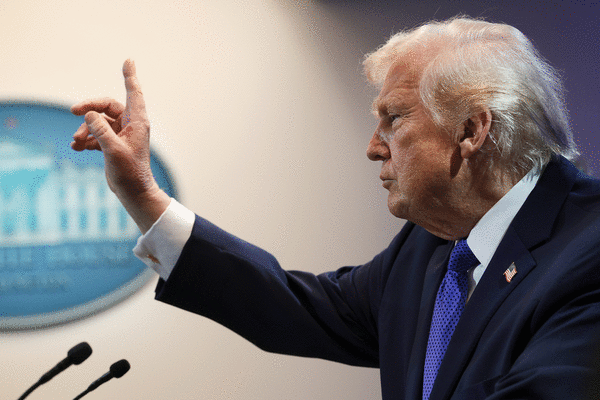
U.S. farmers have been looking for some stability after a mercurial year under President Donald Trump’s tariffs. But after new trade upheaval last week, it’s becoming increasingly clear that uncertainty is the only constant.
“One of the things in this industry is that there’s always uncertainties,” Krista Swanson, chief economist at the National Corn Growers Association, said in an interview at the Commodity Classic conference in San Antonio. “So we’re constantly in this place of trying to balance these things.”
The latest shift came as Trump implemented a new 10% global tariff aimed at preserving his trade agenda, after the U.S. Supreme Court struck down the president’s original sweeping duties. He also threatened to raise the number to 15%.
Tariffs have battered U.S. agriculture for more than a year, upending trade flows and choking off access to key markets like China. The pressure is landing on farmers already squeezed by weak crop prices and stubbornly high input costs, deepening anxiety over how the administration’s latest moves will shape demand for U.S. harvests.
Dissatisfaction among farmers — a cornerstone of Republican support — carries potential political consequences. Sentiment among growers has darkened at the start of 2026, while former farm leaders and government officials warn current trade policies are inflicting lasting damage. The escalating friction over tariffs risks alienating rural voters ahead of midterm elections.
Tariff tensions echoed throughout the presentations at the three-day Commodity Classic.
“The global tariff now throws more volatility and uncertainty into the market,” said Caleb Ragland, chairman of the American Soybean Association. “We’re drastically held back when these burdens of tariffs and other issues make it where we can’t be competitive.”
Last year, Trump’s message to farmers worried about tariffs was “bear with me.” That hasn’t change much, judging by comments from administration officials at the conference.
“The president’s message is still valid to be patient, like these things don’t happen overnight,” Richard Fordyce, an undersecretary at the U.S. Department of Agriculture, said in an interview, adding that agriculture “is playing a prominent part” in trade discussions.
Trump recently has been pushing for China to secure more soybeans from the U.S., even as supplies produced in Brazil are currently much cheaper.
“I don’t know that I remember an administration where the president has said soybeans so many times,” he said. “The administration is listening to agriculture, they’re listening to farmers.”
China, the world’s top consumer of the oilseed, avoided buying soybeans from the U.S. for much of the season, only recently resuming purchases to meet a pledge to secure 12 million tons this season. Whether the Asian nation will meet a commitment to purchase 25 million tons a year through 2028 remains to be seen in the wake of the Supreme Court decision.
Jim Sutter, chief executive officer of the U.S. Soybean Export Council, said he thinks that will hinge on the relationship between the U.S. and China — and the countries’ presidents, who are scheduled to meet again when Trump travels to China in late March.
“I think they’re signaling to the United States, ‘you want to sell us 25 million tons at least of soybeans, we want to have a good relationship,’” Sutter said in an interview on the sidelines of the conference.
He reiterated the need to diversify export markets, and said he thinks countries that have recently agreed to trade deals with the U.S. will still honor those commitments.
Agriculture Secretary Brooke Rollins said the signs are “very encouraging” on China’s buying through 2028.
“We’re going to keep focusing on soybeans, focusing on China purchasing,” Rollins told journalists at the conference. But she said the administration is also focusing on opening up markets so it’s “not so reliant on China.”
Beyond tariffs and export markets, U.S. farmers are also looking for more stability on domestic policies, including biofuels and input costs. Farmers pressured by a tough farm economy see both as key to creating a healthier market where they’ll have less need for government assistance. The USDA is currently dispersing aid through a $12 billion farm bailout.
While agricultural economists at the Commodity Classic said prices for inputs like fertilizer and seed remain stubbornly high, Rollins on Thursday told conference attendees that several of those costs have begun to moderate and the U.S. would work to continue lowering them.
Meanwhile, U.S. biofuels policy is increasingly gaining the spotlight as the administration is about to finalize mandates for mixing renewable fuels with gasoline and diesel. Yet a backlash is growing among farmers because of the lack of progress in Washington over expanding the use of higher ethanol gasoline known as E15. Farm groups have long advocated for the change as a way to help expand domestic demand for renewable fuel feedstocks like soybeans and corn.
At Commodity Classic, many attendees sported buttons calling for “E15 NOW.”
“With the lack of work we’re seeing in DC we’ve been ‘Midwest nice’ for too long,” National Corn Growers Association President Jed Bower said at the conference. “We need to be aggressive.”
The crowd burst into applause after Rollins told conference attendees that Congress must pass legislation. “I wish you all knew how much E15 has been discussed in the Oval Office and the Capitol, and what a priority it is,” she said.
©2026 Bloomberg L.P. Visit bloomberg.com. Distributed by Tribune Content Agency, LLC.





Comments