Caribbean nations to send aid to Cuba amid fears crisis will spread to region
Published in News & Features
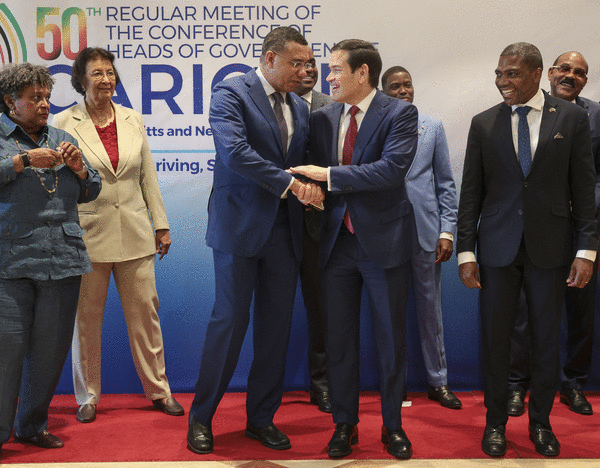
Leaders of the Caribbean Community said Friday they plan to send humanitarian aid to Cuba, stressing that the island’s deepening economic crisis could destabilize the wider region.
The announcement came in a joint statement the 15-member regional bloc, known as CARICOM, said it was issuing along with the United States. U.S. Secretary of State Marco Rubio met with leaders this week in Saint Kitts and Nevis, where heads of government closed out a four-day summit that addressed a number of critical issues including their strained relationship with the U.S. and the ongoing volatile situation in Haiti, a member country.
As the meeting wrapped up Friday, leaders announced the formation of a three-person working group to reframe their cooperation framework with the U.S. and elaborated on their decision to assist Cuba.
“We are going to respond on the humanitarian end, in short order, within a month,” Saint Kitts and Nevis Prime Minister Terrance Drew, the current CARICOM chairman.
Drew said specifics — including the type and amount of aid — still need to be worked out, but “we are going to respond in a significant way.
“All parties recognize that there should be efforts to address the growing humanitarian crisis,” he added.
Tightened U.S. embargo
Since last month, Cuba has faced a tightened embargo from Washington after the Trump administration cut off fuel imports from Caracas following its capture of Venezuelan leader Nicolas Maduro. The blockade has led to an acute oil shortage in the country that was already facing economic collapse amid an energy crisis that was already plunging the country into daily prolonged blackouts.
While Cuba is not a member of CARICOM, it has long maintained close ties with member states that historically have urged the U.S. to lift its decades-old embargo. Cuba’s crisis, deepened by the change in U.S. policy, loomed large at the CARICOM conference and fueled fears that the whole region could be affected.
Those fears were apparent as Rubio met with Caribbean leaders. The administration also held secret talks with Raúl Rodriguez Castro, the grandson of Raul Castro. The talks, first reported by the Miami Herald, were focused on a possible deal involving the U.S. easing restrictions in exchange for Cuba making economic reforms.
In addition to the presence of Rodriguez Castro, who met with Rubio’s close advisers, Josefina Vidal, Cuba’s deputy foreign minister and a key player in negotiations with the U.S. during President Barack Obama’s effort to thaw relations with the island, was also in Saint Kitts on Wednesday and Thursday. She met with several Caribbean government officials.
Asked about the meetings between the U.S. and Cuba and CARICOM’s role, Drew deflected. “With respect to the matter of Cuba, CARICOM's focus at this time is the humanitarian situation,” he said.
The State Department has not publicly addressed the Cuba discussions. A statement issued after Rubio’s departure said only that he met with Caribbean leaders on the sidelines of their 50th annual CARICOM conference in Basseterre.
“The Secretary underscored the United States’ enduring partnership with the Caribbean and reaffirmed our shared commitment to regional security cooperation,” State Department spokesperson Tommy Pigott said in a statement.
Drew was joined at the press conference by both the immediate past chairman of CARICOM, Jamaica Prime Minister Andrew Holness, and the incoming chairman, Prime Minister Philipe J. Pierre of St. Lucia.
They announced that new three-person team will work on U.S.-Caribbean relations. The last serious engagement between the community and Washington happened nearly 50 years ago during the administration of President Ronald Reagan.
Working with U.S. counterparts, the goal of the team is to craft a framework “appropriate to the 21st century,” addressing structured migration programs, security cooperation, trade and investment, disaster recovery, human development and technical assistance.
Leaders did not directly address the Trump administration’s crackdown on legal and illegal immigration, nor did they comment on third-country agreements that several countries, including Saint Kitts and Nevis, have signed. Under those agreements, the United States can send asylum-seekers who cannot be returned to their home countries to participating nations.
Given the migration pressures across the region, Holness said Caribbean governments “have to look at the program from a holistic view, so that we are not put at a disadvantage — both from losing our nationals, which is a historical challenge, as we participate in other programs.
“We haven’t worked out all the details of it, but certainly the idea of looking into this to make sure that migration is comprehensively addressed, and not just from the issue of migration to the United States,” he said.
The organization also said it would remain engaged in Haiti through an initiative led by the former prime ministers of The Bahamas, St. Lucia and Jamaica. Former Saint Lucia Prime Minister Kenny Anthony and Haitian Prime Minister Alix Didier Fils-Aimé both provided an update on the crisis in Haiti, including the signing of a national pact with more than 200 political parties and civil society groups.
_____
©2026 Miami Herald. Visit miamiherald.com. Distributed by Tribune Content Agency, LLC.






Comments