NASA revamps Artemis plan, adding one more mission near Earth before moon landing
Published in News & Features
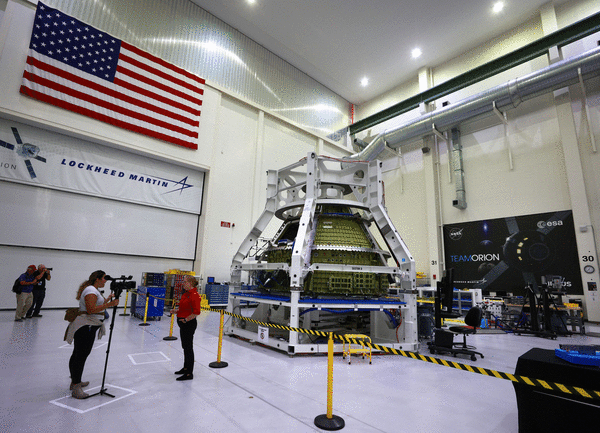
NASA Administrator Jared Isaacman announced a major overhaul of the agency’s Artemis mission plans on Friday, adding an extra mission next year to help the program better prepare for a moon landing in 2028.
And less than a year after nearly one-fifth of NASA’s workforce took a voluntary departure amid government-wide cuts, Isaacman now wants to see an increase in its civilian workforce.
Artemis III, which was initially planned to be the first touchdown by humans on the moon since 1972, will instead aim for a crewed launch to low-Earth orbit by mid-2027 to demonstrate the Orion spacecraft’s ability to dock with lunar landers.
“Launching a rocket is important. And as complex as SLS is, every three years is not a path to success,” he said.
NASA is still aiming for a crewed moon landing in 2028 before President Donald Trump leaves office. Isaacman said an increase in launches of the Space Launch System rocket could mean both an Artemis IV and V could launch that year.
Artemis I launched on an uncrewed flight in late 2022, while Artemis II is back at Kennedy Space Center’s Vehicle Assembly Building for needed repairs before it can venture back to the pad. A potential launch for the first crewed flight of Orion, which will travel around the moon but not land on it, could happen as soon as April 1.
Artemis III, with its complex plan to rendezvous with either SpaceX’s Starship or Blue Origin’s New Glenn and stick the landing, was not on the roadmap to fly until late 2028.
“When you are launching every three years, your skills atrophy, you lose muscle memory,” he said. “We’ve got a lot of really talented folks that have been working hard on the Artemis II campaign. And you know whether they’re going to want to stick around for three more years after this mission is complete is a question mark.”
He pointed out that Artemis III was trying to combine what amounted to three Apollo missions combined, as Apollo 8 in 1968 was similar to the lunar fly-by plans for Artemis II plans but Apollo 9 and 10 worked out more issues before the historic Apollo 11 moon landing in 1969.
Reconfiguring Artemis III to be closer to the planet, he said, just adds to the safety margins.
“We didn’t go right to Apollo 11, right?” he said. “Right now, our program is essentially set up with an Apollo 8 and then going right to the moon. That is not a pathway to success.”
A major component of the shift is NASA putting a halt on the larger versions of the SLS rocket that had been planned, meaning the Block 1 version of the rocket that was used on Artemis I and planned through Artemis III will now be used for all of the first five missions.
The simplification of launch hardware and potential for three more launches in two years does mean that NASA will need more help.
“There’s a lot of work we have to do here at NASA to prepare,” he said. “We’ve got to rebuild our core competencies. Now, does this mean the overall workforce count increases at KSC? I don’t know the answer to that specifically. I would say that there’s a lot of contractors which do fantastic work that should be civil servants. It’s kind of the heart of the workforce directive right now.”
He noted 75% of NASA’s workforce is contractors.
“I think a lot of them should be civil servants. I think we should have those capabilities in house,” he said. “We should have the ability to make changes and adjustments as we see fit, because we are NASA. … We know an awful lot, and this is going to be our kind of pathway back to the moon.”
It also means the primary suppliers, including Lockheed Martin’s Orion spacecraft, Boeing’s core stage for the SLS rocket and Northrop Grumman with the solid rocket boosters, had to sign off on the plan.
Isaacman said standardizing the rocket’s configuration, though, means the number of launches can now go up.
“You’re not going to be able to do that if every rocket is a work of art,” he said. “You’re going to inevitably learn the same lessons and over again. So standardize, increase production, pull everything in which allows you then to increase your your launch rate.”
He hopes to be able to turn around SLS launches every 10 months.
The reasons behind changing the Artemis launch cadence falls in line with a critical report from the Aerospace Safety Advisory Panel released this week.
“The Artemis III mission, as baselined, cannot be accomplished with appropriate margins of safety,” the panel concluded.
“ASAP was rightful to call out some of our shortcomings, and we should be addressing them,” he said.
He also said Congress was on board with the changes.
“We’ve certainly spoken to all of our stakeholders on the Hill,” Isaacman said. “They all understand that this is the path forward. And I don’t think I heard a single objection on these subjects. Everyone understands what’s at stake here.”
_____
©2026 Orlando Sentinel. Visit orlandosentinel.com. Distributed by Tribune Content Agency, LLC.






Comments