Maryland battles over ICE facilities raise constitutional question
Published in News & Features
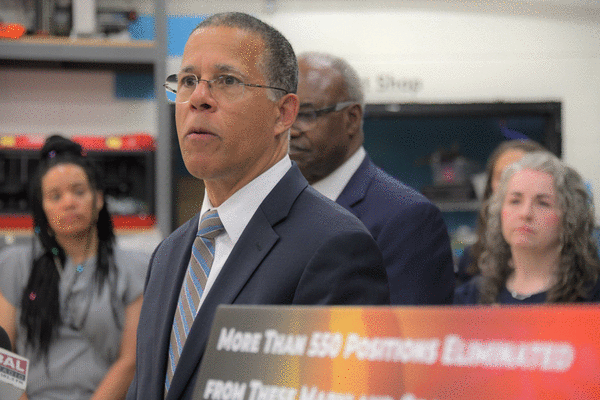
BALTIMORE — As local governments in Maryland clash with the Trump administration’s plans for new federal immigration facilities, the issue is reviving a long-running constitutional question: When the federal government buys or uses property, does it have to obey state and local zoning and land use laws?
Legal scholars say the short answer is complicated — and multiple disputes now unfolding across Maryland could help determine it.
At the center is a lawsuit filed Monday by Maryland Attorney General Anthony Brown seeking to block the Trump administration’s plan to convert an 825,000-square-foot warehouse in Washington County into a 1,500-bed Immigration and Customs Enforcement (ICE) detention center. The suit argues the Department of Homeland Security failed to complete required local environmental review before spending $102.4 million to purchase the Williamsport property.
Meanwhile, Baltimore County lawmakers may have passed emergency legislation banning private immigration detention facilities earlier this month, but it doesn’t stop ICE or its legal department from occupying office space in Hunt Valley.
Together, the disputes highlight a fundamental constitutional tension: the supremacy clause — which generally gives federal law priority over conflicting state law — versus traditional local authority over land use.
Federal immunity and growing uncertainty
Historically, federal courts have treated the federal government as largely immune from local regulation on land it owns.
“I can cite you cases from the 1950s to the 1980s — the federal government is completely immune from state and local regulation,” said Georgetown University law professor David Super. “For example, nonlicensed contractors can work on federal land even if state or local law prohibits doing this kind of work without a license.”
Under that traditional doctrine, local zoning ordinances typically cannot prevent federal agencies from using federally owned property for their operations, including detention facilities.
But the issue isn’t settled. Instead, Super said it might come down to which interpretation lower courts and possibly the U.S. Supreme Court, chooses to follow.
In recent years, conservative Supreme Court justices have emphasized limits on federal power and expanded recognition of areas traditionally controlled by states.
“Control of land has been explained by the courts as one of the most important things state and local governments do,” Super said. If the court continues expanding state authority, he added, justices could someday allow neutral local regulations to apply to the federal government as long as they do not single it out for discrimination.
That possibility is partly why Maryland’s lawsuit focuses not on zoning, but on federal environmental review requirements — an area where courts historically do regulate federal agencies.
What local governments can and can’t do
Baltimore County’s new ordinance illustrates the legal line governments are trying to draw.
The law bars permits for detention centers — including jails, prisons and temporary holding facilities — and passed 6-0 last week. But it does not prohibit federal immigration offices.
“Local governments have considerable authority to regulate the use of land within their jurisdictions,” Audrey McFarlane, a Dean Julius Isaacson Professor of Law at the University of Baltimore School of Law, told The Baltimore Sun in an email. “Zoning allows a county to determine which land uses are permitted or prohibited in particular districts.”
“Baltimore County has now prohibited the use of privately owned warehouse facilities as detention centers. The County can justify that prohibition on a range of ordinary land use grounds, which means it has a rational basis,” she continued. “Leasing office space for ICE’s administrative purposes is a different category of use. Office space remains a permitted use under the Baltimore County zoning code, so that activity would not fall within the prohibition.”
Councilman Julian Jones, a Woodstock Democrat and county executive candidate who sponsored the measure alongside his three Democratic colleagues, said at a news conference last week that it was “a little tricky” trying to craft legislation that would stop an office, though he said there had been some discussion about the idea of the bill saying there couldn’t be some administrative function to support a detention facility.
“If they own the property, they can do whatever they want to do, but if they have to lease the property or someone else is involved, those are the people that we can control,” he said in explaining the reach of the bill. “We can control property owners who own properties by not giving them permits and not giving them permission to do certain functions in their buildings.”
Legal experts say that distinction is critical. Governments typically cannot regulate federal agencies directly, but they can regulate private landlords, developers and contractors.
Cori Alonso-Yoder, director of the Immigration Clinic at the University of Maryland Francis King Carey School of Law, said a federally owned detention center would generally be permissible so long as it does not violate constitutional rights. The Baltimore County law instead targets private actors who might host detention operations.
Federal immigration detention relies heavily on private facilities; a February 2025 analysis by the Transactional Records Access Clearinghouse found roughly 90% of people held by ICE were housed in privately owned or operated centers.
“I think this is a very innovative way to sort of get into and disrupt a bit of that existing model for detention,” she said of the legislation.
_____
©2026 Baltimore Sun. Visit baltimoresun.com. Distributed by Tribune Content Agency, LLC.






Comments