Voters overly optimistic about how Michigan ranks against other states, poll shows
Published in News & Features
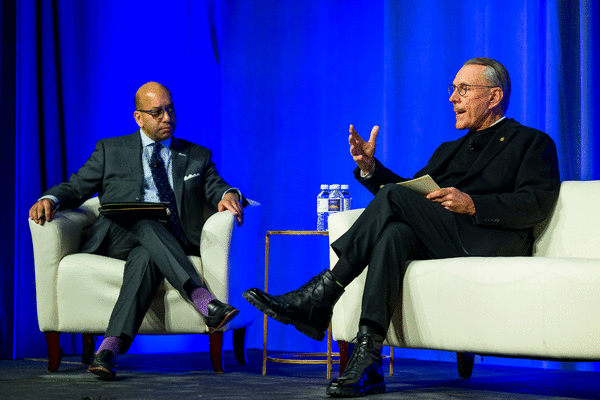
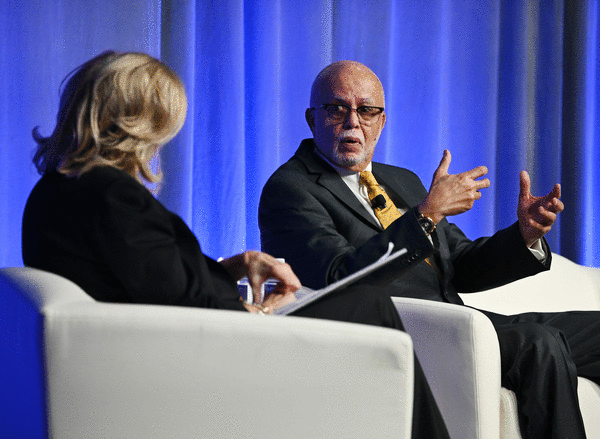
DETROIT — About half of Michigan voters believe the state is headed in the right direction, but many are unaware of how poorly it ranks nationally on key metrics, according to a new statewide poll commissioned by the Detroit Regional Chamber.
The Glengariff Group poll of 600 registered Michigan voters was conducted from Jan. 27 to Feb. 2 and surveyed respondents about a range of topics, including the economy, data centers and political civility headed into this year's midterm election.
The poll also asked voters to rank Michigan's performance on metrics like per capita income and educational achievement.
“On nearly every metric we tested, Michigan voters believe the state is doing average against the other states,” said Richard Czuba, president of The Glengariff Group.
“The reality is that Michigan is doing far worse. Michigan voters have no clue how we stack up against the other states, even on those metrics where Michigan is at the bottom of the list," Czuba added.
Sandy Baruah, CEO of the Detroit Regional Chamber, said, “In many ways, our house is on fire. In just one generation, Michigan has fallen from a top 10 or 20 state to a bottom 10 state in per capita income and educational achievement, which is not a recipe for long-term economic success."
In the poll, Michigan voters placed the state between 25th and 29th on average on each metric, despite ranking 33rd for college degree rate, 44th for student reading performance and 45th for the state's unemployment rate.
“It’s interesting that voters think Michigan is average on everything … but more importantly, they appear to have absolutely no clue whatsoever about how MI stands on these issues, how we really stack up," Czuba said.
Among the 600 registered voters surveyed, 40.1% said they tend to vote for Democrats, 39.6% who vote Republican and 19% who identify as political independents.
The telephone survey had a margin of error of plus or minus 4 percentage points. Approximately 85% of the voters surveyed were contacted by telephone operators on their cell phones.
How Michigan voters feel about the economy
Michigan voters are split on the state's economy, with 41.6% saying it's on the wrong track and 42.1% saying it's on the right track.
Respondents who said the economy was on the wrong track overwhelmingly indicated that inflation and the cost of goods were the underlying causes.
“We’ve seen a pretty significant increase in people who are expecting inflation to grow," said Baruah, the Chamber CEO.
Despite the split perceptions of the economy as a whole, three-quarters of all voters said they were doing as well or better than the same time last year. The majority of that group said they were doing about the same and 20% said they were doing better.
The other 24.6% of respondents said they were worse off, laying the blame primarily on inflation and the cost of goods. Those who said they were doing better pointed to pay raises and new or better jobs.
Republicans and young adults were more likely to say they were doing better since the same time last year, while Independents and low-income respondents were the most likely to say they were doing worse.
“Independent voters are now viewing the economy much more similar to the Democrats than the Republicans," Czuba said. "It used to be how you saw the economy was how you saw the party in power. Now, how you see the party in power is how you see the economy.”
Fewer than half of all voters who responded to the poll believed that good jobs are available to anyone who wants them.
According to the chamber, that's the lowest figure for that question since at least May 2024, declining 16 percentage points since the beginning of last year.
Within that group, white-collar workers were the most pessimistic: only 42.5% responded that good jobs are available for everyone who wants to work, compared to 60.7% of blue-collar workers.
Those white-collar numbers likely reflect the challenge of entering the workforce after graduating college, Czuba said.
“In our last survey, we actually asked voters if they knew anybody who was graduating from college and what we found was a huge amount of those people who knew someone graduating from college was having a hard time," he said.
The response was also split along partisan lines: Republicans were far more likely to say that good jobs are available to anyone who wants to work and Democrats were the most likely to say they were not.
Most voters neutral on data centers
Despite local controversies over AI data centers planned across Michigan, less than 60% of voters said they'd seen or heard anything about them.
"It’s very clear that Michiganders don’t know what data centers are, what they do, and what the value of them is," Baruah said.
The Detroit Regional Chamber, which advocates for businesses across southeast Michigan, has been vocally supportive of the proliferation of data centers housing computers and servers that tech companies need to fuel the growth of artificial intelligence.
College-educated voters were by far the most likely to be aware of data centers, with 70% saying they had heard about data centers being built in Michigan. Less than half of non-college-educated respondents said they had heard anything.
Among respondents who had heard about data centers, 25.3% were opposed and just 5.2% supported them. But most of the voters gave neutral responses, explaining only that they had seen protests or knew that they were being built.
“Essentially what they were doing was basically repeating what they were seeing in current coverage," said Czuba, the pollster.
Most people who opposed data centers cited environmental or infrastructure concerns, including their water usage and impact on electricity rates.
Still, 36.4% of voters said data centers would provide economic benefits to Michigan, compared to 19.3% who said they would not. 76% of those expecting some kind of benefit mentioned jobs.
"From what I see in these numbers, we are in the initial stage in framing the narrative about data centers," Czuba said.
"From what I see, that framing is largely negative right now. There is very little in those neutral statements about the benefits of those data centers," he said.
_____
©2026 The Detroit News. Visit detroitnews.com. Distributed by Tribune Content Agency, LLC.






Comments