Is Minnesota cooperating with ICE after Operation Metro Surge?
Published in News & Features
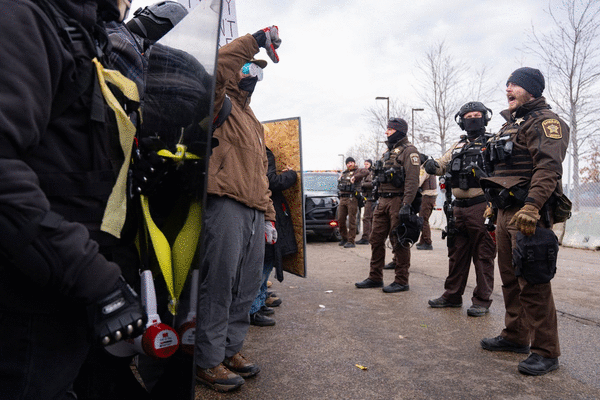
MINNEAPOLIS — Border czar Tom Homan ended Operation Metro Surge without clear signs of the “significant” cooperation that he said was necessary to draw down thousands of federal agents.
There have been no widespread policy changes at the state or local level to help Immigration and Customs Enforcement (ICE). Gov. Tim Walz, Minneapolis Mayor Jacob Frey and Hennepin County Sheriff Dawanna Witt made it clear they did not capitulate in exchange for a drawdown.
Homan has not provided details on what changed in Minnesota in order for him to end the surge. The U.S. Department of Homeland Security did not respond to a request for comment.
James Stuart, executive director of the Minnesota Sheriffs’ Association, said he thinks federal immigration officials now understand local law enforcement agencies are typically helping as much as they can.
“I think the single biggest change is improved communication,” Stuart said. “I think a lack of communication was perceived as a lack of partnership, by both sides, in the past.”
Stuart has been nominated by President Donald Trump to be Minnesota’s next U.S. Marshal and awaits Senate confirmation. He acknowledged that he wasn’t aware of immediate policy changes that helped the immigration surge come to a close.
But the chaotic 70-day operation, which left two citizens dead, may have ended because immigration officials recognized the limitations of state law, which does not give Minnesota sheriffs and police the authority to arrest or detain people for immigration violations.
In addition, some communities have further restrictions on locals helping with immigration enforcement in any way.
Stuart’s organization advocates for the state’s 87 county sheriffs. The Minnesota Star Tribune reached out to all of them, and of the more than half who responded, none said they made changes to appease immigration officials.
“We are operating the same as we have for the last four decades with no changes,” St. Louis County Sheriff Gordon Ramsay said in a response typical of those from other sheriffs.
The biggest point of conflict between local and federal officials are the detainer requests ICE sends to county jails when it wants to arrest someone in local custody. Detainers do not carry the same legal weight as a judicial warrant, and sheriffs risk civil rights violations if they hold people beyond the end of their criminal case.
ICE detainers jumped 63% in Minnesota during the first nine months of the Trump administration, according to the latest data available from the Deportation Data Project. The majority of the requests were issued to jails in the seven-county metro.
David Zimmer, a former Hennepin County sheriff’s deputy now at the Center for the American Experiment, said that in the past, ICE struggled to have enough staff to pick up immigrants as they were released from local jails.
Homan promised to have more agents available to quickly pick up immigrants with detainers so local jails do not have to hold them beyond their criminal cases.
“It gets down to what is the safest manner to take custody of somebody and it is obviously within the secure setting of a jail and not once they are out on the street,” Zimmer said.
Minnesota prisons already work closely with ICE. Corrections Commissioner Paul Schnell has repeatedly admonished federal officials for claiming the state does not turn over inmates wanted by ICE upon their release.
“The latest false narrative is that Minnesota is a lawless sanctuary where dangerous criminals are allowed to slip through the cracks,” Schnell told a Senate Homeland Security Committee hearing on Feb. 12 in Washington, D.C. “That simply is not true.”
While there were no immediate policy changes to end the immigration surge, that doesn’t mean they’re not in the works, Stuart said.
Some sheriffs are still considering an agreement that Homan says would shield them from liability for holding immigrants up to 48 hours beyond the end of their criminal cases.
But Robert Small of the Minnesota County Attorneys Association said his group believes the proposal violates state law.
Sheriffs also could sign agreements with Homeland Security so they can help with immigration enforcement. Only seven counties and the city of Isle have signed up, even though there is nearly $14 billion in funding available for reimbursements for those local governments that do.
Attorney General Keith Ellison said he thinks these agreements violate state law. Jackson County decided to drop out of the program after Ellison said in an opinion that it was illegal.
Freeborn County Sheriff Ryan Shea faces a lawsuit from four residents and the ACLU of Minnesota over his agreement.
Stuart said not everyone agrees with Ellison’s nonbinding legal opinions and he doesn’t think they’ve changed a lot of minds.
Another potentially lucrative way to help ICE is for sheriffs to sign contracts to hold detainees in their county jails. Freeborn, Kandiyohi and Sherburne counties have longstanding contracts, and Crow Wing County and the Northwest Regional Correction Center hold ICE detainees under a rider on an agreement with the U.S. Marshals Service.
ICE pays roughly $140 a day to house a detainee, but that wasn’t enough to persuade Carver County officials to sign up. Last month, the Sheriff’s Office said ICE wanted to use too much of the jail’s capacity.
New restrictions on ICE are also in the works. Hennepin and Ramsey counties have moved to limit how the agency operates on county property.
The immigration surge is already a hot topic at the narrowly divided Minnesota Legislature, which convened Tuesday, Feb. 17.
“There’s more than one way to get across the finish line,” Stuart said of helping with immigration enforcement.
©2026 The Minnesota Star Tribune. Visit at startribune.com. Distributed by Tribune Content Agency, LLC.





Comments