'There will be accountability': NASA says leadership failed amid Boeing Starliner mission
Published in News & Features
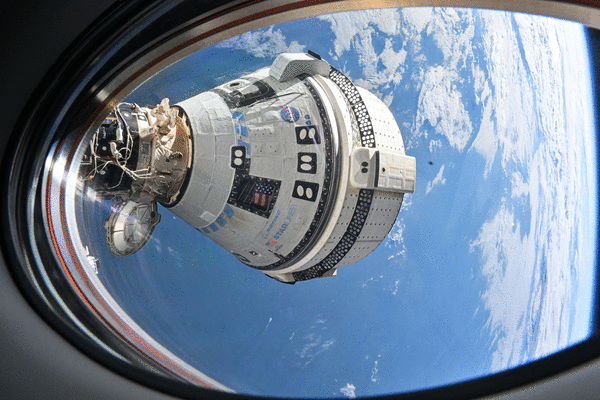
A report on the Boeing Starliner mission that left two astronauts behind on the International Space Station in 2024 has pushed NASA to reclassify the incident in the same category as the Space Shuttle Columbia and Challenger disasters.
NASA Administrator Jared Isaacman said the agency now considers the mission a “Type A mishap,” which means it was an event that resulted in at least $2 million in damage, but it could have been much worse.
“This is about getting the record straight, and I do think that failure to acknowledge this … and ensure that we are transparent and correct, management leadership missteps that could lead to an unhealthy culture is absolutely warranted,” he said during a press conference Thursday. “Failing to do so invites repeats of previous catastrophic events, which is never, never an acceptable outcome here at NASA.”
His statements came in the wake of findings from the Program Investigation Team that examined the Boeing CST-100 Starliner Crewed Flight Test that launched from Cape Canaveral on June 5, 2024 with NASA astronauts Butch Wilmore and Suni Williams for what was supposed to be an eight-day stay on board the station.
The spacecraft, though, suffered thruster failures ahead of docking on top of helium leaks that led to a temporary loss of complete control.
“Control was recovered and docking was achieved. It is worth restating what should be obvious.” Isaacman said. “At that moment, had different decisions been made, had thrusters not been recovered or had docking been unsuccessful, the outcome of this mission could have been very, very different.”
NASA elected to keep the duo on board the station and send Starliner home without them. They ended up flying home on a SpaceX Crew Dragon instead, nearly 10 months later.
Boeing and SpaceX were originally awarded contracts in 2014 to construct spacecraft that would end the U.S. reliance on Russia for trips to the space station after the end of the Space Shuttle Program in 2011. SpaceX was first to its crewed launch in 2020 while Starliner suffered a series of delays.
“The spaceship was not healthy,” he said. “We got to the right place. How we got there was not correct, and that’s why we are trying to set the record straight and classify the situation accordingly, so lessons are learned and not repeated.”
He said he’s thankful Williams and Wilmore’s safety ultimately became the driving force behind decision making.
“We’re grateful we have two astronauts here, and that we did properly investigate this, and that lessons will be appropriately learned across the agency and there will be accountability,” he said.
The report has yet to be released publicly, but Isaacman said it would do so soon.
The administrator called out the agency’s handling of the event, alongside Boeing’s management of the spacecraft’s development.
“Starliner has design and engineering deficiencies that must be corrected but the most troubling failure revealed by this investigation is not hardware, it’s decision making and leadership that if left unchecked could create a culture that is incompatible with human spaceflight,” he said reading from a letter he sent to Congress about the report.
Had the incident been declared a Type A mishap as it has now been classified, it would have triggered an independent review. This report is the result of that now completed review, but was only begun in February nearly five months after Starliner’s return.
“Concern for the Starliner program’s reputation influenced that decision,” he said, adding later, “That was a mistake. It should have been declared from the get-go. That’s why we’re righting the wrong here and trying to course correct.”
He said the root cause for the domino effect that threatened its astronauts’ lives began with how NASA and Boeing interacted during development.
“Starliner, with its qualification deficiencies, is less reliable for crew survival than other crewed vehicles, and that was, as noted by the report,” he said. “But at NASA, we manage the contract. We accepted the vehicle, we launched the crew to space. We made decisions from docking through post-mission actions. A considerable portion of the responsibility and accountability rests here.”
He specifically took to task teams at both Boeing and NASA that prioritized the company needing to match or exceed its fellow commercial crew firm SpaceX.
“Witness statements routinely reflected a belief that management within the Commercial Crew Program could only succeed if Starliner launched,” Isaacman said.
He noted that while Williams and Wilmore remained on orbit, discussions about how the crew should return deteriorated into “unprofessional conduct.”
“Witness statements describe an environment where advocacy tied to the Starliner program viability persisted alongside insufficient senior NASA leadership engagement to refocus teams on safety and mission outcomes,” he said.
He said that leadership failed all the way up to then NASA Administrator Bill Nelson, noting the idea there needed to be two working commercial companies ferrying astronauts to space kept entering into the conversation when “mission and crew safety should have come first.”
That resulted in “a breakdown in culture, created trust issues. And where leadership failed was to recognize that this was taking place and to intervene and course correct.”
The option to have SpaceX come to the rescue and keep the astronauts safe should always have been in the discussion, he said.
“What levels of the organization inside NASA did that exist at? Multiple levels, including, I would say, right up to the administrator of NASA,” he said.
He also noted that there will be consequences on NASA’s side, but did not elaborate on who among its leadership might be affected.
NASA Commercial Crew Program Manager Steve Stich remained on task, at least as of last week with the launch of SpaceX’s Crew-12, and has been working with Boeing to try and get Starliner’s issue remedied for its next flight.
That won’t be with humans on board though, with Starliner-1 still on NASA’s launch schedule to fly no earlier than this April as a cargo mission.
Isaacman reiterated that despite the problems with the program so far, NASA has not given up on Starliner.
“NASA will continue to work with Boeing, as we do all of our partners that are undertaking test flights,” he said. “But to be clear, NASA will not fly another crew on Starliner until technical causes are understood and corrected, the propulsion system is fully qualified and appropriate investigation recommendations are implemented.”
Fallout had already led to a restructure of Boeing’s original agreement under NASA’s Commercial Crew Program cutting its planned operational crew rotation missions to the station from six to three.
Boeing released an updated statement of gratitude to NASA for the “thorough investigation and the opportunity to contribute to it.”
It noted that in the 18 months since the CFT launch it had made “substantial progress on corrective actions for technical challenges we encountered and driven significant cultural changes across the team that directly align with the findings in the report.”
The independent report began in February 2025 and was completed in November.
“NASA’s report will reinforce our ongoing efforts to strengthen our work, and the work of all Commercial Crew Partners, in support of mission and crew safety, which is and must always be our highest priority,” Boeing’s statement said. “We’re working closely with NASA to ensure readiness for future Starliner missions and remain committed to NASA’s vision for two commercial crew providers.”
________
©2026 Orlando Sentinel. Visit at orlandosentinel.com. Distributed by Tribune Content Agency, LLC.






Comments