Peru president's ouster splits right-wing field before election
Published in News & Features
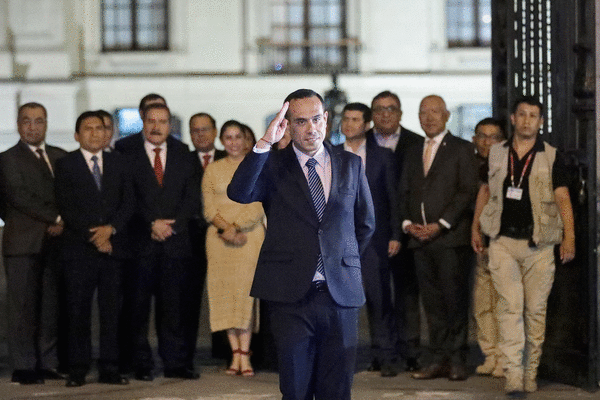
President Jose Jeri’s impeachment by congress Tuesday — making him the third straight president to be removed from office — is highlighting divides within Peru’s political right-wing and the top two conservative presidential contenders just ahead of general elections.
Jeri was ousted over corruption allegations and for hiring young women who’d stayed overnight with him and whom critics saw as unqualified for their roles. But the ouster of the interim president took place just as the election cycle is heating up, with Peruvians set to vote for a new president in April and later in a likely run-off in June.
The latest voter opinion polls show two conservative leading the field, though by the slimmest of margins. Rafael Lopez Aliaga — a former mayor of Lima and leader of the Popular Renovation party — is polling first and positioned his congressional bloc to support Jeri’s ouster. But Keiko Fujimori — a three-times presidential runner up who leads the Popular Force party — is polling second and her lawmakers argued for keeping Jeri in power.
“This could be a pivotal inflection point in the electoral campaign as the two leading right-wing candidates have positioned themselves at the opposite sides of the tussle,” wrote analysts at LarrainVial led by Head of Equity Strategy Luis Ramos.
In an Ipsos poll published this week before Jeri’s removal, Lopez Aliaga led a wide-open field of 36 candidates with 12% of the vote, followed by Fujimori with 8%.
While both candidates are considered pro-market, Lopez Aliaga is proposing stronger regulations on some of Peru’s biggest companies, including pushing banks to lower interest rates on loans. Fujimori has not put forward a regulatory agenda. Both are Catholic, socially conservative and anti-abortion.
Lopez Aliaga would beat any rival in a run-off, according the poll. But a full 42% of Peruvians said they would either null their vote or hadn’t decided yet. Meanwhile, another eight candidates tallied support of 2% to 4%.
“Peru’s electoral process should be analyzed less as a structural rightward shift, as recent elections in Latin American are often characterized, and more as a potential anti incumbent process,” Ramos wrote.
Successor
Peru cycles through more presidents than virtually any country in the world and Jerí’s successor will be the ninth head of state since 2016.
Jerí’s successor is expected to be picked later Wednesday, with the new interim president set for a short mandate of just five months before a newly elected president takes office in late July.
Because Peru has already ousted its last-elected president, Pedro Castillo, and later his vice president, Dina Boluarte, there are no more people left in the line of succession from the original presidential ticket. Like Jeri, who was a lawmaker before being promoted to the presidency, the next interim president must also come from congress.
There are four lawmakers vying to fill the now vacant post. Two were picked by conservatives — Maria del Carmen Alva and Hector Acuña — and two were picked by left-wing parties: Edgard Reymundo and Jose Maria Balcazar.
Peru’s congress is controlled by a mix of conservative parties and analysts expect that a conservative will be selected, with the vote set to start Wednesday evening.
Bonds and stocks did not move following Jerí’s ouster. Peru’s sol currency on Wednesday was little changed, down less than 0.1% against the dollar.
Jeri’s removal “is far from a risk event and at this stage forms part of the institutional political status quo in Peru,” wrote Ramos.
©2026 Bloomberg L.P. Visit bloomberg.com. Distributed by Tribune Content Agency, LLC.






Comments