More than $1.1 billion in medical debt erased in Illinois, with the help of a state program
Published in News & Features
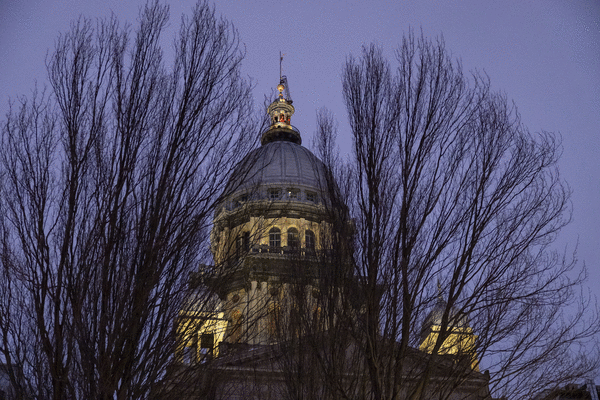
Illinois residents have seen more than $1.1 billion in medical debt erased, with the help of a state program that launched less than a year-and-a-half ago.
More than 500,000 Illinois residents have so far benefited from the program, with average debt relief of about $1,200 per person, according to the governor’s office. In some cases, the program terminated tens of thousands of dollars worth of medical debt for individuals, and, for one person, more than $300,000 worth of medical debt.
So far, Illinois has spent about $10 million on the program, with $5 million in state funds left for this fiscal year. For each dollar Illinois spends on the program, more than $100 of medical debt is terminated, according to the governor’s office.
“No one should be forced to choose between life-saving care and feeding their families, which is why we launched the Illinois Medical Debt relief program,” said Gov. JB Pritzker in a news release Tuesday.
Illinois is one of more than a dozen states and local governments that have partnered with the nonprofit organization Undue Medical Debt to terminate residents’ medical debt. Cook County has also had a separate program to erase medical debt.
The way it works is that Undue Medical Debt is able to buy bundles of medical debt — mostly from health systems — for far less than face value and then forgive that debt.
To qualify for debt forgiveness as part of the program, Illinois residents must have incomes at or below 400% of the federal poverty level, which is $63,840 a year for a single person or $132,000 for a family of four. Or, to qualify, Illinois residents’ medical debt must equal 5% or more of their annual household income.
Individuals can’t apply for the program, which is automatically applied to the debt of people who received care at certain hospitals and health systems, including Lurie Children’s Hospital, Loyola Medicine and UChicago Medicine, among others. Those who benefit from the program receive letters letting them know their debt has been erased.
Algonquin resident Lori Lighthall said she was surprised to receive a letter in the mail telling her that her medical debt had been canceled. Lighthall said she had about $2,300 of debt erased, following a liver transplant about seven years ago. Though she said she has good insurance, it can be tough to pay the entire out-of-pocket maximum each year, given that transplants require significant ongoing follow-up care.
“The bills just kept coming,” said Lighthall, who added she had set up payment plans with providers and talked with her insurance company in an effort to handle all the bills. When the state wiped out her medical debt, it “just allowed me to relax a little bit and just live.”
Cook County’s separate program had terminated more than $664,000 of medical debt for 556,815 Cook County residents as of June. That program, which started in 2022, has been funded with $9 million in American Rescue Plan Act funds.
The issue of medical debt has been much discussed in recent years, with the increasing costs of health care services and the growth of high deductible health insurance plans. High deductible insurance plans require patients to pay thousands of dollars for many types of medical services before their insurance plans will pick up costs.
About a quarter of adults said they had medical or dental bills that were past due or that they were unable to pay in 2022, according to a survey by KFF, a nonprofit organization focused on health policy.
About 63% of adults with medical debt surveyed in 2022 said during the past five years, they had cut back spending on food, clothing and basic household items because of that debt, according to KFF.
Though a number of states have adopted medical debt relief, there’s been mixed evidence of its effectiveness.
People with debt are three times more likely to struggle with depression and/or anxiety, and medical debt disproportionately affects Black and Latino adults, according to Undue Medical Debt.
Past studies have also shown strong associations between medical debt and negative financial and health outcomes. But a 2024 National Bureau of Economic Research working paper showed that the erasure of medical debt did not affect mental health, physical health, health care use or financial well-being.
When organizations or governments buy medical debt that is very old, it doesn’t have much of a material impact, except on credit scores of people whose medical debt has already been reported to credit bureaus, said Neale Mahoney, director of the Stanford Institute for Economic Policy Research, and an author of the paper. People with old medical debt may already have gotten used to ignoring calls and letters from collectors, he said.
“We also know that if we address things earlier you can make a big difference,” Mahoney said, noting that combining medical debt relief with efforts to keep patients from accumulating the debt in the first place, such as through financial assistance at hospitals, may be a more promising strategy.
“The more they’re combining those downstream measures with upstream things to address the issue at the source, I think the greater the prospect of having a real impact,” Mahoney said.
In 2024, the federal Consumer Protection Financial Bureau finalized a rule that would have removed medical debt from many credit reports. The administration of President Donald Trump has since reversed course on that rule, which was set aside in court.
____
©2026 Chicago Tribune. Visit at chicagotribune.com. Distributed by Tribune Content Agency, LLC.





Comments