Who is Thailand's leader Anutin and how did he seal a clear win?
Published in News & Features
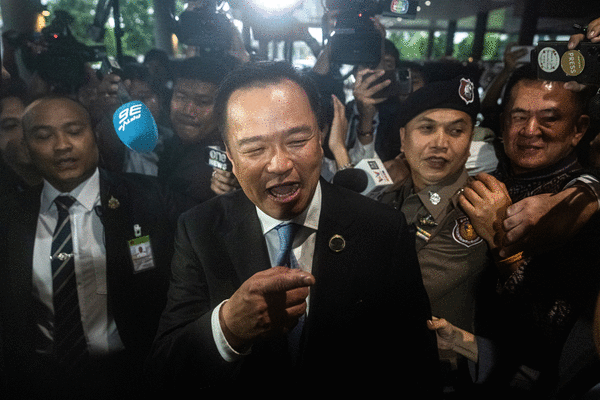
Thailand’s Prime Minister Anutin Charnvirakul’s pro-royalist party scored a resounding win in Sunday’s election over a progressive group seen as a pre-poll favorite.
His conservative Bhumjaithai Party rode on a wave of nationalism tied to a simmering border clash with neighboring Cambodia and championing the status quo to emerge as the largest in the 500-member House of Representatives, according to preliminary results.
Anutin is now set to head a coalition government with a comfortable majority that may end bouts of political upheaval which have rattled the Southeast Asian nation in recent years and left its economy adrift.
Who is Anutin?
The veteran politician — also known by his nickname “Nu,” which means mouse — is one of the country’s most durable power brokers. An engineer by training, Anutin entered politics in 1996 while still running family firm Sino-Thai Engineering & Construction, now known as Stecon Group Pcl, the country’s second-largest builder. He is the son of former acting premier Chavarat Charnvirakul and holds an engineering degree from Hofstra University in New York.
A longtime leader of the Bhumjaithai Party, Anutin has spent years waiting in the wings for power. He held senior cabinet posts across several administrations, cultivating a reputation as a pragmatic operator who works comfortably with both civilian governments and military rulers.
In September, he became prime minister in a deal with the People’s Party, the country’s biggest opposition bloc, after Paetongtarn Shinawatra was ousted by the Constitutional Court for committing ethical violations in her handling of tensions with Cambodia. He called early elections after People’s Party threatened to oust him in a vote of no confidence.
Once known as the “Cannabis King” for spearheading Asia’s first decriminalization policy in 2022, the 59-year-old voted in a weed print T-shirt in 2023. This time around, he distanced himself from the issue in a bid appeal to more conservative voters amid a wider backlash over the proliferation of dispensaries.
In his free time, Anutin collects Buddhist amulets and plays the saxophone and the piano. He also volunteers as a pilot for the “Heart With Wings” program with the Thai Red Cross Society, using his private jet to deliver donated hearts for transplant patients.
How did he rise to power?
Anutin’s rise to the top reflects both strategy and circumstance, and is a testament to his patience and savvy coalition building. Bhumjaithai — which means “proud to be Thai” — started out in 2008 as a breakaway faction from a party linked to Thaksin Shinawatra, the telecom billionaire and political legend. Anutin has since steadily expanded his party’s parliamentary base by consolidating local political families.
Anutin emerged as the new champion of the conservative camp after the exit of Prayuth Chan-Ocha, a former general and coup leader, who ruled from 2014 to 2023. In Thailand, where courts and coups can topple elected governments, the backing of the royal establishment goes a long way.
Most recently, Anutin has used personal clout to recruit technocrats to join his cabinet and positioned himself as a stabilizing force in an increasingly polarized landscape.
A recent surge in nationalist sentiment following bouts of border violence with Cambodia has played to his message of security, sovereignty and continuity.
What are his priorities?
Anutin has a tough stance on defending Thai sovereignty — a message that seems to resonate with voters nationwide. During his final campaign rally on Friday, Anutin said he plans to revoke Thailand’s 2001 agreement with Cambodia aimed at settling a disputed maritime claim in the Gulf of Thailand, which involves potential natural gas reserves. The two countries have been squabbling over it since the 1970s. He has also pledged to build walls along the Thai-Cambodian land border.
His party wants to focus on pragmatic deliverables rather than sweeping reforms. Touting more of his popular co-payment handout program, Anutin underscores continuity and short-term relief to households burdened by debts and high costs of living.
Bhumjaithai estimates its policy platform would require about 148 billion baht ($4.7 billion) a year, with the co-payment scheme requiring 44 billion baht. The biggest outlay would go to its low-cost energy plan aimed at reducing electricity prices through green and community-based power generation.
_____
©2026 Bloomberg L.P. Visit bloomberg.com. Distributed by Tribune Content Agency, LLC.



Comments