Modi officials move to allay fears US deal is bad for India
Published in News & Features
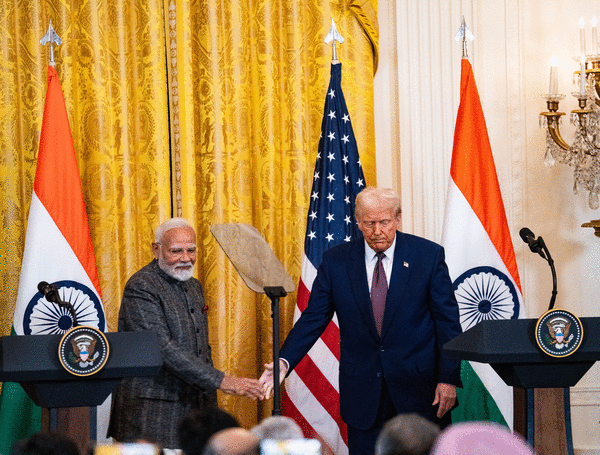
Two days after U.S. President Donald Trump announced a surprise trade deal with India, New Delhi officials moved to counter concerns that the country may have made too many concessions to secure lower tariffs.
Over the past 24 hours, Commerce Minister Piyush Goyal has spoken twice to say India adequately protected its farm sector, especially dairy, during negotiations with Trump. Officials also sought to clarify that a commitment to buy $500 billion of U.S. goods over five years includes projects already in the pipeline.
Trump hailed the deal as a win for the U.S., saying India will drop its tariffs on American goods to zero, while the U.S. will charge a tariff of 18% on Indian shipments, down from 50% previously. Senior Trump officials have said the agreement would open India’s market more widely to American agricultural products.
Indian financial markets rallied on Tuesday and the currency surged, but stocks ended little changed on Wednesday as investors sought more clarity.
“The U.S.-India trade deal can be considered as a positive from macro and market standpoint. However, one should wait for the fine print for more clarity,” analysts at Mirae Asset Mutual Fund said in a note.
U.S. Trade Representative Jamieson Greer said Tuesday that India would cut tariffs on U.S. products ranging from tree nuts, fruits and vegetables to wine and spirits to zero. “This is a big win,” he said. U.S. Agriculture Secretary Brooke Rollins said the agreement would pump “cash into rural America” and narrow the U.S. trade deficit in the farm sector.
The 18% tariff rate on Indian goods — which was confirmed by Prime Minister Narendra Modi — is lower than most Asian peers. The two sides also agreed to lift a punitive 25% duty that was imposed on India for buying Russian oil. In turn, Trump said, India agreed to purchase $500 billion of U.S. goods, buy Venezuelan oil, and reduce tariffs on U.S. imports to zero. Modi’s government hasn’t confirmed those details and neither side has published any documentation to codify the agreement.
The lack of details has fueled concerns that small farmers could be hit particularly hard, especially soybean, maize and cotton growers. Agriculture groups have vowed to organize protests nationwide from Feb 4-11.
“We won’t allow the U.S. farmers to enter India,” said Mohini Mishra, general secretary of Bharatiya Kisan Sangh, a farmers’ group close to Modi’s idealogical parent organization.
The unease reflects long-running areas of tension in the trade talks. During the protracted negotiations, Washington pressed New Delhi to lower barriers in its vast but heavily protected farm sector. The U.S. sought greater access for its genetically modified crops — which dominate American corn and soybean production — as well as entry for its dairy products, another industry India closely guards.
Goyal reiterated in Parliament on Wednesday that India had protected agriculture and dairy in the deal. “During these negotiations, the Indian side has been successful in safeguarding its sensitive sectors,” he said. Farmers are a crucial voting bloc in the world’s most populous nation, where millions of smallholders cultivate less than 2 hectares (5 acres) of land.
Opposition parties have also criticized the deal, saying the agreement appears to favor the U.S. while exposing Indian farmers to competition from American goods.
“The hard work, sweat and blood of Indian farmers has been sold by Narendra Modi in this deal,” Rahul Gandhi, a leader in the opposition Indian National Congress, said on Tuesday.
Modi’s address in the lower house of the parliament, scheduled for Wednesday evening, was postponed after opposition leaders continued their protests, disrupting the proceedings repeatedly through the day.
New Delhi officials — many of them caught off guard by Trump’s announcement — have not elaborated further, saying only that a joint statement would be released in two to three days with more details.
Delayed details
It’s not uncommon for Trump to announce a trade agreement on social media with little detail. In July, he announced a tariff reduction for Vietnam, but his administration only released an a statement on the framework agreement in October — and even that omitted several crucial specifics.
In India, oil refiners are also seeking clarity on the future of Russian purchases after Trump said the world’s third-largest importer would stop buying Moscow’s crude. The Kremlin said on Tuesday it had not heard from India about any plans to halt those purchases.
Concerns have also surfaced in labor-intensive sectors hit by steep U.S. levies, including gems and jewelry, as companies do not have clarity on which products would attract zero duties. It’s also not clear whether tariffs imposed on some sectors — steel and auto components — under Section 232 would be phased out. These tariffs are separate from the reciprocal levies.
--------
—With assistance from Chiranjivi Chakraborty, Alisha Sachdev, Satviki Sanjay, Nguyen Dieu Tu Uyen and Ashutosh Joshi.
©2026 Bloomberg L.P. Visit bloomberg.com. Distributed by Tribune Content Agency, LLC.




Comments