US rachets up pressure on Iraq over post of prime minister
Published in News & Features
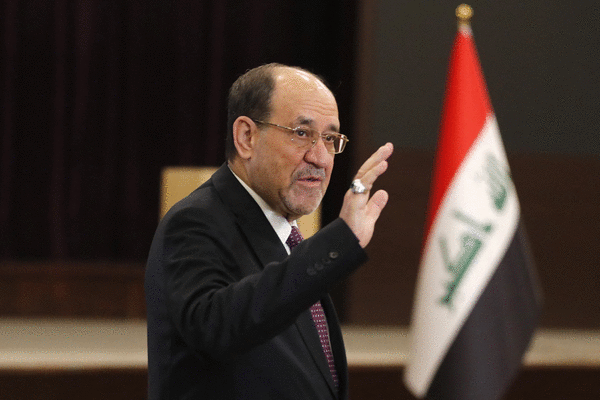
A standoff between the White House and Iraqi politicians over who should be the Middle Eastern country’s next prime minister is worsening, according to several people, with the rift threatening to destabilize the OPEC member.
In recent days, Washington told Iraqi officials it would reduce the country’s access to oil-export revenues if it appointed Nouri Al-Maliki, seen by the U.S. as too close to Iran, as premier, said the people, who asked not to be identified discussing private talks.
The U.S. gave a new warning during a meeting between Ali Al-Alaq, the central bank governor of Iraq, and senior American officials in Turkey last week, said the people.
The Turkey meeting came around the same time that U.S. President Donald Trump, posting on social media, insisted that Iraqi politicians cannot choose Al-Maliki. U.S. frustration has grown because Al-Maliki, who was prime minister between 2006 and 2014, has refused to back down, said the people.
The tensions highlight Trump’s attempts to sever Iran’s influence over its neighbor. In the wake of mass protests in Iran last month, the U.S. has threatened to strike the Islamic Republic if it refuses a deal to curb its nuclear ambitions and missile program as well as end its support for proxy militias across the region including in Iraq.
Iraq held parliamentary elections in November. Under its power-sharing arrangements, the most important post of prime minister should be given to a Shiite, with Sunnis and Kurds getting other positions. It’s unclear how much longer it will take for Iraq’s politicians to make a final choice and form a governing coalition.
A White House official confirmed the meeting had taken place between the Iraqi central bank governor and U.S. Treasury and Federal Reserve officials but called it a routine technical one that was unconnected to the president’s announcement. The official gave no further details.
Al-Alaq’s deputy, Ammar Khalaf, and an aide to the governor both refused to comment. An assistant to Trump’s ambassador to Turkey Tom Barrack, who also acts as his special envoy to Syria and is now increasingly involved in Iraq, has not responded to questions sent to his mobile phone.
Al-Maliki is “still the candidate,” Hisham Al-Rikabi, a spokesman for the politician, said to Bloomberg on Tuesday. There’s “no change on that.”
Following its invasion and occupation of Iraq in 2003, the U.S. set up the Development Fund for Iraq at the Federal Reserve Bank of New York. It was designed to collect proceeds from oil sales and use them to rebuild the war-ravaged country. While the fund itself was wound down in 2011, shortly before former President Barack Obama announced the withdrawal of U.S. troops from Iraq, the arrangements have persisted in a different form. The U.S. says they shield Iraq’s oil income from lawsuits related to the ousted regime of Saddam Hussein.
Money from Iraqi oil exports currently goes to an account in the name of Iraq’s ministry of finance at the New York Fed, which is managed by Iraq’s central bank. The government uses this to pay for its expenditures, including public sector salaries and pensions, amounting to around $7 billion a month. It also receives around $500 million in cash each month from the account that’s sent by plane from New York to Baghdad.
Iraq is one of the world’s most oil-dependent nations, with such revenue accounting for roughly 90% of its budget.
In his post, Trump said America would “no longer help Iraq” if it went ahead with the nomination of Al-Maliki. Trump lambasted the 75-year-old, who at one point was supported by both the Obama and George W. Bush administrations, for “insane policies and ideologies.”
“If we are not there to help, Iraq has ZERO chance of Success, Prosperity, or Freedom,” Trump said. “MAKE IRAQ GREAT AGAIN!”
Iran says resist
Iran has told Iraqi political leaders close to it to resist what it has described as Trump’s bullying and threats, according to people familiar with Tehran’s strategy. Last month, Iran’s Supreme Leader Ali Khamenei dispatched Esmail Qaani, commander of the Islamic Revolutionary Guard Corps, to Baghdad bearing a letter from him in which he congratulated Iraqi leaders for nominating Al-Maliki. This has angered U.S. officials, said these people.
Iran shares an almost 1000-mile border with Iraq and sees it as an extension of its own national security. The two fought a war in the 1980s — while Saddam, a Sunni, still ruled Iraq — in which hundreds of thousands of people were killed.
Iran, a predominantly Shiite country, has built significant sway over Iraq since Saddam’s downfall. That event gave Iraq’s Shiites — also the majority in their country — more power, helped by ideological and political support from Tehran, and a network of Iranian-backed militias.
The outgoing prime minister, Mohammed Shia Al-Sudani, has been in power since 2022 and has balanced ties between Iran and the U.S. He has good relations with the latter and has recently pushed for U.S. oil companies, including Exxon Mobil Corp. and Chevron Corp., to invest more in Iraq. Al-Sudani believes he can still get a second term because Al-Maliki will be forced to step aside or fail to win enough support, Bloomberg has previously reported.
_____
©2026 Bloomberg L.P. Visit bloomberg.com. Distributed by Tribune Content Agency, LLC.




Comments