Alexander brothers' NY trial to begin on sex charges stretching to Miami Beach
Published in News & Features

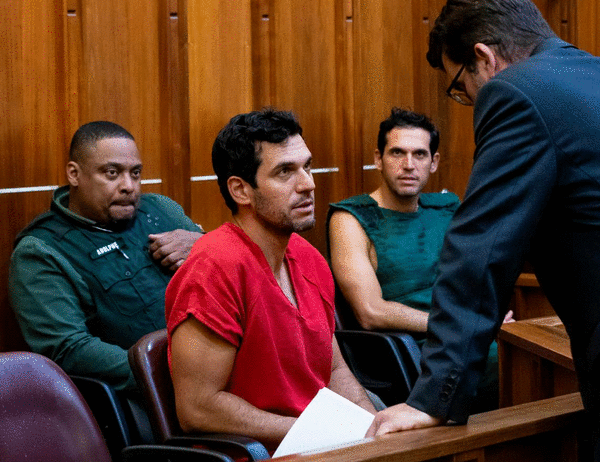


The defense teams representing the Alexander brothers in their sex-trafficking case may have formidable reputations, but they can’t seem to catch a break as the brothers’ trial in Manhattan federal court gets underway with jury selection starting Tuesday.
Against the backdrop of similar, high-profile cases involving music mogul Sean “Diddy” Combs and financier Jeffrey Epstein, a federal judge in New York has consistently rejected defense moves to challenge evidence that may be harmful or helpful to the three brothers from Miami Beach. The judge even disallowed one of the brothers from mentioning his marriage about seven years ago.
Since their arrests by the FBI on sex-trafficking charges in December 2024 in Miami Beach, twins Alon and Oren Alexander and their older brother Tal Alexander have been held at a federal detention center in Brooklyn, the same lockup where Diddy was held. Alon, 38, worked in the family’s security business in the Miami area, while Oren, 38, and Tal, 39, attained fame and fortune as luxury real estate brokers in New York City.
Wealthy roots in South Florida
The brothers, whose parents own a waterfront home in Bal Harbour, Florida, and other assets worth tens of millions of dollars, attended Dr. Michael M. Krop Senior High School near Aventura in the early 2000s. They were seemingly on top of the world until 2024, when the first of more than two dozen lawsuits were filed by women alleging they sexually assaulted them. Those suits not only dredged up dark secrets dating back years but also laid the foundation for their federal criminal case.
Each brother faces up to life in prison, with a mandatory-minimum sentence of 15 years, if convicted of luring dozens of women to apartments, mansions, hotels and parties and then giving them drug-laced alcoholic drinks before sexually assaulting them in New York, Miami Beach and elsewhere. Their trial is expected to last six to eight weeks, with opening statements set to begin Jan. 26.
Once the trial is over, Alon and Oren will also have to face three state rape charges in Miami, including one that stems from an alleged assault at Alon’s Miami Beach condo on New Year’s Eve in 2016. The twins have denied the charges.
This week, in Manhattan, U.S. District Judge Valerie Caproni sided with government prosecutors in opposing the defense argument that Alon Alexander was engaged to be married in March 2019 and therefore withdrew from the alleged sex-trafficking conspiracy at that point. His lawyer argued that prosecutors should not have been allowed to charge Alon on that main count along with his brothers in late 2024 because the five-year statute of limitations had expired — but the judge disagreed.
“Alon Alexander’s motion for acquittal is denied,” Caproni, a former federal prosecutor and Obama appointee, ruled Monday. “The government’s motion to exclude evidence of his engagement and marriage is granted.”
Last week, the judge granted another government motion blocking the defense from mentioning the name of a New York civil attorney, Evan Torgan, who has filed a slew of lawsuits seeking damages on behalf of more than a dozen women. Some are expected to testify at trial that they were drugged and raped by one or more of the Alexander brothers between 2008 and 2021, according to their indictment.
Caproni ruled that, on cross-examination, defense attorneys can ask whether a witness is represented by a civil lawyer, has filed a lawsuit against the brothers and whether the lawyer “has informed the witness what other witnesses have told the government” in the criminal case.
Two underage girls: feds
At least eight women, including two girls under the age of 18 at the time of the incidents in 2009, are identified as victims in the 12-count indictment alleging the main trafficking conspiracy and related sexual assault charges. Those alleged victims are expected to testify against the brothers. Between 15 and 20 additional women are also expected to testify about being victimized.
Most of the women will be allowed to testify anonymously by using pseudonyms for their first and last names, Caproni ruled in another favorable order for the government.
Of course, the value of their testimony will boil down to whether jurors find the women credible. Defense attorneys will likely call into question their accusations of being drugged and raped, using text messages to show that some maintained friendly relationships with the brothers. They’re also going to point out that while testifying as government witnesses, the women are pursuing civil claims seeking millions of dollars in damages from the brothers.
“In these types of cases, when there’s no physical evidence, it comes down to ‘he said, she said,’ ‘’ said Joel DeFabio, a veteran South Florida defense attorney who has been involved in sex-trafficking cases. “When you have one or two or three victims, it’s easier for the defense to go after them. But when you have multiple women telling the same story, it makes it very hard for the defense to discredit them.
“The defense has to throw everything at them,” he said, including portraying the accusers as “gold diggers.”
Sex-trafficking cases can be difficult to prove
In major U.S. cities, federal sex-trafficking investigations have become more commonplace in the era of Epstein and Diddy amid the #MeToo movement. But making such cases is not easy because authorities have to show that a trafficker either physically threatened or forced women to engage in sexual activity with them or others for money to fulfill the legal definition of a commercial sex act.
In cases involving adults, prosecutors have to show that a trafficker used “force, fraud, or coercion to subject victims to engage in commercial sex” under federal law. In cases involving minors, the barriers to prosecution are not as high because the victims are under 18.
In 2019, authorities said Epstein killed himself at his federal lockup in New York City as he awaited sex-trafficking charges stemming from allegations that he sexually abused dozens of underage girls at his mansions in Palm Beach, Manhattan and the Virgin Islands.
More than a decade earlier, after federal prosecutors in South Florida chose not to indictment on sex-trafficking charges, Epstein and his defense team cut a plea deal with state authorities on charges of soliciting prostitution involving minor girls. That led to a 13-month jail term in Palm Beach County. But he was allowed to leave the jail to go to work, returning only to sleep there.
Last year, Diddy was acquitted of sex trafficking and racketeering charges in Manhattan federal court but found guilty of two counts of transportation to engage in prostitution — a mixed result for federal prosecutors in the Southern District of New York. He was sentenced to four years and two months in prison. Diddy was represented by prominent New York attorney Marc Agnifilo, who is the lead lawyer handling Oren Alexander’s defense.
The outcome of the Diddy trial will undoubtedly weigh on prosecutors as they square off with the brothers’ defense teams.
In the Alexander brothers’ trial, “the government will have to show that it’s a commercial sex act versus this is just guys partying who went a step too far,” DeFabio said.
‘Something of value’
That means that to win their case, prosecutors must prove “something of value crossed hands,” such as the brothers paying for plane tickets or hotel rooms for female guests accusing them of sexual assault.
In federal court records, Judge Caproni has expressed harsh views of defense efforts to dismiss the indictment based on arguments that the Alexander brothers did not pay the women for sex, that their relationships were consensual and that there were no toxicology reports proving they drugged the women before allegedly raping them.
“As much as defendants want to characterize the charged conduct as just men behaving badly, this is not what the indictment charges,” Caproni wrote in a November order denying the dismissal motion. “The charges are that three grown men conspired to entice women and girls to travel in interstate foreign commerce, to provide things of value to those women and girls, and to use force and drugs in order to have sexual contact with those victims.”
Caproni also rejected the defense argument claiming the government lacked the authority to prosecute the sex-trafficking crimes and that the power to do so rested with the states where the crimes allegedly occurred, such as New York and Florida.
“While defendants assert that their alleged illegal conduct amounts to no more than the occasional local ‘date rape’ ... that badly misrepresents the nature of the charges,” the judge wrote. She added that the indictment “is not charging sexual assaults that serendipitously occurred when a group of ‘20- to 30-somethings (went) on vacation and one side of the romantic equation fund(ed) part of the vacation.”
Caproni also rejected the defense argument that prosecutors’ interpretation of the “anything of value” portion of the sex trafficking statute was too broad: “To the extent the defendants argue that ‘there is no cash for sex,’ their argument is irrelevant.”
The defense attorneys representing Alon Alexander are Howard Srebnick, Jackie Perczek and Jason Goldman; lawyers defending Oren Alexander are Marc Agnifilo, Teny Geragos and Zach Intrater, along with Jenny Wilson; and lawyers representing Tal Alexander are Milton Williams, Alexander Kahn and Deanna Paul.
Srebnick and Perczek, former partners of the late Roy Black, as well as Wilson are the only attorneys from Miami.
_____
©2026 Miami Herald. Visit miamiherald.com. Distributed by Tribune Content Agency, LLC.






Comments