Debate grows in protest movement over how hard to push back against ICE
Published in News & Features
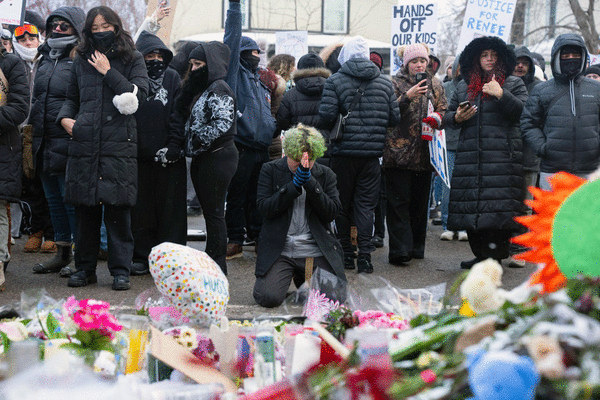
MINNEAPOLIS — The scene that played out this week in Minneapolis illustrated a growing tension among those protesting federal immigration sweeps: Demonstrate at a distance or become more disruptive, even violent?
A federal agent on the night of Wednesday, Jan. 15, shot a man during a struggle to apprehend him, prompting residents to pour from their homes and protesters to flock to the North Side neighborhood.
Some kept their distance, but other protesters thrust cellphones in the faces of agents and hurled profanities. Some launched fireworks and water bottles at federal, state and local police officers. Three vehicles used by federal agents were ransacked, with vandals taking documents, including agent ID badges, from them.
Authorities fired projectiles and chemicals into the crowd. Soon, thunderheads of noxious green gas billowed through the neighborhoods, and police Chief Brian O’Hara declared the gathering “unlawful” while Mayor Jacob Frey called such actions “not helpful.”
Frey, who has urged peaceful protest, said at an evening news conference, “We cannot counter Donald Trump’s chaos with our own brand of chaos.”
A leading anti-ICE group, the Minnesota Immigrant Rights Action Committee, rejected that plea. “There is violence and there is resistance to violence,” a statement read. “They must not be equated.”
The next morning, President Donald Trump threatened to invoke the Insurrection Act, raising the specter of military involvement.
The interactions between protesters and ICE agents have become increasingly charged in the week after an ICE agent shot and killed Renee Good. Yet even before the second shooting, the divergent views among the protest movement — about how and how aggressively to combat the federal government’s presence — have been on display in group chats and street protests, as well as at training events designed to welcome a new wave of volunteers inspired by Good’s death.
At one recent event, some 300 people packed a Minneapolis music venue to sign up for the same kind of work Good was doing Jan. 7, when an ICE agent shot and killed her during a confrontation that appears to have started after Good’s SUV partially blocked ICE vehicles on a residential street.
The training taught ways to protest and document immigration enforcement activity without interfering with law enforcement. Those who have completed the training refer to themselves as “constitutional observers.”
In a live TV address, Gov. Tim Walz essentially endorsed the practice as a way to gather evidence. “If you see these ICE agents in your neighborhood, take out that phone and hit record,” he said. Minneapolis and St. Paul have joined a state lawsuit seeking to halt the current blitz, known as “Operation Metro Surge.”
Walz, Frey and a number of Democratic elected officials have pled for restraint, warning against giving the federal government a reason to militarily occupy Twin Cities streets at a tinder-box moment.
But at the Jan. 8 training event at the Cedar Cultural Center, state Sen. Zaynab Mohamed, DFL-Minneapolis, said it wasn’t her role to tell activists how to protest.
“I know a lot of folks are also getting upset at the idea of elected officials telling them to stay calm,” Mohamed said. “I’m not here to tell you that. You do what you need to do to keep yourself safe and to keep your community safe.”
While some activists stressed the paramount importance of staying alive to resist another day, others, like Ben Ramirez of the faith-based nonprofit Asamblea de Derechos Civiles, pushed for a stronger response to what he called a “racist, fascist” federal government.
“It’s now time to take our gloves off,” he said. “We will not go peacefully.”
Despite different opinions on tactics, those involved say they’re unified in their anger about the behavior of immigration agents, which they see as inhumane and out of control.
“I can’t just sit by anymore,” trainee Lyra Schneider told the Minnesota Star Tribune. “I don’t think anyone knows what that is yet, but people are itching for a chance to do something more significant. I know the polite political discourse line is to be nonviolent and to not put yourself at risk, but at a certain point it’s just ... how many more murders are we supposed to tolerate?”
Shortly before Good’s killing last week, Wes Burdine of St. Paul was patrolling his neighborhood in his vehicle when he found himself abruptly boxed in by agents’ SUVs and face-to-face with a screaming officer.
After a few tense minutes, the agents left.
“At the time I didn’t think it was that dangerous of an encounter, but yesterday made me rethink that,” he said the day after Good was killed behind the wheel of her SUV.
Still, the morning after Good died, Burdine and other activists confronted agents in another grocery store parking lot and informed them they were watching, he said. The agents soon departed.
“Those little wins are exactly why we do it,” he said.
After the shooting, others with similar experiences of having their vehicles surrounded by ICE agents now viewed those incidents through a different lens.
Private group chats have exploded with activity in the days after Good’s killing, with new legions of ICE opponents dividing their time between back-to-back protests and the neighborhood patrol circuit.
Alvin Sheng, a member of the Minnesota Immigrant Rights Action Committee, urged activists to commit to the St. Paul Principles of protest, which activists formulated during protests against the 2008 Republican National Convention. The principles call for disparate groups with different philosophies to make room for all tactics — lawful or not — while keeping disagreements contained within the movement.
Activists have also been wary of far-right provocateurs trying to bait demonstrators into rioting. Out-of-town conservative influencers and anti-ICE protesters have clashed at the Whipple Federal Building near Fort Snelling. When a man burned an American flag at the site of Good’s killing, skeptical protesters hounded him until he left, demanding to know who he was.
On the rare occasion that anonymous users have suggested violence in mass unvetted group chats, others have promptly rebuked and ejected them, warning that instigators could be lurking.
“Do not take the bait,” Gov. Tim Walz begged Minnesotans at a news conference after Good’s killing.
Over the weekend, federal immigration officials detained a number of motorists and passengers, forcefully removing them from vehicles and leaving the vehicles abandoned along busy roads, according to videos posted to social media and statements by Minneapolis Police Chief Brian O’Hara.
Protesters briefly forced their way into a hotel in downtown Minneapolis, apparently targeting it because it’s part of a national chain believed to house ICE agents. Demonstrators also broke windows of a different downtown hotel.
Ella Hagan, of the Party for Socialism and Liberation Twin Cities, said she tells people they may need to reassess their tolerance for risk following Good’s death when considering how to participate. For example, some might choose to deliver food to immigrants laying low at home or drive their children to and from school, rather than risk a confrontation with armed federal agents.
“Everyone can show up as they see fit,” she said.
Colin Anderson of Zion Community Commons, a community center and food pantry in St. Paul, wondered whether recording ICE is even worthwhile. Instead, the group has focused on providing food for immigrant families.
“Everybody wants to help,” he said. “But I’m not sure every action has a productive outcome.”
--------------
©2026 The Minnesota Star Tribune. Visit at startribune.com. Distributed by Tribune Content Agency, LLC.





Comments