Lawmakers explore new taxes to fill California's ongoing budget deficits
Published in News & Features
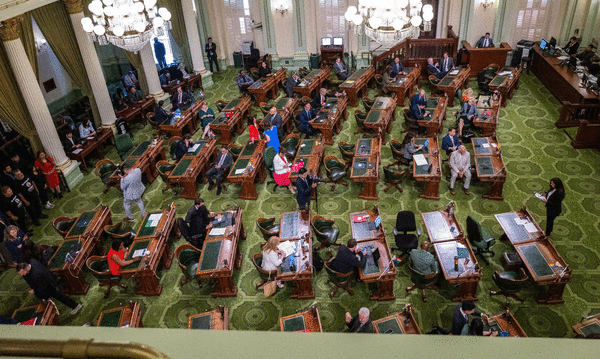

As state lawmakers returned to Sacramento for a new legislative session this week, Democratic members are having serious behind-the-scenes conversations about ways to raise revenue for the state budget.
State spending has outgrown its tax revenues and in recent years the budget has faced structural deficits in the tens of billions of dollars. Barring drastic cuts to spending or bringing in additional revenue, the nonpartisan Legislative Analyst’s Office estimates the deficit could be as high as $18 billion this year and $35 billion in future years.
“We’re really looking at the various options,” said Assemblymember Sade Elhawary, D-Los Angeles, who in recent months has drawn on her organizing background to corral dozens of Democratic lawmakers onto Zoom calls to meet with experts and discuss options. “There are so many good ideas … but we don’t know that we’re at a place where we can say, ‘This is the one.’ ”
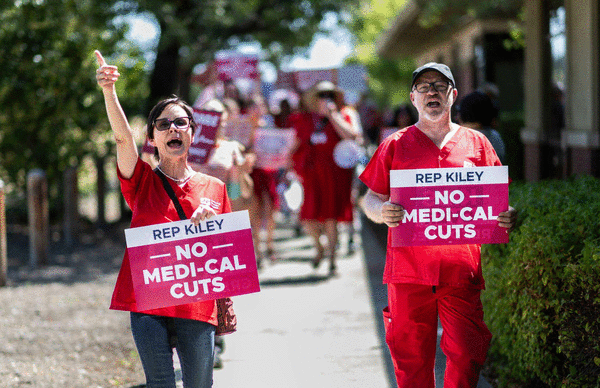
A group of progressive lawmakers began meeting last summer as it became clear the state would move to pare back Medi-Cal coverage for undocumented immigrants as the program’s costs ballooned.
The group has met at least monthly and often more regularly, with around 25 to 30 members in regular attendance, including some moderate Democrats.
One proposal gaining support at least among progressive members is a payroll tax, loosely modeled after a Massachusetts measure, targeting companies that do not offer employees health insurance.
Because those employees are in turn often availing themselves of Medi-Cal, Elhawary said, lawmakers see a logical path to taxing their employers in order to support the healthcare system at large. “I think people will be down for that,” she said, “even the Legislature would be open to it.”
Lawmakers noted the sums such a measure could raise pale in comparison to the gap in health care funding caused by H.R. 1, also known as President Donald Trump’s One Big Beautiful Bill Act. But the current crisis — with people losing access to health insurance entirely or seeing a big increase in their cost because of the elimination of the federal subsidies for Obamacare — provides an opportunity for progressive lawmakers to advance measures they say lead to a permanently more equitable tax system in which companies pay more.
“I don’t think there’s any way we could make up the shortfall,” Asm. Chris Rogers, D-Santa Rosa, another lawmaker who has been part of the discussions, said. “The cuts (from the federal government) and the cuts the Legislature is looking at are putting a really bright light on access to health care and who is paying their fair share and who isn’t.”
Progressive caucus members have also discussed legislation to tighten the reporting requirements for multinational corporations who might shift profits into tax havens offshore. California today allows such companies to choose whether they include their overseas earnings when they report profits to the state, according to tax policy think tanks. The California Budget and Policy Center in an August report labeled that choice the state’s largest “corporate tax loophole,” and found it causes California to miss out on as much as $3 billion in revenue a year.
“For me, closing tax loopholes is the low-hanging fruit,” said Assemblymember Alex Lee, D-San Jose, who chairs the Progressive Caucus. “I have always been in favor of raising progressive revenue. Especially given that Trump just handed the largest unprecedented tax breaks to corporations and his billionaire oligarch friends … it’s important that California stands on its own two feet.”
While Gov. Gavin Newsom has opposed new wealth taxes and other broad tax increases during his tenure, he has approved budgets that included smaller tax hikes on corporations and limiting corporate tax breaks.
Newsom is expected to unveil key priorities for his final year Thursday morning in a State of the State address before lawmakers. His finance director, Joe Stephenshaw, will present the governor’s final spending plan on Friday.
“Of course, I haven’t seen their budget yet,” Lee said. “But I do hope that it will close up tax loopholes, especially given that corporations got such lucrative tax breaks under the Trump tax cuts.”
In response to questions from The Sacramento Bee, representatives from the governor’s office did not address any of the proposals lawmakers have been discussing. Newsom has in the past closed budget shortfalls without resorting to the tax increases currently being discussed by some lawmakers, H.D. Palmer, a spokesperson for the Department of Finance, said.
Republicans, who hold a super-minority in the Legislature and have long raised concerns about taxes and regulations overburdening California businesses, will likely oppose any tax bills. “California has had a Democratic trifecta for years. The state now collects over $80 billion more a year than it did at the end of the Brown administration and still ends up in deficit. That is not a lack of revenue. That is a lack of discipline,” said George Andrews, a spokesman for the Assembly Republican Caucus, referring to former Gov. Jerry Brown and the Democrats’ control over both chambers of the Legislature and the governor’s office.
The Legislature’s tax discussions are unfolding in the shadow of a controversial ballot measure proposal to impose a one-time tax on the state’s billionaires.
That measure, pushed by SEIU-UHW, a labor union representing many of the state’s health care workers, would impose a 5% tax on people with $1 billion or more in assets. That proposal would raise far higher sums than anything lawmakers discussed with The Bee this week.
Proponents have estimated it could bring in as much as $100 billion, which in the short term could be enough to plug many of the budget holes created by federal cuts.
The proposal wouldn’t alter the state’s tax system in the long term, however, as progressive lawmakers have suggested they hope to do. And it faces massive political headwinds, as Newsom has vocally opposed the measure and some billionaires have said they’ll exit California, taking years of future sales tax revenue with them.
Elhawary acknowledged the billionaire tax proposal is a complicating factor in discussions about taxes, which is already a politically fraught issue. But, she said, voters in California and nationwide have demonstrated an appetite for addressing economic inequalities one way or another.
“We can’t make rash decisions without really ensuring that we’re prepared,” she said. “I also think we’re in a time where people are very like, ‘f— the rich, tax the rich, eat the rich.’”
_____
____
©2026 The Sacramento Bee. Visit at sacbee.com. Distributed by Tribune Content Agency, LLC.






Comments