'I'm innocent': Venezuela's deposed ruler pleads not guilty to drug conspiracy
Published in News & Features
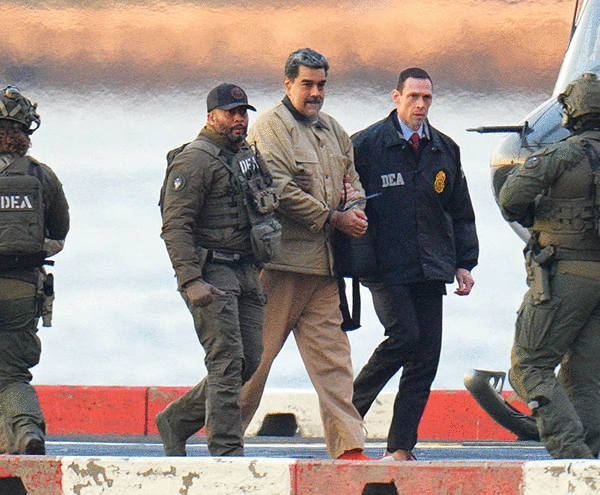
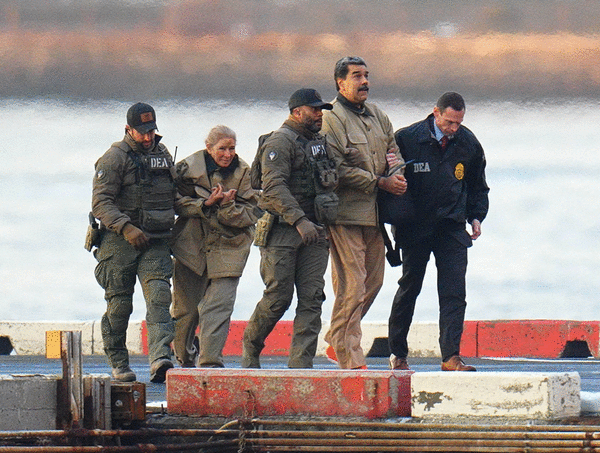
NEW YORK — Ousted Venezuelan President Nicolás Maduro appeared in a federal courtroom in Manhattan on Monday, three days after his stunning capture in a night-time military operation in Caracas by the U.S. military. He pleaded not guilty.
He and his wife, Cilia Flores, who joined him in the courtroom, stand accused of facilitating the trafficking of thousands of tons of cocaine into the United States and two other charges related to the possession of machine guns. Maduro is also accused of narco-terrorism.
The couple had their feet shackled and wore tan pants, orange shirts and another blue, V-necked shirt on top.
“I’m innocent. I am not guilty,” Maduro told the court. “I am a decent man, I am the constitutional president of my country.” He later added that he is not guilty of anything that is mentioned in the indictment.
His wife, Flores, also pleaded not guilty and asserted her role as Venezuela’s first lady. The United States does not recognize the Maduro regime as the legitimate government of the country.
Flores’ lawyers said that she had been injured during the U.S. military operation and requested she get an X-ray to determine if she had fractured ribs. Flores had two visible bandages on her face during the hearing.
Maduro’s attorney said that he would file motions soon challenging the legality of his capture and subsequent arrest. Neither Maduro nor Flores sought bail at the moment. Their attorneys stated they would reserve that right for later.
Asked for further comment after the hearing, one of Flores’ attorneys, Mark Donnelly, provided the following statement: “Our client is in good spirits. We look forward to reviewing and challenging the evidence the government has,” the statement said.
“While we would love to present our side now, we will wait to do so in court at the appropriate time. The first lady is aware that there is a long road ahead and is prepared.”
Maduro’s attorney did not immediately respond to a request for more comment.
Several Venezuelan refugees waited in line for hours to witness the court appearance of their former president and first lady.
Nizar El Fakih traveled up from Washington, where he is a nonresident senior fellow at the Atlantic Council.
“I want to see Maduro facing what I expect to be justice,” said Fakih, an attorney who represented political opponents of Maduro in Venezuela before moving to the U.S. in 2017.
After the hearing, Fakih said he was struck by the fact that Maduro and his wife are afforded rights by the U.S. court system — such as the right to consult their attorneys before the hearing and the right to meet with people at the Venezuelan consulate — that their administration denied its political opponents.
There were dueling rallies across the street from the courthouse following Maduro’s hearing.
A large group celebrating Maduro’s arrest waved Venezuelan flags, pro-Trump signs and several homemade signs including one featuring a picture of Sean “Diddy” Combs welcoming Maduro to New York. In the same New York courthouse, Combs was found guilty last year of two counts of transporting individuals for the purposes of prostitution and sentenced to more than four years of prison.
A smaller group, some waving Palestinian flags, protested Maduro’s arrest and capture.
According to the four-count indictment, which was unsealed Saturday, Maduro, his wife and other government officials stand atop the so-called “Cártel de Los Soles” — Cartel of the Suns — an informal group of elite government officials who benefit directly from their partnership with drug cartels and gangs in South America and Mexico.
The leader of Venezuela’s Tren de Aragua gang, Niño Guerrero, is charged alongside Maduro and the other government officials.
The indictment alleges that Maduro sold diplomatic passports to known drug traffickers when Maduro was Venezuela’s minister of foreign affairs and also helped traffickers fly private planes under diplomatic cover to conceal their activities from law enforcement.
Maduro’s wife, Flores, who was previously president of Venezuela’s national assembly, is accused of accepting hundreds of thousands of dollars in bribes to set up a meeting between a drug trafficker and the director of Venezuela’s national anti-drug office. The indictment alleges that the drug trafficker then set up monthly bribes to the anti-drug director, a portion of which was transferred to Flores.
The indictment covers activity beginning in 1999, when Maduro’s predecessor, Hugo Chavez first took office in Venezuela. Chavez died in 2013, at which point Maduro assumed the presidency.
The indictment also alleges that in 2017, Maduro’s son facilitated the transportation of hundreds of kilos of cocaine to Miami. It also alleges that he discussed with drug traffickers about arranging a 500-kilogram shipment of cocaine to be unloaded from a cargo container near Miami.
Notably absent from the indictment is any mention of fentanyl trafficking — a charge touted by the Trump administration in the initial days of the remarkable U.S. military buildup against the Venezuelan regime. The U.S. military so far has conducted around three dozen lethal strikes on boats it says were transporting drugs in the region, killing more than a hundred people.
The administration is yet to produce any evidence to the public that the individuals killed are drug-traffickers, leading to concerns both in Congress and among U.S. allies that the lethal strikes may be illegal.
The trial of Maduro and his wife is being presided over by Judge Alvin K. Hellerstein, a Clinton appointee.
_____
©2026 Miami Herald. Visit at miamiherald.com. Distributed by Tribune Content Agency, LLC.




Comments