Wind-battered Lick Observatory rushes to shield historic telescope after dome damage
Published in News & Features
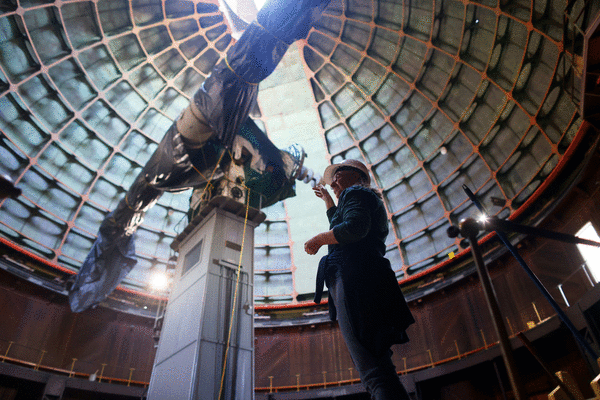
Winds exceeding 110 mph that tore across the top of Mount Hamilton early Christmas morning blasted a massive steel protective door off the iconic white dome at Lick Observatory.
Now, with back-to-back rainstorms bearing down on the Bay Area, officials this week are racing to seal the gaping hole and protect the historic Great Lick Refractor telescope beneath it.
“I’ve never seen or even heard of damage like this to a dome,” said Lick Observatory site superintendent Jamey Eriksen.
The damage threatens one of the Bay Area’s most significant scientific landmarks — a telescope that helped shape modern astronomy and still draws thousands of visitors each year to the mountaintop east of San Jose.
From the Bay Area below, the dome sheltering the Great Refractor still appears intact. Up close, the damage is stark: a multi-ton, 60-foot crescent of steel that once covered half the dome’s vertical opening is gone. It was one of two giant doors that slid open to reveal the night sky, then closed again to protect the telescope from the elements. Now it lies on the pavement beside the dome.
Inside, an all-hands scramble by a skeleton holiday-season crew helped avert worse damage. Beneath the dome, the 57-foot-long Great Refractor telescope is wrapped in black plastic tarps from eyepiece to lens assembly. Above it, the fallen door has left a gap in the steel dome roughly 4 feet wide and 10 feet tall, with a larger opening below it covered only by a fabric windscreen.
This week’s first storm is expected to dump about an inch of rain atop Mount Hamilton on Wednesday evening into Thursday morning. A second storm could add another inch Friday and Saturday, National Weather Service meteorologist Dial Hoang said Tuesday.
“Lenses, of course, don’t like water,” Lick astronomer Elinor Gates said. “Electrical equipment doesn’t like water.”
What a permanent fix will look like remains unclear. Even a temporary solution has proven difficult. Contractors suggested drilling into the surface of the dome — built in the 1880s — to fasten sheets of plywood or other materials over the opening. Eriksen rejected that approach, saying the solution will likely involve attaching large sheets of wood or siding to the dome’s interior steel framework instead. Tarps may also be suspended beneath the opening to catch any rain that gets through.
“It is not an easy solution,” Eriksen said. “We’re just trying to get through, protect this amazing telescope and building.”
Why the steel door fell off remains unclear. It initially crashed down onto an adjoining building, breaking windows and splintering attic beams, before a crane hoisted it and lowered it to the ground.
“Every winter we get very strong winds of 90 to 100 miles per hour,” Gates said. “This just seemed to have been a little more sustained than usual.”
The dome’s aging hardware may have made it vulnerable, she added. Newer research telescopes at Lick appeared undamaged and will continue operating, according to the University of California, which owns and operates the observatory.
When the damage was discovered Christmas morning, the roughly 10 staff members who had not left for the holidays rushed to the dome as rain fell and winds continued to buffet the peak.
“The set of skills up here is very good,” Eriksen said. “We worked full blast Christmas and the next day.”
Sensitive equipment and historical artifacts — including the Mills spectrograph used in the observatory’s early days to measure the colors of light emitted by stars and galaxies — were wheeled out as rain blew inside and winds swirled through the opening.
Gates and others mopped the circular wood-laminate floor surrounding the telescope, which sits atop elevators that raise it about 16 feet for observation. Others climbed a spiral staircase along the pedestal that supports the instrument. A 60-foot black tarp was cut in half, wrapped around each side of the telescope and secured with ratchet straps and minimal duct tape.
“We had nothing falling inside the dome but water,” Gates said — an outcome staff described as a relief under the circumstances. “We’re reasonably certain the telescope is fine, and that is a huge relief because of course the telescope is the heart and soul of this place.”
Built between 1880 and 1888, the Great Refractor — with lenses 3 feet across — was once the largest lens-based telescope in the world. For the 100 years after it was hauled up Mount Hamilton by horses and mules, it ranked among astronomy’s premier research instruments. It gained worldwide fame in 1892 after astronomers used it to discover Jupiter’s fifth moon, Amalthea, almost 300 years after Galileo identified the planet’s first four.
Later advances in mirror-based telescopes eventually eclipsed its scientific dominance.
But, said Andrew Fraknoi, former head of the Astronomical Society of the Pacific and an astronomy professor at the University of San Francisco, the telescope “remains both a great teaching tool, and a historical place where generations of students were trained.”
Still the second-largest refracting telescope in the world, it anchors Lick’s popular visitor programs, which draw adults and children eager to peer through its eyepiece into distant galaxies.
“At many observatories, you just showcase the science and you go to museums for the history,” Fraknoi said. “But here, you have a combination of both the history and science.”
Those public programs — including nighttime stargazing events, tours and educational programs — are now on hold indefinitely. The observatory’s Main Building, which houses the Great Refractor dome, the smaller Nickel reflector dome and an exhibit and lecture space between them, has been red-tagged by the county as temporarily unusable.
“It’s going to take many months,” Gates said. “This is going to be a real blow to our public programs.”
Fraknoi noted that terrestrial telescopes like those at Lick remain vulnerable to extreme weather. The site narrowly escaped destruction during a major wildfire in 2020.
“Fire, water, wind — all those things are issues,” he said. “In part, that’s why we have telescopes in space. But they can get hit by a chunk of rock, so no observatory is totally safe.”
©2025 MediaNews Group, Inc. Visit at mercurynews.com. Distributed by Tribune Content Agency, LLC.




Comments