Chevron steers risky path to oil's biggest prize in Venezuela
Published in News & Features
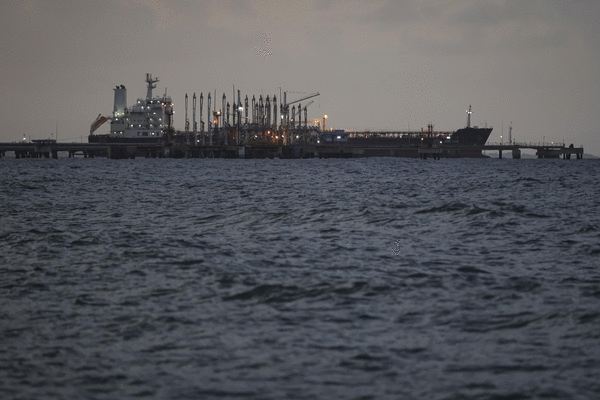
For almost two decades, oil giant Chevron Corp.’s stubborn persistence in Venezuela looked like folly: with billion-dollar investments constantly under threat from the tug-of-war between Caracas and Washington, D.C.
Now, however, that strategy has placed the world’s biggest petroleum prize within Chevron’s reach.
As tensions mount between Venezuela and the U.S., Chevron remains the only global oil company with access to the country’s immense crude reserves — the largest known. Should U.S. President Donald Trump, who has deployed a fleet of warships to the Venezuelan coast, attack and overthrow the government, no company would be better positioned to help rebuild the country’s battered oil industry. Should Trump and Venezuelan President Nicolás Maduro strike a deal, the country would need to export as much oil as possible to generate cash — again benefiting Chevron.
The Houston company’s unique position carries big risks — not least to its people — if hostilities break out. Chevron could still find itself shut out of the country by either Maduro or Trump, a fate that has befallen multiple foreign oil companies in Venezuela over the years.
But both Trump and Maduro have reason to see Chevron as a useful ally, and neither side has moved to halt the company’s operations during the current standoff. As of Thursday, Chevron was preparing to export 1 million barrels of Venezuelan crude, according to Bloomberg tanker tracking — a day after Trump labeled the country’s government a “foreign terrorist organization.” Chevron produces about 200,000 barrels a day from multiple joint ventures with Venezuela’s national oil company and exports its share of production to U.S. refineries on the Gulf Coast.
“These are very tough waters to navigate,” said Francisco Monaldi, director of Latin American energy policy at Rice University in Houston. “But Chevron is a very attractive partner for Venezuela and the US government. It a very strong strategic position in almost any possible scenario.”
The situation for most of the Venezuelan oil industry is bleak.
Trump’s blockade in the southern Caribbean means state-owned Petróleos de Venezuela SA can no longer export crude through its shadow fleet of “ghost vessels” to China and may have to start shutting in wells within 10 days. A cyberattack hit Venezuela’s main export terminal in December, while air travel in and out of the country has largely halted after signal jamming and U.S. warnings of heightened military activity.
Successive U.S. administrations have slapped sanctions on Venezuela, as Maduro tightened his grip on power. But Chevron, which started exploring for oil there in 1923, has obtained special licenses to circumvent sanctions. And while the Venezuelan government arrested (and later released) two Chevron employees in a 2018 probe of alleged corruption, Maduro often praises the company, saying he wants it to stay for “another 100 years.”
A unique arrangement
It’s a unusual arrangement that racks up enemies in both Caracas and Washington. American critics, who at times have included Secretary of State Marco Rubio, accuse the company of funneling billions of dollars to a brutal, corrupt regime. Some hard-liners within Venezuela’s ruling party, meanwhile, see Chevron as a symbol of U.S. imperialism and want to end foreign influence over their country’s biggest industry.
The company, for its part, says its Venezuela operations help stabilize the local economy and the entire region, while complying with all U.S. sanctions and laws. People familiar with Chevron’s internal discussions say its executives don't welcome the increased public scrutiny that comes with the Venezuela position but believe the stay-put strategy is sound given the potential windfall. It also sends a message to other oil-rich governments around the world that Chevron is a partner for the long-term — even in difficult circumstances, they said.
“We’ve been there through ups and downs, and like many places in the world, we have to take a long view on our presence in countries like this,” Chief Executive Officer Mike Wirth said this month on Bloomberg TV.
Venezuela’s giant reserves long attracted international oil companies. That changed after Hugo Chavez, a protege of Cuban revolutionary Fidel Castro, won Venezuela’s presidency in 1998. The larger-than-life paratrooper turned socialist icon passed laws requiring the state to own 51% of any joint venture with foreign companies. It amounted to nationalizing the country’s oil industry. ConocoPhillips, then the largest foreign investor in Venezuela, refused the new terms and exited in the early 2000s. Exxon Mobil Corp. did the same.
Chevron decided to stay. Ali Moshiri, the company’s Latin America chief at the time, had a close relationship with Chavez and sought to build a partnership rather than leave. At one industry event in the mid-2000s, Chavez noticed Moshiri didn’t have a chair, so he jocularly offered his own. Moshiri accepted after an embrace and a series of back slaps.
“You can’t have an attitude of ‘in and out,”’ Moshiri told Bloomberg News in 2005. “We have to go where the oil is.”
The bet paid off, at least to begin with. Oil prices climbed from $25 a barrel in 1999 to a record high of $146 in 2008, meaning Chevron and Venezuela were sharing a much bigger pie, even if the U.S. company had a smaller slice. The relationship continued under Maduro after Chavez’s death in 2013.
Relations between Maduro and the U.S. government, however, steadily worsened. Trump in his first administration placed sanctions on Venezuela’s oil industry, and President Joe Biden maintained them, sparking a period of intense lobbying by Chevron in Washington. Chevron argued that its Venezuelan oil played a critical role in U.S. energy security, because Gulf Coast refineries are set up to run the heavy crudes that Venezuela produces, people familiar with the lobbying efforts said at the time. Leaving the country would only hand more assets to Maduro while creating a void that Russian and Chinese companies could exploit, they said.
Facing a gasoline price spike in 2022 after Russia’s invasion of Ukraine, Biden relaxed sanctions, allowing Chevron to ramp up production. In an effort to save face against a regime with a deteriorating human rights record, the Biden administration’s public waiver expressly forbade Chevron from paying taxes or royalties to any Venezuelan state-owned entities. A secret private license, however, which was revealed by Bloomberg News in March, allowed these payments.
Venezuela’s oil continued flowing — lowering U.S. gasoline prices — while Chevron’s operations stayed within the law. The episode underscored how much the US still benefited from Chevron’s presence in Venezuela even as it attempted to raise pressure on Maduro.
The long game
Venezuela isn’t the first country in which Chevron has deployed its "hang around the oil" strategy.
As Standard Oil of California, it made the first commercial discovery in Saudi Arabia in 1938 and has maintained a production presence there for seven decades, even as most of the kingdom’s oil is now produced by state-controlled Saudi Aramco. Chevron was the first oil major in Kazakhstan after the fall of the Soviet Union and endured technical and political challenges as it built up production to more than 1 million barrels a day over three decades.
But the strategy is not without costs. It exposes Chevron to disruptions from conflicts around the world. Meanwhile, critics pillory the company for partnering with anti-democratic governments that use oil money to suppress human rights. That includes Venezuela.
“Companies like Chevron are actually providing billions of dollars of money into the regime’s coffers,” Rubio said in January. “And the regime kept none of the promises that they made.”
While Trump and Rubio have refrained from saying they want to oust Maduro, they have steadily ratcheted up pressure on him. And weak oil prices, now trading near their lowest level in four years, have allowed the U.S. to act more aggressively, according Carlos Bellorin, an executive vice president at Welligence Energy Analytics.
Trump “can afford to disrupt Venezuelan flows with far less risk of a price spike, especially one that would hit U.S. gasoline prices,” he said. Blockading sanctioned oil tankers in the south Caribbean helps Trump remove a key source of revenue from Maduro, whose government has become adept at using “dark fleet” vessels that turn off or spoof their transponder signals to export oil despite sanctions.
If there were regime change in Venezuela, it’s unlikely Chevron would be only oil major interested in the country. Exxon would look at any potential opportunity but would be cautious because its assets there have been expropriated in the past, Chief Executive Officer Darren Woods said in an interview last month.
“I wouldn’t put it on the list or take it off the list,” Woods said. “We’d have to see what the circumstances are at the time.”
Chevron CEO Wirth, in contrast, remains steadfast that the company will be staying, despite the difficulties.
“We don’t choose where the resource is,” he said at the Wall Street Journal CEO Council Summit earlier this month. “If we left every time we had a disagreement with the government, we would be leaving everywhere — including this country.”
____
(With assistance from Fabiola Zerpa, Peter Millard, Lucia Kassai and Andreina Itriago.)
©2025 Bloomberg L.P. Visit bloomberg.com. Distributed by Tribune Content Agency, LLC.





Comments