Bondi confronts aftermath of beach attack as crime scene reopens
Published in News & Features
SYDNEY — The gray arched footbridge, just a few meters from the grassy park where Jewish people gathered to celebrate Hanukkah last Sunday, gave the Bondi Beach gunmen an elevated vantage point over the crowd they attacked.
Police on Thursday peeled back the metal barriers that had surrounded the scene of Australia’s worst-ever terror incident, allowing the public to enter the area for the first time since the massacre that left 15 people dead.
From the concrete overpass where the father-and-son duo opened fire, the view spans virtually all of Archer Park and the children’s playground inside. As the area reopened, only a small trailer carrying pieces of a kids’ climbing wall remained as a reminder of the Hanukkah gathering.
Much has happened in the five days since the attack. The surviving gunman accused of the massacre, a 24-year-old identified as Naveed Akram, has been charged with 59 offenses including murder and terrorism. His 50-year-old father was killed in the shootout.
The victims — who ranged from 10 to 87 years old — are being laid to rest. Prime Minister Anthony Albanese is shouldering intense pressure over his handling of a tide of antisemitism over the past two years by pursuing a post-attack agenda of gun control and tougher action on anti-Jewish hate.
And at Bondi Beach, residents and businesses are struggling to come to terms with the atrocity. The sandy strip is famous worldwide, and a shaken community now fears the longer-term damage to one of Australia’s top destinations.
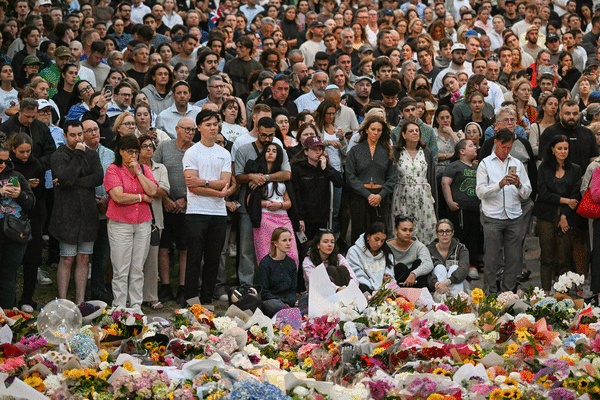
In Bondi, it’s hard to avoid the attack’s aftermath. Dozens of armed police officers have descended on the area. They stand guard by Archer Park, where a sprawling floral tribute to the victims continues to grow.
On Thursday morning, a small boy wearing a kippah stood at the edge of the memorial site, struggling to hold a bunch of flowers that was almost as big as him.
Nearby, Porch & Parlour is usually a cheerful haunt for locals seeking breakfast or a morning coffee. But the horror of the attacks is now weighing on owner Louise Shaw. The 39-year-old says she’s trying to remain strong to support her young staff, but is struggling to process the tragedy.
Shaw said she was eating at a nearby restaurant when the attacks started. After taking cover, she rushed to the scene where she helped a woman who’d been shot in the eye, flagging down a car to take her to the hospital.
“Secretly, I am not going great,” Shaw said. While loyal customers are supporting her, Shaw is concerned the next few months will be tough on her business. “I don’t expect it’s going to very busy over the summer.”
On Thursday, a clear, warm day at the iconic beach, regulars were starting to return. Swimmers completed laps of the Icebergs pool at the southern end of the beach, as they have for decades. Walkers strode out on the popular coastal path to nearby Bronte Beach. A few dozen surfers bobbed in the waves.
But despite the resumption of activity, fear is not far from the surface. And it may be long-lasting.
“You don’t have to be Jewish to be terrified,” said Johan Gabrielsson, 62, a local who has swum at Icebergs for 27 years. A Swedish journalist with three adult children, Gabrielsson said his daughter broke down in tears on Wednesday thinking of the little girl who was killed.
“It could be years before people start feeling safe again,” he said.
Global attention on the shooting may deter tourists from visiting Bondi, or at least make them delay their trips, according to Hasin Yousaf, a senior lecturer at the University of New South Wales who analyzes the financial effects of such incidents. The fallout could hurt the local economy for three-to-five years, Yousaf said.
“If you look at the economic impacts of mass shootings, they are really detrimental for local economies,” he said.
A travel shop at the southern end of the beach, offering camper vans for rent, or trips to Uluru and the Blue Mountains, was empty on Thursday morning. Staff were too upset to talk.
Others are more upbeat. Paul Georgiou, whose family has run Bondi Surf Seafoods on the beach front for more than half a century, said his shop has survived downturns, recessions and COVID-19, and it will get through this, too. As Sunday’s attacks took place, four families fled the site and sheltered in Georgiou’s shop.
Yes, business is down, but tourists who booked trips to Sydney long ago will still visit, maybe as soon as next week, the 65-year-old said.
“It’s early days,” said Georgiou, filling shelves behind the counter with fish fillets and calamari rings, ready to fry. “The crowds will come back.”
Local resident Alana Hannan walked to the crime scene on Sunday evening and comforted with hugs some of those who had escaped. Sitting on a window ledge of a local pub days later, she said she’s numb and hasn’t been sleeping.
“Bouncing back means wrapping our arms around everyone,” Hannan, 64, said. “The process is going to take a while.”
(Nasteho Said contributed to this report.)
©2025 Bloomberg L.P. Visit bloomberg.com. Distributed by Tribune Content Agency, LLC.






Comments