DOE using its own land to help pair AI centers, nuclear reactors
Published in News & Features
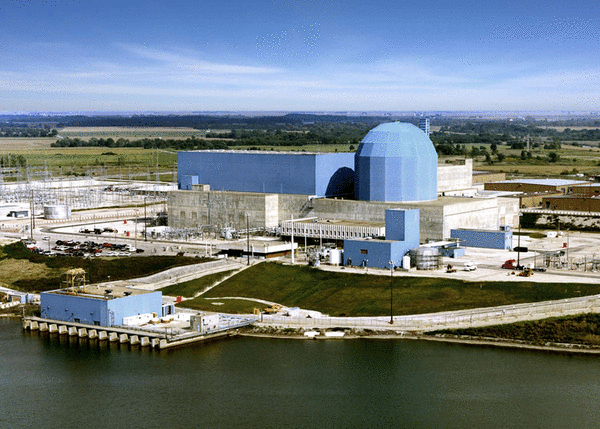
WASHINGTON — The Energy Department wants to build nuclear-powered artificial intelligence data centers on federal land using new public-private partnerships.
Co-locating advanced nuclear reactors with data centers on DOE sites is part of the Trump administration’s bid to accelerate the development of both technologies, sources say, as research efforts tease out their “symbiotic relationship.” But questions remain about how these projects could affect local communities and the actual timeline for bringing more nuclear power online.
DOE first announced its intention to use federal land for data center development and co-location in early April with a request for information to gauge industry interest. According to the RFI, the department intends to begin construction at the selected DOE sites by the end of the year, with operations beginning by the end of 2027.
The department said in July that its Idaho National Laboratory, Oak Ridge Reservation, Paducah Gaseous Diffusion Plant and Savannah River Site would house the co-location projects. Idaho National Laboratory, or INL, is expected to announce this month which nuclear power and AI companies will participate in the project on that site. Offers for Oak Ridge and Savannah River were due in early December, and companies hoping to work at the Paducah site have until late January to apply.
Two questions factor into the co-location initiative, according to Chris Ritter, the national technical director for AI at the DOE’s Office of Nuclear Energy and the division director for scientific computing and AI at INL.
“How can we use nuclear energy to power the data centers — the demand — that we have?” he said. “And the other part of the equation is how can we use AI to accelerate the nuclear time deployment timelines and reduce the cost?”
The tech industry already is showing enthusiasm for pairing AI data centers with nuclear power. Google, Amazon, Microsoft and Meta have announced their own separate partnerships and projects to power some of their facilities, including data centers, with nuclear energy.
Accelerating development
The federal government has identified advanced nuclear reactors, such as small modular reactors, as a prime way to address increasing demands for power and has invested financial and regulatory support into accelerating the development of that technology.
Advanced reactors use the same fission process — splitting atoms to release heat and energy — as nuclear power plants already deployed for commercial use. But the designs currently under development with DOE’s assistance are intended to be much smaller, easier to manufacture and scale, and safer than traditional reactors. Through its Reactor Pilot Program, the department has set a goal of getting at least three advanced reactors to criticality, meaning they are producing a sustained nuclear reaction, by July 4.
Patrick Hedger, director of policy for the tech industry group NetChoice, said nuclear energy is a good choice to power data centers, adding that he believes a new data center is needed every week to keep up with the growing demand for AI in this country.
“The amount of power, the energy density, and … the fact that it is a really stable and controllable source of energy makes it a really good fit,” Hedger said. “You can’t have downtime in data center operation.”
The concept of co-location has advantages for all participants, Ritter said.
For AI developers, he said, onsite nuclear reactors would help ease the industry’s growing demands for power.
“From the nuclear perspective,” he said, “you have a unique customer. You have someone who needs your power generation source.”
Andrew Chien, a professor of computer science at the University of Chicago and senior computer scientist at Argonne National Laboratory, said tech companies also will benefit from collaborations with the “wealth of innovation” taking place at DOE.
“There are projects on data center design, there are projects on cooling technology, there are projects on large-scale computing,” he said, naming a few examples.
INL’s director of nuclear reactor development, Brian Smith, said using federal land also helps “streamline the deployment for commercial industry.”
Because these projects are part of commercial activity, he said, the Energy Department would not have to handle the physical construction and development of the centers. But it could help with the permitting and regulatory process on department land without having to worry about state or local jurisdictional considerations.
“Doing it on federal lands is a way to get at this and get at it quickly,” Smith said.
Hedger, of the tech group, agreed an industry partnership with government would reduce the red tape required to get data centers up and running.
“As long as the partnership is about making sure that regulatory barriers are being cleared and expediting that process versus adding new ones, that’s certainly a positive sentiment,” he said. But, he added, “it remains to be seen how it plays out.”
Another ‘Manhattan Project’?
When announcing the site selections in July, Energy Secretary Chris Wright said department land is “uniquely positioned to host data centers as well as power generation to bolster grid reliability, strengthen our national security, and reduce energy costs.”
“By leveraging DOE land assets for the deployment of AI and energy infrastructure, we are taking a bold step to accelerate the next Manhattan Project — ensuring U.S. AI and energy leadership,” he said.
Wright has continued using the Manhattan Project reference when talking about the DOE’s efforts to build out AI and energy, signaling a significant federal investment in developing both those technologies. Last month, when announcing the launch of the Genesis Mission program to integrate decades of federal scientific data into a new AI supercomputer platform, he added a comparison to the Apollo space program.
“Throughout history, from the Manhattan Project to the Apollo mission, our nation’s brightest minds and industries have answered the call when their nation needed them,” he said.
One of the goals of Genesis Mission, established by executive order, is to help aid the build-out of advanced nuclear fission power.
Big tech companies such as Anthropic, Nvidia, Amazon and Microsoft are also collaborating with the government on that effort, creating a “kind of public-private ecosystem,” Ritter said.
Climate and communities
That same group of companies, along with others, have seemingly latched on to nuclear energy as a potential answer to their own emissions reductions goals while still meeting the demand to power AI.
Chien, of Argonne National Laboratory, said nuclear energy is an “attractive option” for companies looking to decrease climate harms from their data centers because it’s “close to zero carbon power technology.”
Still, he also called the climate pledges companies are trying to fulfill a mistake, adding their goals might not be met on time or even by 2040.
“The companies mated themselves to these goals that I think are extremely difficult, you know, probably unrealistic for the foreseeable future,” he said. “And as a result, they’re in kind of a bind, because the public opinion is such that it’s hard to recant these kinds of goals.”
Chien said there will be cultural differences between faster-moving technology firms and the scientific-minded, slower-moving DOE. But he thinks those differences could help improve data center culture.
For instance, he said, some data center companies might not want a relationship with the communities in which they’re building. But the national labs often have an existing connection to their local communities, and that could rub off on Big Tech, even if “these public-private partnerships, I don’t think they could ever even aspire to be a large fraction of the total data centers that are built.”
Scott Babwah Brennen, head of NYU’s Center for Technology Policy, called nuclear energy a “side show” to questions about the environmental and community impacts of data centers, questions that might not have the “democratic value” of local input as the Trump administration pushes for less red tape.
“It seems like it’s not an immediate fix, even in the best case scenario, right? Like we’re talking many years out. So that leaves us with a lot of questions,” he said, such as “what are we going to do for the next five years, or the next 10 years, or however long it takes” before nuclear power can serve the energy needs of the data centers.
_____
©2025 CQ-Roll Call, Inc., All Rights Reserved. Visit cqrollcall.com. Distributed by Tribune Content Agency, LLC.






Comments