Ukraine and US make 'real progress' as European leaders meet
Published in News & Features
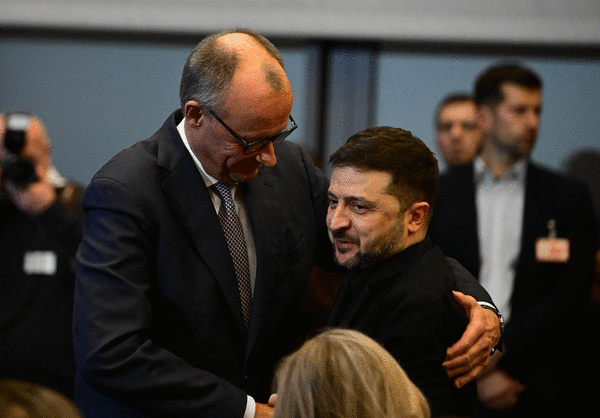
Ukrainian and U.S. negotiators gave an upbeat assessment of talks in Berlin on ending Russia’s war, with a top aide to President Volodymyr Zelenskyy voicing optimism that the sides could close in on an agreement by the end of the day.
Zelenskyy’s top security official, Rustem Umerov, cited “real progress” in the German capital after the Ukrainian leader and his team held a second day of discussions lasting about five hours with with U.S. officials led by special envoy Steve Witkoff and Jared Kushner, President Donald Trump’s son-in-law.
A U.S. official said consensus was reached on an estimated 90% of issues, and that negotiators in specific working groups may meet again this coming weekend in the U.S., possibly in Miami, the site of previous discussions.
“Over the past two days, Ukrainian-U.S. negotiations have been constructive and productive, with real progress achieved,” Umerov said in a statement on platform X. “We hope we will reach an agreement that will bring us closer to peace by the end of the day.” Zelenskyy told a business conference in Berlin that talks were “very constructive.”
Negotiators spent much of Monday discussing security guarantees, a central demand from Kyiv to ensure that Russia will be deterred from attacking again. Discussion involved “Article 5-like” guarantees, referring to measures similar to NATO’s mutual defense clause, according to the U.S. official, who spoke on condition of anonymity.
The Americans and Ukrainians also discussed territorial issues, with the U.S. backing a Russian demand for Kyiv to withdraw from areas of its eastern Donetsk region that Moscow’s forces have failed to seize since 2014, a person familiar with the matter said.
Zelenskyy repeatedly rejected the demand and — together with European allies — is insisting on a ceasefire along the current line of contact, the person said, asking not to be identified discussing sensitive issues. Chancellor Friedrich Merz was set to host about 10 European leaders later Monday together with NATO Secretary General Mark Rutte and European Commission President Ursula von der Leyen.
The Ukrainian president signaled Sunday that Kyiv could step back from its long-term goal of joining NATO if it reached bilateral security agreements with the U.S., European and other states, potentially including Canada and Japan. Speaking at the same conference in Berlin, Merz vowed to stand by Kyiv.
Russia’s war “is and remains a criminal attack on Europe’s order of peace,” the German leader said. “Ukraine’s destiny is the destiny of all of Europe.”
The U.S. delegation said in a statement that much progress had been made, with in-depth discussions on the 20-point peace plan, economic agendas and other matters. Umerov lauded Witkoff and Kushner for “working extremely constructively” for peace — and said the Ukrainians were “enormously grateful” to Trump.
Ukraine has sought to join NATO for years as a way to protect its independence, though the U.S. and some European states have been unwilling to back its membership in the face of Russian hostility. Russian President Vladimir Putin has repeatedly demanded that Ukraine abandon its goal of NATO membership as part of any peace deal. The Trump administration has already ruled out support for Ukrainian entry into the defense alliance.
Russia isn’t present at the Berlin talks and Putin has shown no sign of pulling back from his maximalist demands in Ukraine, including on territory.
Kremlin foreign policy aide Yuri Ushakov made clear that Russia is unlikely to accept changes advanced by Europe and Ukraine to the U.S.-led proposals that have been largely favorable to Moscow. Witkoff and Kushner held five hours of talks with Putin in Moscow on the plan on Dec. 2.
“If relevant amendments are made, we will have very strong objections, because we had outlined our position very clearly and the U.S. seemed to have understood it,” Ushakov said in prerecorded remarks to state television broadcast Sunday. “There will be provisions which are completely unacceptable for us, including on territorial issues.”
European Union foreign ministers also plan talks on Ukraine at their meeting in Brussels on Monday. The bloc’s foreign affairs chief Kaja Kallas acknowledged to reporters that efforts to reach agreement on a reparations loan to Ukraine backed by frozen Russian state assets are growing increasingly difficult.
Merz put the issue in starker terms, saying it was essential to demonstrate EU unity.
“If we fail to do this, the EU’s ability to act will be severely damaged for years to come,” Merz said.
Meanwhile, the new chief of Britain’s foreign intelligence service MI6 accused Putin of deliberately prolonging negotiations to put an end to the war.
“We all continue to face the menace of an aggressive, expansionist and revisionist Russia, seeking to subjugate Ukraine and NATO members,” Blaise Metreweli said in her first public appearance since she became head of MI6 in September. She said of Putin: “He is dragging out negotiations and shifting the cost of war onto his own population.”
_____
(With assistance from Christoph Rauwald, Arne Delfs and Iain Marlow.)
©2025 Bloomberg L.P. Visit bloomberg.com. Distributed by Tribune Content Agency, LLC.






Comments