'California' brand insulin is hitting the market
Published in News & Features
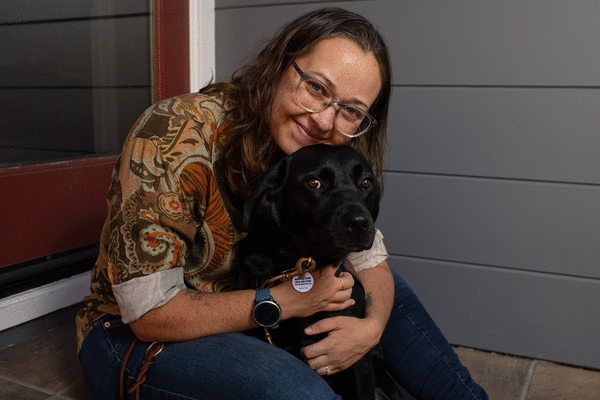
Emma Kleck has been totally dependent on insulin, the lifesaving medication for people living with diabetes, for 25 years.
Kleck, 32, of Santa Cruz, was diagnosed with the rarer Type 1 diabetes at age 7. About 3.5 million Californians have a form of diabetes and need constant doses of insulin, a hormone that keeps blood sugar levels in check, to stay alive.
“I’m so reliant on this liquid,” Kleck said. “I guess I try not to think about it a lot. I wouldn’t be functional without it after three or four hours.”
Insulin is notoriously expensive in the U.S. — more than 10 times the cost in other countries, according to one study. Kleck, a nurse practitioner at a community health clinic in Santa Cruz, where half of her patients worry about affording their insulin, said some are forced to “ration” their insulin in a dangerous attempt to save money.
Two new state policies that are expected to pull the cost of insulin back down to earth have thrilled Kleck and others with diabetes in California.
Gov. Gavin Newsom, a Democrat, kickstarted a plan in 2020 to contract the manufacturing of California’s own insulin and sell it for less. That strategy, though behind schedule, is finally bearing fruit: Generic insulin branded “CalRx” will reach the market in January, at the more-affordable price of $55 for about a month’s supply. In 2019, the average person with diabetes paid about $82 per month. It’s the first time a U.S. state will sell its own insulin.
In October, Newsom signed a separate law that limits health insurance co-pays and deductibles for insulin to $35 a month. The governor vetoed a version of that bill in 2023, angering some Democrats and diabetes advocates, but he reversed course this year. Depending on their health plan, Californians will see the benefits this January or in January 2027.
Two state lawmakers from the Bay Area pushed the bill across the finish line this year: Sen. Scott Wiener of San Francisco and Sen. Aisha Wahab of the East Bay and Silicon Valley, both Democrats.
The California-brand insulin and co-pay cap “complement each other so well to give Californians more affordable options than ever before,” said Christine Fallabel, a policy executive for the Virginia-based American Diabetes Association.
But the plans have some limits. So far, the state is only offering one type of insulin: glargine, a long-acting medication that isn’t the main insulin used by many with the most common form of diabetes, Type 2, and all people living with Type 1 diabetes. California’s drug partnership is working on getting a fast-acting insulin to market for those patients.
And the market for insulin has changed fast. Since 2023, drug companies have cut costs voluntarily, spurred by government interventions like California’s. Before that, in 2019, about 9% of people with diabetes were paying a whopping $315 per month, KFF Health News reported.
Prices for insulin are sky-high overall in the U.S., even though the medication is inexpensive for drug companies to produce. But the actual cost borne by those with diabetes can vary wildly depending on their access to health insurance, the fine print of different health plans and the kind of insulin they use.
Christine Christensen, who lives in Danville, said her son Jack was diagnosed with Type 1 diabetes in 2017. He is now 19 and studying at Notre Dame University.
For now, Jack is covered by his parents’ Anthem health insurance, and a three-month supply of insulin costs the family $180, Christensen said. But she said her son is anxious about his costs after he turns 26, when he’ll need to obtain his own insurance.
Roughly a quarter of the 8 million Americans who use insulin are forced to ration because they can’t afford it, according to a 2025 Yale School of Medicine study. The risks of that are serious: diabetic shock, blindness, lost limbs, heart attacks and death.
“You shouldn’t have to have health insurance charging you exorbitant amounts when you know it really doesn’t cost that,” Christensen said.
Newsom’s health policy chiefs say California-branded insulin will be more affordable because it is produced without a profit motive, unlike that made by large, for-profit pharmaceutical companies.
Producing the insulin is Civica Rx, a Utah nonprofit that manufactures generic versions of drugs, to which the state awarded a $50 million contract. Civica will receive the profits of drug sales, which “are intended to cover the costs of insulin production going forward,” said Andrew DiLuccia, a spokesperson for the California Department of Health Care Access and Information.
CalRx has already offered reduced-price naloxone, the life-saving medication that reverses opioid overdoses. And the state gained new legal authority in June to purchase brand-name drugs. That may include medication abortion pills, the governor’s office said.
_____
©2025 MediaNews Group, Inc. Visit at mercurynews.com. Distributed by Tribune Content Agency, LLC.




Comments