Econometer: Is the Artemis program worth the cost?
Published in Business News
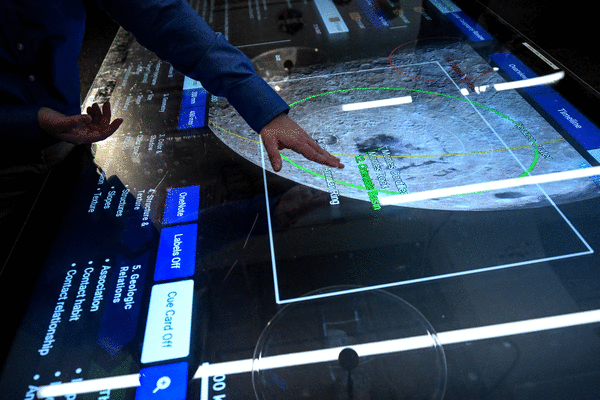
Excitement over the Artemis II launch to the moon has raised some questions about the cost.
The U.S. government has spent at least $93 billion and counting on the Artemis program, which seeks to eventually establish a long-term human presence on the moon. There are other nations contributing, such as Canada and Japan, but it is relatively small compared with what the U.S. taxpayer is footing.
Proponents of the program say discoveries made in that pursuit will pay for the cost in the long term and will give the U.S. an edge over China, which also seeks an eventual moon presence.
In an opinion piece in The Houston Chronicle, a former researcher of pharmaceutical purification in microgravity, Gregory Asimakis, argued sending humans to the moon is too costly when robots are available. He points to the success of the Mars rovers as an example. “In the end, human spaceflight missions are impressive engineering achievements in search of a problem to solve,” he wrote.
Question: Is the Artemis program worth the cost?
Executives
Bob Rauch, R.A. Rauch & Associates
YES: Artemis enables deep‑space science, resource mapping and technology testing that cannot be done in low Earth orbit. It lays the groundwork for Mars missions that require life support, propulsion and habitat systems validated on the moon. The program funds U.S. aerospace innovation across dozens of suppliers and ensures that we lead the next era of space exploration, especially as China accelerates its lunar program. Past NASA programs produced GPS, advanced materials, medical imaging and more.
Chris Van Gorder, Scripps Health
YES: There are many scientific, research and even medical benefits learned from space travel. And instead of being a polarizing issue, it could bring us together. It is positive for country morale and can build pride at a time when this country could use more of both. I felt such pride caring for NASA’s SpaceX Crew-11 after they splashed down in the Pacific in January.
Jamie Moraga, Franklin Revere
YES: Humans haven’t orbited the moon since 1972, setting our space program back decades. If we don’t invest now, then when? China, India and Russia are advancing toward the moon and Mars, and failing to compete weakens U.S. national security and hinders continued progress in science and exploration. Like Apollo, Artemis is driving breakthroughs in space technology that help shape modern innovation. A sustainable lunar presence is essential for future Mars missions and deep space exploration.
Phil Blair, Manpower
NO: Timing is everything. With Americans’ concerns about affordability and the money currently wasted on unnecessary wars, this is not the time to invest in long-term moon habitation options. Space travel should be funded by a consortium of countries that will all benefit from any potential discoveries that are made on the moon.
Gary London, London Moeder Advisors
YES: Whether the Artemis program is worth the lofty $4 billion per launch depends on what you value. I value the scientific gains of space programs and how the technologies have contributed to commercial breakthroughs. I also value the intangible of exploration and the possibility of human habitation beyond Earth. It’s a big price tag, but the resource extraction, lunar infrastructure or the stairway to Mars can be amortized over the generations of humans (or robots) beyond ours.
Economists
Caroline Freund, UC San Diego School of Global Policy and Strategy
NO: Been there, done that. With U.S. debt soaring, Artemis is a costly rerun when funds could go to new technologies and health care. Let SpaceX and Blue Origin chase human spaceflight; taxpayers shouldn’t. Today’s moonshot is robotics and AI.
Kelly Cunningham, San Diego Institute for Economic Research
NO: Not that valuable discoveries and findings are not made by the program, but the costs may not be worth the scarce resources that could more efficiently be used in other more profitable efforts, such as the canceled robotic mission returning Martian soil samples collected by the Perseverance rover. Providing human space travel is immensely risky and considerably raises costs. Significant advancements in fully capable robotics have become much more efficient and useful for scientific discovery.
Alan Gin, University of San Diego
NO: Space exploration is important, but there are cheaper and safer ways to do it than sending humans. Robots and artificial intelligence are increasingly used for all purposes on Earth. They can be sent into space to explore, gather materials, and even manufacture products for less money, as there is less concern for the well-being of the robots. This is important in a time of budget deficits that have led to cuts in programs for education, health, housing, etc.
James Hamilton, UC San Diego
NO: Each week brings stunning new demonstrations of how well machines can complete tasks formerly performed by humans — robots in factories, drones in warfare, artificial intelligence in data analysis. SpaceX will let you put a 200-pound payload into orbit for about $600,000 on a ride-share launch. If you want to go up yourself as a space tourist, it will cost you more than $50 million. Why in the world are we sending people to the moon instead of machines?
Norm Miller, University of San Diego
NO: I view this exploration as primarily feeding our national ego, offering modest scientific returns. While some might find Artemis’ $93 billion price tag reasonable, those same funds could fully operate the TSA for eight years, restore several years of university research cuts (which offer a much higher probability of scientific breakthroughs), or reverse our National Park funding cuts for 80 years.
Ray Major, economist
YES: Understanding our place in the universe and ensuring our survival through manned exploration is a worthwhile endeavor. Besides the obvious, the positive benefits from space programs are extensive, including medical and technological breakthroughs that affect our daily lives in countless positive ways. Furthermore, the $93 billion spent on the Artemis program is a bargain when compared to the revised figure of $231 billion needed to finish the California bullet train to nowhere project.
©2026 The San Diego Union-Tribune. Visit sandiegouniontribune.com. Distributed by Tribune Content Agency, LLC.










Comments