Companies stare down $100,000 fee with new H-1B visa rules
Published in Business News
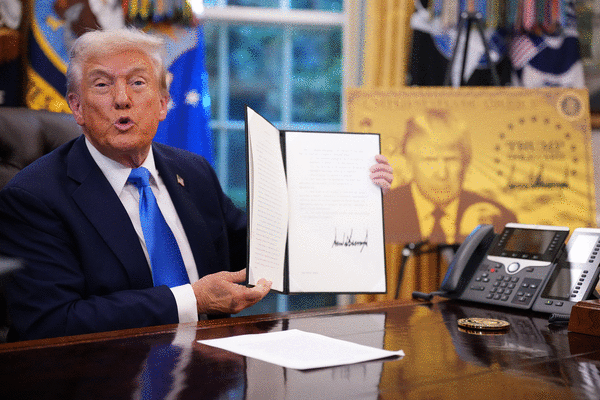
The Trump administration’s overhaul of the U.S. visa system for highly skilled immigrants is about to get its first major test.
The annual lottery for H-1Bs, the most popular visa for white-collar professionals looking to build a career in the U.S., gets underway with new rules this month. For the first time, successful sponsors for immigrants arriving from another country will need to pay a $100,000 fee. And the system will now favor more experienced and higher paid workers, rules likely to disadvantage IT consulting firms that won an outsize share of the visas in recent years.
It’s the biggest revamp in decades, and employers, lawyers and staffing firms are studying how to get the best chance at winning one of the 85,000 coveted slots that will be awarded at the end of March. Last year, about one-third of petitioners were successful.
“This is going to be a bit of a sea change,” said Peter Bendor-Samuel, the executive chairman of global research firm Everest Group, which works with companies that routinely use the H-1B program. He added that staffing firms are likely to balk at the $100,000 fee for workers from overseas, so that should free up slots for employers in tech and finance better able to absorb the cost.
Big Tech, including Amazon, Google and Microsoft, have been among the largest users of H-1B visas, alongside outsourcing and placement firms such as Tata Consultancy Services, Infosys and Cognizant Technology Solutions. Staffing companies developed a lucrative niche recruiting programmers and other technology professionals from abroad and placing them with U.S. clients in industries including finance and healthcare.
But staffing firms have come under scrutiny in Washington, where labor advocates and some Democratic and Republican lawmakers argue that they put downward pressure on wages or reduce opportunities for American workers. The companies say they comply with U.S. rules and use the visas to fill specialized roles.
Even before the latest policy changes, many consulting firms had begun reducing their reliance on the visas as the immigration system became more complex and uncertain, said Rod Bourgeois, managing partner at DeepDive Equity Research, who works closely with such firms and is familiar with their staffing approaches. He said he expects those staffing firms to expand overseas placement.
Cognizant, a global IT services and consulting firm, is one of the staffing companies that has reduced its reliance on H-1Bs. It said the new H-1B filing fee will have a “limited near-term impact.” It now relies on the program mainly for “select technology roles that supplement our U.S. workforce,” according to spokesperson Jeff DeMarrais.
Tata Consultancy Services and Infosys didn’t respond to requests for comment about their plans for this year’s visa lottery.
Hiba Anver, a partner with Erickson Immigration Group, said employers she’s working with are prioritizing hiring recent graduates and other immigrants who are already in the U.S. and therefore not subject to the $100,000 fee. Her company provides services and advice to clients, mostly tech companies, looking to hire foreign-born workers.
“Most companies are still going to proceed with sponsoring first-time H-1B visa applicants, but only if those individuals are already in the U.S.,” Anver said.
Trump implemented the $100,000 fee through an executive order in September, saying it was necessary to address abuses of the H-1B system that undercut U.S. wages and job opportunities.
Another change announced by the Department of Homeland Security last year: The lottery now assigns better odds to those with higher salaries, dividing applicants into one of four categories based on how their wages compare with others in specific industries and locales. That will give a boost to candidates seeking to fill jobs that pay higher than average for their industry and location.
When Los Angeles-based apparel maker True Religion was looking to fill a senior position last year — a director of production and sourcing — the company thought it had found a perfect candidate. But the person was a Guatemalan national, so would need a work visa to get to the U.S.
Under the new rules, that meant a $100,000 fee for an H-1B. That was a nonstarter for the jeans company, which emerged from bankruptcy after the COVID-19 pandemic and is now owned by the investment firms Acon Investments and SB360 Capital Partners.
“We will not seek an H-1B for a role if we have to pay $100,000,” said Mara Roitman, the company’s vice president for human resources. “It’s a lot of money.”
Roitman said the company looked into making the hire via the O-1 work visa, intended for foreigners with “extraordinary ability” in science, education, business or athletics, but the federal government turned down that application. Now the search is on for a new candidate.
There’s a possibility there could be some relief next year. The executive order that created the $100,000 fee is due to sunset in October, and so far there is no word on plans for a renewal, adding another layer of uncertainty.
But states have also sought to put their own limits on H-1B hiring at universities and other public institutions. On Monday, a board that oversees Florida’s public universities voted 14-2 to freeze hiring of H-1B visa holders this year while officials study if the schools’ past use of the program disadvantaged American workers. The move follows a January decision by Texas state officials to ban H-1B hiring at public universities and state agencies until at least May 31, 2027.
For tech startups, the net result of changes to the H-1B lottery and application process — and the broader immigration crackdown from the Trump administration — likely means they’ll have a harder time getting the talent they need to grow and innovate, according to Rahul Gudise, the chief executive officer at Gale. His company, backed by Y Combinator, helps clients navigate work-based immigration processes.
Many of them often have a specific person or skill set they want to hire in their early stages because it’s “instrumental to how your company forms,” Gudise said. “It’s going to set the tone of what you’re building.”
Anver, of Erickson Immigration, said the revamped H-1B fees and narrowing legal paths for immigrants will weigh on U.S. companies for years to come.
“There are several changes that taken collectively will diminish the tech industry’s ability to attract and retain key talent,” she said. In the end, it “will result in a smaller talent pool for tech companies.”
(With assistance from Andrew Kreighbaum, Eric Fan and Newley Purnell.)
©2026 Bloomberg L.P. Visit bloomberg.com. Distributed by Tribune Content Agency, LLC.







Comments