Tech review: iPhone Air is thin and light -- but is it worthy?
Published in Business News
Back in the fall, Apple sent me the new iPhone 17 Pro Max and the thinner and lighter iPhone Air.
I reviewed the 17 Pro Max, and I’ve been using it daily — and it is still great — but what about the Air? Is it a phone I’d want to use every day?
The Air and 17 Pro Max are similar in a lot of ways. Where they differ in size and a few other features like fewer cameras and battery life.
Apple has a stable of iPhone models, some of which have updated versions every year, such as the Pro and the Pro Max, while others are released and then discontinued after a few years, such as the Plus or the Mini, which I think is a good thing.
Cell phones are a mature market. We’ve pretty much settled into what we think a phone should look like and how it should behave. Where things get fun is when manufacturers get a little crazy and step outside the norm.
I’m talking about features like folding screens or phones of differing sizes.
Some people want as much battery life as possible (as with the Pro Max), while others just want a phone to be small (e.g., the Mini). Still others want a mix of larger screen and a thinner profile and lighter weight, as with the new iPhone Air.
Apple has the resources to take a swing at releasing phones like the Mini and the Air just to see if the demand is there. I also think Apple is trying out various features in their different models that might make it into future phones.
So, what does the Air have to offer?
Specs
The iPhone Air is a mid-sized phone with a 6.5-inch Super Retina XDR OLED display with a resolution of 2,736 by 1,260 pixels and a refresh rate up to 120 hertz. It is an always-on display with a dynamic island to house the front camera and sensors. The screen of the Air and 17 Pro and Pro Max are all the same, albeit with different sizes.
The front glass has Ceramic Shield 2, with three times better scratch resistance, and it is water resistant up to 6 meters for up to 30 minutes.
The Air is the only iPhone with a titanium frame. The other current iPhones are made of aluminum, but the Air needs the added strength of Titanium for its thin body, so you don’t bend it when you sit with it in your back pocket.
Like the 17 Pro Max, it uses the A19 Pro chip with a 6-core CPU. It has a 5-core graphics processor and a 16-core neural engine.
Battery capacity is one of the necessary trade-offs of a thin chassis. The space inside the phone is smaller, but Apple says users will still get all-day battery life. It can charge through USB-C or wirelessly through 20W MagSafe.
The battery metric Apple lists on its website says the Air gets up to 27 hours of video playback, while the 17 Pro Max can play video for up to 39 hours on a charge.
Apple says the Air can be charged from empty to 50 percent in just 30 minutes with a 20W charger through USB-C or with a 30W charger through MagSafe.
The 17 Pro Max is Apple’s flagship with three 48-megapixel Fusion cameras on the back and one 18MP center stage selfie camera on the front. The Pro Max cameras have an optical zoom range of .5x (ultra-wide angle) to 8x (telephoto).
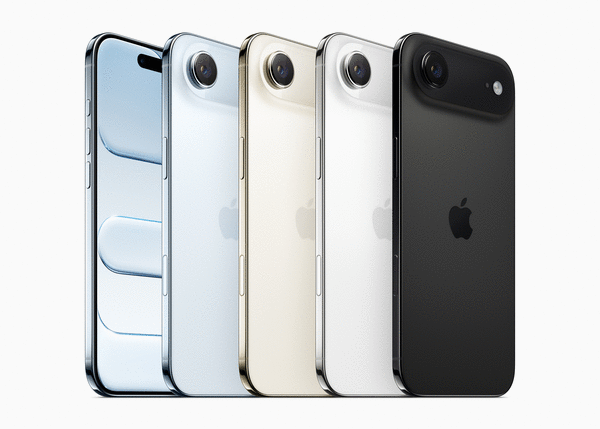
In keeping with the smaller and lighter theme, the Air only has one 48MP Fusion main camera on the back with 1x and 2x optical zoom and the same 18MP selfie camera.
The camera sensors are exactly the same, so photos and videos look identical, but the difference in the zoom range is a big advantage for the 17 Pro Max.
The Air lacks some video recording modes of the Pro Max, like spatial video, ProRes video and Cinematic mode.
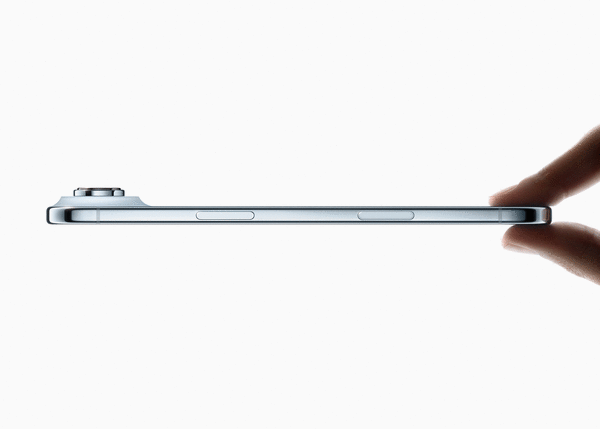
The Air measures 6.15 inches by 2.94 inches by 0.22 inches, and it weighs 5.82 ounces.
For comparison, the 17 Pro Max measures 6.43 inches by 3.07 inches by .34 inches, and it weighs 8.22 ounces.
The physical measurements don’t sound all that different, but side by side, the size difference between the Air and 17 Pro Max is very noticeable.
How is it?
I can appreciate what Apple is trying to do with the Air, and I’m thrilled people who are clamoring for the thinnest and lightest phone will finally have an iPhone option.
The Air is quite an easy phone to carry.
In my hands, with my eyes closed, the Air feels like it’s half as thick as the Pro Max, even though it’s only a few millimeters thinner. Add a case and the Air feels closer in size to its thicker cousins.
I don’t have the space or time to run a full-blown review or comparison. There are plenty of places to find more in-depth reviews online.
What I can say about using the Air is that, except for the difference in the cameras, I loved using the Air and really appreciated its size and had no issue with the battery lasting all day, but to be safe, I do top up the charge at my desk during the day.
That said, for me, the $200 difference in the price of the Air vs. the Pro Max is a worthy cost.
In a previous career, I was a newspaper photographer, and I’m the designated photographer in my family, so I’m willing to spend a bit more for better cameras.
Price and availability
The iPhone 17 Air starts at $999 for a model with 256 gigabytes of storage. You can add $200 to double the storage to 512GB and $400 to bump up to one terabyte.
The Air comes in Sky Blue, Light Gold, Cloud White and Space Black, and they are available at Apple.com and Apple retail stores, as well as at all the major carrier stores and retailers like Best Buy.
©2026 Tribune Content Agency, LLC.










Comments